‘Enemy Within’: CDS Oluyede Urges Borno, Yobe Residents to Lead Anti-Terror Fight

Chief of Defence Staff, Olufemi Oluyede

Nigeria’s Chief of Defence Staff, Olufemi Oluyede, has sounded a stark warning over the evolving dynamics of insurgency in the North-East, declaring that internal collaboration within local communities is sustaining terrorist operations and complicating military efforts.

Speaking after a closed-door, high-level security meeting in Maiduguri, the Borno State capital, Oluyede urged residents of Borno State and Yobe State to take greater responsibility in the fight against terrorism, stressing that the “enemy” is often embedded within the very communities affected by the violence.

The meeting, which lasted about four hours, brought together senior military leadership, including the Chief of Army Staff, Waidi Shuaibu, and the Theatre Commander of Operation Hadin Kai, Abdulsalam Abubakar, alongside other top officials coordinating counterinsurgency operations in the region.

At the core of Oluyede’s message was a troubling assessment drawn from intelligence reports, which indicate that many perpetrators of attacks over the past 15 years are not outsiders but individuals originating from the same communities they terrorise. According to him, this internal dimension has provided insurgents with significant operational advantages, including familiarity with terrain, access to local networks, and the ability to blend into civilian populations.

He pointed to a recent incident in Kukawa, where troops conducting post-attack clearance operations discovered wounded insurgents hiding within the community, underscoring the difficulty of distinguishing between civilians and collaborators in conflict zones.

The CDS emphasised that while the military has sustained pressure on terrorist groups such as Boko Haram and the Islamic State West Africa Province, long-term success will depend on stronger civilian cooperation. He urged residents to view the counterinsurgency campaign as a shared responsibility rather than solely a government-driven effort.

Oluyede’s remarks signal a strategic recalibration in Nigeria’s approach to the insurgency, shifting from predominantly kinetic operations to a more community-centred model that prioritises intelligence sharing and local engagement.

He also highlighted the changing tactics of insurgent groups, noting an increased deployment of drones and other technologies in recent attacks. In response, he said the Nigerian military is adapting its capabilities, including the integration of advanced drone systems to improve surveillance, targeting accuracy, and battlefield coordination.

Eid-el-Fitr: Lagos Police Tightens Security Across Land, Waterways

The Nigeria Police Force in Lagos has intensified security operations across the state ahead of the upcoming Eid al-Fitr celebrations, deploying personnel and assets to ensure a peaceful and incident-free holiday.

The directive follows orders from the Inspector-General of Police, Olatunji Rilwan Disu, with the Commissioner of Police in Lagos State, Olohundare Jimoh, overseeing a coordinated statewide security strategy. Authorities say the operation is designed to safeguard lives and property before, during, and after the festivities.

According to a statement issued by the Police Public Relations Officer, Abimbola Adebisi, the command has activated a comprehensive security framework that combines conventional police officers, tactical response units, and intelligence operatives. The statement noted that this structure is supported by “an enhanced intelligence gathering network to keep close watch on activities that may threaten public peace.”

As part of the expanded measures, Marine Police units have been deployed to strategic points along Lagos waterways to prevent criminal infiltration, reflecting heightened vigilance across both land and maritime domains. The command has also directed Area Commanders, Divisional Police Officers, and heads of tactical formations to maintain sustained patrols and ensure visible policing, particularly in densely populated and high-risk areas.

“To maintain order and visibility, Area Commanders, Divisional Police Officers (DPOs), and Heads of Tactical Units, have been directed to sustain routine patrols and ensure a strong police presence across communities, especially in busy and vulnerable locations,” the statement read, adding that officers are expected to remain “professional, courteous, and firm at all times.”

Traffic management has also been prioritised, with a significant number of personnel assigned to regulate vehicular movement on major highways, inner roads, and congestion-prone corridors across the state, as authorities anticipate increased travel during the holiday period.

The police further confirmed that robust security coverage has been arranged for Eid prayer grounds, mosques, markets, recreational centres, and other public spaces expected to witness large gatherings.

Reassuring residents, the Commissioner of Police said the command remains fully committed to public safety, urging citizens to stay alert and cooperate with law enforcement agencies. “The Command’s commitment to protecting lives and property before, during, and after the festivities” remains unwavering, the statement emphasised, while encouraging the public to report suspicious activities through designated emergency lines.

Qatar Expels Iranian Military, Security Attachés Amid Escalating Diplomatic Rift

Qatar's Prime Minister Sheikh Mohammed bin Abdulrahman bin Jassim Al Thani

The government of Qatar has ordered the expulsion of Iranian military and security officials, declaring them “persona non grata” and directing them to leave the country within 24 hours, in a sharp escalation of tensions with Iran.

In an official statement released Wednesday, Qatar’s Ministry of Foreign Affairs confirmed that the decision applies to the military attaché, the security attaché, and all staff affiliated with their offices at the Iranian embassy in Doha. The directive was formally conveyed during a meeting between the Director of Protocol at the ministry, Ibrahim Yousif Fakhro, and Iran’s ambassador to Qatar, Ali Salehabadi.

According to the ministry, the move comes in response to what it described as “repeated Iranian targeting and blatant aggression against the State of Qatar,” actions it says violate the country’s sovereignty and security. The statement further noted that such actions constitute “a flagrant breach of the principles of international law” and referenced violations of United Nations Security Council Resolution No. 2817, as well as the principles of good neighborliness.

Qatar’s foreign ministry warned that any continuation of what it termed a “hostile approach” by Iran would prompt further countermeasures. It stressed that Doha remains prepared to act decisively to safeguard its national interests and territorial integrity.

“The State of Qatar reserves the right to take all necessary measures to protect its sovereignty and security, in accordance with the provisions of international law,” the statement added.

While Qatari authorities did not publicly disclose specific incidents underlying the allegations, the unusually swift 24-hour expulsion order signals a serious deterioration in diplomatic relations between the two countries. As of press time, there has been no immediate official response from Tehran regarding the expulsions.

Tinubu Seeks Stronger Security, Economic Partnership With UK

The King and Queen bid farewell to President Bola Tinubu and Mrs Remi Tinubu on Thursday.

President Bola Ahmed Tinubu has reaffirmed Nigeria’s commitment to deepening its long-standing relationship with the United Kingdom, delivering a landmark speech at a state banquet hosted in his honour at Windsor Castle on Wednesday.

Addressing an audience that included King Charles III, Queen Camilla, Prince William and Catherine, Princess of Wales, Tinubu described the moment as both historic and symbolic, noting that he was the first Nigerian leader to speak at the centuries-old royal residence.

“It is a profound honour to stand before you today, representing the people of Nigeria as we reaffirm the enduring bonds of friendship, history, and shared purpose that have united our two nations for several centuries,” the president said, expressing gratitude for the hospitality extended to him, his wife, and the Nigerian delegation.

The King and Queen invited The President and First Lady to view a special exhibition of items relating to Nigeria from the Royal Collection, in the Green Drawing Room.

Tinubu used the occasion to highlight the deep-rooted historical and institutional ties between Nigeria and Britain, pointing to shared democratic values and legal traditions. Referencing the legacy of the Magna Carta, he said it “laid the early foundations for the rule of law and the development of parliamentary democracy,” adding that such principles continue to shape governance systems globally, including Nigeria’s.

He also acknowledged the influence of British intellectual and cultural heritage, citing figures such as Thomas Hobbes, John Locke, Edmund Burke, and literary icons like William Shakespeare and Charles Dickens. According to Tinubu, their contributions have had a lasting impact on global thought and the evolution of democratic ideals.

Beyond history, the president emphasised the human connections that underpin bilateral relations, particularly the contributions of Nigerians living in the UK. He noted their significant role in sectors such as healthcare, where Nigerian professionals form a vital part of the workforce within the National Health Service.

Highlighting cultural and sporting ties, Tinubu pointed to high-profile athletes of Nigerian heritage, including Maro Itoje, Bukayo Saka, Eberechi Eze, and Anthony Joshua, as symbols of the enduring connection between both nations.

On the global stage, Tinubu reaffirmed Nigeria’s commitment to the Commonwealth of Nations, describing it as a vital platform for cooperation among member states. He stressed that Nigeria, as one of the largest members, remains committed to contributing to its growth and relevance.

Security cooperation featured prominently in his remarks, particularly in relation to terrorism challenges in West Africa and the Sahel region. Tinubu underscored Nigeria’s strategic role in maintaining regional stability and signalled the importance of continued collaboration with Britain. He also confirmed plans to meet with UK Prime Minister Keir Starmer to further discussions on security and other areas of mutual interest.

Reflecting on Nigeria’s democratic journey, Tinubu expressed gratitude for the support the UK provided during the country’s years under military rule. “Like many Nigerians involved in the pro-democracy struggle, I found safety here,” he said, recalling how his residence was placed under police protection during that period.

The president struck an optimistic tone about Nigeria’s future, describing the country as one driven by youthful ambition, entrepreneurial energy, and resilience. He concluded by urging both nations to continue building on their shared history to forge a stronger partnership.

“In the spirit of friendship and our shared destiny, I invite you all to raise a glass with me: to the special bond between Nigeria and the United Kingdom, and to the bright future that we shall build together,” Tinubu said.

The visit marks a significant diplomatic moment, reinforcing ties between Abuja and London at a time when both countries are seeking closer cooperation on security, trade, and global governance.

Senegal Slams CAF Ruling, Heads to CAS

The Senegalese Football Federation has strongly rejected a decision by the Confederation of African Football Appeal Board to award the 2025 Africa Cup of Nations final to Morocco, describing the ruling as “unfair, unprecedented, and unacceptable” as it prepares to challenge the verdict at the Court of Arbitration for Sport.

In a formal statement issued on Tuesday, the federation confirmed it had received notification of the CAF Appeal Board’s decision in case DC23316, which stemmed from a complaint lodged during the AFCON 2025 final between Senegal and Morocco. The board upheld an appeal filed by Morocco, overturning an earlier ruling by CAF’s Disciplinary Jury.

CAF’s Appeal Board ruled that Senegal’s conduct during the match breached Articles 82 and 84 of the tournament regulations. As a result, the match was declared forfeited, with a 3–0 scoreline awarded in favour of Morocco under Article 84, effectively handing the title to the North African side.

Explaining the basis of its decision, the Appeal Board determined that the initial disciplinary ruling had failed to respect the appellant’s right to be heard, prompting its annulment and a reassessment of the case. The subsequent findings led to sanctions against Senegal, including the forfeiture of the final.

However, Senegal’s football authorities have fiercely contested both the process and the outcome. “The Senegalese Football Federation denounces a decision that is unfair, unprecedented, and unacceptable, which brings disrepute to African football,” the statement said.

The federation confirmed it will escalate the dispute to the Court of Arbitration for Sport in Lausanne, seeking to overturn CAF’s ruling and defend what it described as the interests of Senegalese football. “To defend its rights and the interests of Senegalese football, the Federation will, as soon as possible, initiate an appeal procedure before the Court of Arbitration for Sport (CAS) in Lausanne,” the statement added.

The controversy marks one of the most significant legal disputes in the history of the Africa Cup of Nations, raising broader questions about governance, disciplinary procedures and fairness within African football’s top competition.

Despite the escalating row, the Senegalese federation reaffirmed its commitment to the principles of integrity and sporting justice, pledging to keep the public informed as the legal process unfolds. “The FSF reaffirms its unwavering commitment to the values of integrity and sporting justice and will keep the public informed of further developments in this matter,” the statement concluded.

CAF Strips Senegal of AFCON 2025 Title, Declares Morocco as Champions

The Confederation of African Football has awarded the 2025 Africa Cup of Nations title to Morocco after the Senegal was ruled to have forfeited the final, in a decision that has sent shockwaves across African football.

In a ruling delivered by the CAF Appeal Board, Senegal was deemed to have forfeited the final of the CAF Africa Cup of Nations Morocco 2025 in accordance with Article 84 of the tournament regulations. As a result, the match has been officially recorded as a 3–0 victory in favour of Morocco, effectively handing the title to the host nation.

The decision overturns the expected outcome of the highly anticipated final and marks one of the most dramatic administrative conclusions in the history of the tournament. CAF stated that the ruling was reached after a review of circumstances surrounding the match, applying its disciplinary framework under the competition’s governing rules.

By invoking Article 84, which governs forfeiture in cases of regulatory breaches, the Appeal Board concluded that Senegal could not be deemed to have fulfilled the conditions required to contest the final, thereby awarding the match to Morocco without play or completion under standard conditions.

Nigerian Forces Beat Back ISWAP in Fierce Dawn Attacks Across Borno

Troops of Operation HADIN KAI have repelled coordinated attacks by fighters of the Islamic State West Africa Province across multiple locations in Borno State, inflicting heavy losses on the insurgents and reinforcing military control in key operational areas.

The attacks, which occurred in the early hours of March 16, targeted military positions in Njimtilo, Baga, Buratai, and Damboa, in what military authorities described as a coordinated but failed attempt by the terrorists to overrun troops and gain propaganda advantage.

According to a statement issued by Lieutenant Colonel Sani Uba, Media Information Officer at Headquarters Joint Task Force (North East), the insurgents advanced from multiple directions but were detected early and met with what he described as a “deliberate offensive-defensive posture” by troops on the ground.

“At Ajiri Cross, ahead of Njimtilo, terrorists attempted to infiltrate positions mounted by troops of Sector 1 but were swiftly detected and decisively engaged by the vigilant troops who had anticipated the move,” the statement said.

The military said troops deployed coordinated firepower and tactical manoeuvres to disrupt the attackers and cut off their withdrawal routes, forcing them into a disorganised retreat with significant casualties. Similar offensives at Baga, Buratai and Damboa were also repelled as troops brought superior firepower to bear on the insurgents.

Air support played a critical role in the engagements, with the Air Component of Operation HADIN KAI and Nigerian Army Aviation conducting precision strikes that disrupted the terrorists’ formations and compounded their losses during withdrawal attempts.

Military authorities confirmed that several insurgents were killed during the encounters, including a key commander who led the assault on Buratai. Others were reported injured as they fled along escape routes. Despite the intensity of the fighting, troops maintained control of all attacked locations, although some equipment was damaged and a number of soldiers sustained injuries.

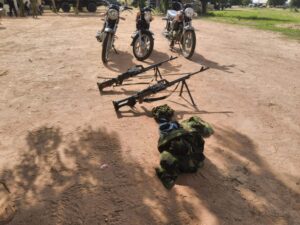
Following the failed assaults, troops launched exploitation operations around Baga, extending to nearby areas including Korochara and Garin Giwa towards the Gidan Kaje axis. During these operations, security forces recovered a cache of weapons and equipment, including machine guns, rifles, ammunition, rocket-propelled grenades and other combat supplies.

The military also reported the recovery of seven insurgent bodies, while additional intelligence indicated that the fleeing fighters buried about 20 of their dead in shallow graves during their retreat.

The latest clashes, according to the military, underscore increasing pressure on insurgent groups operating in the North-East, with repeated operational setbacks limiting their ability to mount sustained offensives. “These failed attacks further demonstrate the growing desperation of terrorist elements under sustained operational pressure from OPHK forces across the theatre,” the statement noted.

Authorities reassured residents that all affected locations remain firmly under military control, with troops sustaining offensive operations to track fleeing insurgents and dismantle their logistics networks.

Operation HADIN KAI reiterated its commitment to defeating terrorism in the region, urging members of the public to remain vigilant and disregard misinformation aimed at undermining ongoing counter-insurgency efforts.

Ghana Leaves Out Andre Ayew from Black Stars World Cup Squad

Black Stars coach Otto Addo

In a bold move signaling a shift toward youth and fresh talent, Ghana head coach Otto Addo has omitted longtime captain Andre “Dede” Ayew from the Black Stars squad for the upcoming international friendlies against Austria and Germany later this month.

The 36-year-old forward, who currently plays for Dutch club NAC Breda where he recently scored his first Eredivisie goal, has been a cornerstone of Ghana’s national team for over a decade. Ayew last featured for the Black Stars during the 2023 Africa Cup of Nations and has been excluded from recent call-ups, including the March 2024 friendlies against Nigeria and Uganda despite being named in the squad.

Addo’s latest 26-man squad, announced on Monday for the matches scheduled in Vienna (March 27) and Stuttgart (March 30), focuses on reshaping the team as Ghana intensifies preparations for the 2026 FIFA World Cup. The list includes four debutants — defenders Patrick Pfeiffer (SV Darmstadt), Derrick Luckassen (Pafos FC), Marvin Senaya (Auxerre), and forward Daniel Agyei (Kocaelispor) — alongside established stars such as Thomas Partey (Villareal), Jordan Ayew (Leicester City), Inaki Williams (Athletic Bilbao), Antoine Semenyo (Manchester City), and Abdul Fatawu Issahaku (Leicester City).

Notable absences include injured midfielder Mohammed Kudus and several other key players, with Ayew’s omission drawing particular attention given his leadership role and experience. The coach has kept the door open for the veteran in the past but appears to be prioritizing other attacking options in this transitional phase.

Ghana Football Association Communications Director Henry Asante Twum addressed the uncertainty surrounding Ayew’s long-term future, stating: “Nobody knows if Andre Ayew will go to the World Cup.” He emphasized that the final decision rests entirely with Addo and his technical team.

Ayew’s exclusion comes amid ongoing debate in Ghanaian football circles about whether the veteran — Ghana’s all-time leading scorer at major tournaments — still has a place in the squad for the 2026 World Cup in the United States, Canada, and Mexico. Supporters argue his experience and leadership could stabilize a young dressing room, while critics point to his age and the need for a new generation.

The friendlies against European powerhouses Austria and Germany serve as crucial tests for the Black Stars, who are aiming to rebuild after failing to qualify for the 2025 Africa Cup of Nations — their first miss since 2004.

Multiple Bomb Blasts Hit Maiduguri, Casualties Feared

Multiple bomb explosions ripped through Maiduguri, the capital of Borno State, on Monday night, triggering panic across the city and leaving an unspecified number of people feared dead and injured, according to emergency officials and security sources.

Authorities said the blasts occurred at several locations across the city, including the busy Monday Market, the entrance to the University of Maiduguri Teaching Hospital, and areas around the Post Office district. Emergency responders and security personnel were quickly deployed to the affected locations to assist victims and secure the sites of the explosions.

Preliminary reports indicate that the explosions were likely carried out by suicide bombers, although officials said investigations are ongoing to establish the exact circumstances surrounding the attacks. Emergency services confirmed that several people were killed or wounded in the blasts, though the full extent of casualties had not been officially verified at the time of reporting.

Reacting to the incident, Babagana Zulum, governor of Borno State, condemned the attacks and described them as “utterly condemnable,” while assuring residents that security agencies had been mobilised to restore calm and track down those responsible.

Officials of the National Emergency Management Agency confirmed that ambulances and rescue teams were dispatched to the blast scenes to evacuate the injured to nearby hospitals, including the University of Maiduguri Teaching Hospital. According to the agency’s Maiduguri operations head, the explosions struck key civilian areas, intensifying fears among residents.

The Borno State Police Command also confirmed the explosions, saying security operatives had secured the affected areas while investigations were underway. Police authorities said the attacks were suspected to have been carried out by insurgents linked to extremist groups operating in the region.

Residents described scenes of chaos following the blasts, with people fleeing crowded areas as emergency responders rushed to rescue victims. Witnesses reported seeing bodies at some of the explosion sites, while others said the blasts occurred almost simultaneously, causing widespread confusion across the city.

The attack underscores the continuing security challenges in northeastern Nigeria, where insurgent groups including Boko Haram and the Islamic State West Africa Province have waged a prolonged insurgency for more than a decade. Although attacks in Maiduguri had reduced in recent years due to intensified military operations, authorities say the latest explosions highlight the persistent threat posed by extremist groups in the region.

Ghana Begins Evacuating Citizens from UAE as Security Fears Escalate

The government of Ghana has begun arrangements to evacuate its nationals living in the United Arab Emirates amid escalating security concerns across the Middle East following intensifying regional hostilities.

Officials confirmed that Ghana’s diplomatic missions in the UAE have initiated the evacuation process as part of precautionary measures designed to ensure the safety of Ghanaian citizens living and working in the Gulf state. The move comes as tensions across the Middle East have surged in recent weeks, prompting several countries to review travel advisories and begin contingency evacuations for their nationals in the region.

According to information released by Ghanaian authorities, the evacuation initiative forms part of a broader emergency response plan activated by the government to protect its citizens abroad. Earlier, the Ghana Ministry of Foreign Affairs announced that an emergency preparedness framework had been put in place as regional tensions intensified.

In a travel advisory, the ministry said: “An emergency preparedness plan has been activated,” adding that the government had already begun taking steps to assist citizens in affected areas and assess evacuation needs.

The advisory also urged Ghanaians in the Middle East to remain vigilant and follow guidance issued by local authorities and Ghana’s diplomatic missions. Officials advised citizens to avoid large gatherings, stay away from sensitive locations, and maintain regular contact with Ghanaian embassies in their respective countries.

The evacuation effort comes against the backdrop of growing geopolitical tensions involving Iran, Israel, and the United States, which have heightened security risks across the Gulf region. Several governments have begun contingency plans to safeguard their nationals as fears of wider instability increase.

Ghana has also called on all parties involved in the crisis to exercise restraint and pursue diplomatic solutions to avoid further escalation. In its advisory, the government appealed for calm and urged stakeholders to “exercise restraint, de-escalate, and return to diplomatic engagement in the interest of protecting lives.”

EDITOR PICKS

Recent Posts