The Nigeria Football Federation (NFF) has strongly condemned the racist abuse directed at Super Falcons forward Esther Okoronkwo on social media, describing the attacks as unacceptable and reaffirming its commitment to protecting the welfare and dignity of the national team player.
The federation’s reaction comes ahead of Nigeria’s opening match at the 2026 Women’s Africa Cup of Nations (WAFCON) against Malawi in Morocco, where the Super Falcons are seeking to begin their campaign on a winning note.
In a statement released on Saturday, the NFF said the online abuse followed recent incidents at the Super Falcons’ team hotel in Morocco, insisting that discrimination has no place in football or society.
“The Nigeria Football Federation (NFF) strongly condemns the unacceptable racist abuse directed at Super Falcons forward Esther Okoronkwo on social media following recent incidents at the team’s hotel in Morocco,” the federation stated.
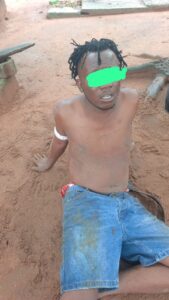
The NFF emphasized that the racist comments and emojis targeted at the player were completely unjustified, noting that authorities had already dealt with the individual responsible for the hotel theft that sparked the controversy.
According to the federation, “The racist abuse and emojis directed at our player make absolutely no sense, especially as the individual responsible for the theft was apprehended, made to return the stolen cash in full, and sentenced to six months in prison.”
The football governing body stressed that the safety and well-being of its players remain paramount, assuring Nigerians that the incident would not distract the team from its objectives at the continental championship.
“The safety, dignity, and well-being of our players remain our utmost priority,” the statement added.
The NFF also disclosed that the Super Falcons remain united despite the incident and are fully focused on their opening fixture at the tournament.
“The entire team stands united, unbothered by distractions, and fully focused on tomorrow’s #WAFCON2026 opener against Malawi,” the federation said.
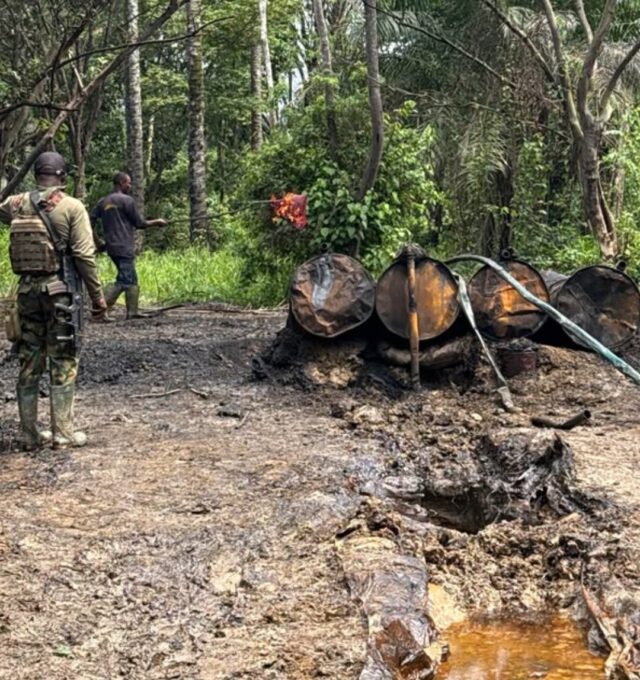
Navy security personnel at the illegal refining site. Photo: Nigerian Navy
The Nigerian Navy has thwarted fresh attempts by suspected crude oil thieves to reactivate dismantled illegal refining sites in Rivers State, recovering more than 126,000 litres of suspected stolen crude oil and illegally refined petroleum products during sustained anti-crude oil theft operations under Operation DELTA SENTINEL.
The latest operation, carried out by personnel of Nigerian Navy Ship (NNS) PATHFINDER, underscores the Navy’s continued offensive against oil theft syndicates operating in the Niger Delta and its determination to prevent criminal networks from restoring illegal refining infrastructure.
According to the Navy, the operation followed renewed surveillance of known illegal refining hotspots in the Egbema axis of Ogba/Egbema/Ndoni Local Government Area of Rivers State after troops earlier dismantled illegal refining camps in the area on July 10, 2026.
Despite that operation, suspected oil thieves reportedly returned to the sites in an attempt to resume illegal refining activities, prompting the Navy to intensify monitoring and launch follow-up anti-crude oil theft operations.
During the latest raid, NNS PATHFINDER personnel rediscovered and deactivated two illegal refining sites that had been reactivated by the suspects.
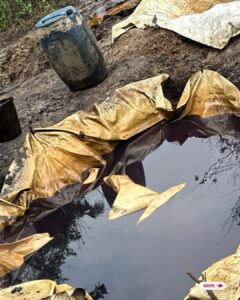
Security operatives recovered approximately 76,000 litres of products suspected to be stolen crude oil and 50,000 litres of suspected illegally refined Automotive Gas Oil (AGO) concealed inside seven dugout pits and reservoirs hidden within the forested area.
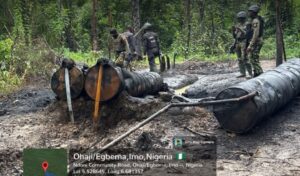
Security operatives at the illegal refining site. Photo: Nigerian Navy
The Navy said the latest recovery increased the total volume of petroleum products seized from the illegal refining locations to more than 126,000 litres, dealing another major blow to crude oil theft syndicates operating in the region.
Photographs released from the operation showed large reservoirs containing suspected stolen crude oil, improvised refining facilities and storage pits concealed in thick vegetation. The illegal refining equipment was subsequently destroyed in line with established anti-crude oil theft procedures to prevent its reuse by criminal elements.
The Navy said the sustained operations form part of Operation DELTA SENTINEL, an ongoing campaign aimed at denying oil thieves operational freedom and protecting Nigeria’s critical oil and gas infrastructure.
Director of Naval Information, Navy Capt. Abiodun Folorunsho, said that the operation demonstrates the Nigerian Navy’s determination to prevent crude oil theft syndicates from regaining operational footholds or rebuilding dismantled refining camps across its area of responsibility.
According to the Navy, all illegal refining sites and recovered petroleum products were handled in accordance with established anti-crude oil theft procedures, while sustained operational pressure continues across identified criminal enclaves in the Niger Delta.
Troops of the Nigerian Army operating under Operation UDO KA have dismantled a suspected kidnapping syndicate in Imo State, arresting one suspect and recovering cash believed to be part of a ransom payment, a Lexus saloon car allegedly used for abduction operations, and other incriminating items.
The operation, carried out on July 17, 2026, was conducted by troops of the 34 Artillery Brigade in collaboration with other security agencies following actionable intelligence on the activities of the criminal network in Njaba Local Government Area of the state.
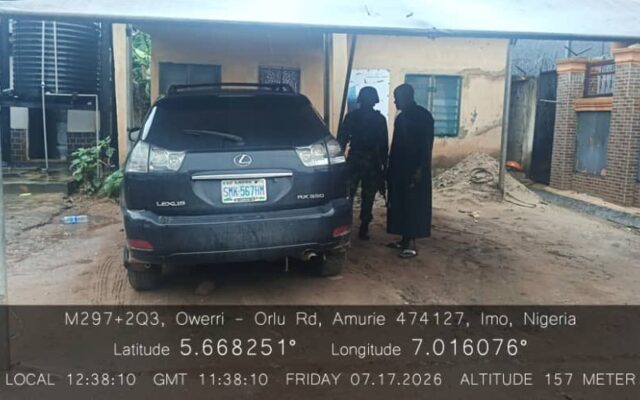
Kidnap suspect
Military authorities said the intelligence-led operation began with a cordon-and-search mission in Obinwanne Umuaka community, where troops uncovered a bag allegedly used to transport ransom payments. The bag was found abandoned in a nearby bush, suggesting that members of the gang had already shared the proceeds before fleeing the area.
The operation was subsequently expanded based on fresh intelligence, leading security operatives to a residential building where one of the suspected members of the syndicate was arrested.
A search of the premises led to the recovery of a black Lexus saloon car believed to have been used by the gang during the kidnapping operation. Troops also recovered several mobile phones, identity documents and ₦298,200 in cash suspected to be the suspect’s share of the ransom collected from the victim.
According to military authorities, the rescued victim later identified the arrested suspect as one of those involved in the abduction, strengthening the case against him.
Preliminary investigations further revealed that the suspect allegedly played a logistical role in the kidnapping by providing his Lexus vehicle to the syndicate’s principal actor and subsequently receiving a portion of the ransom after the victim was released.
The Nigerian Army said all recovered exhibits, along with the suspect, have been handed over to the Department of State Services (DSS) for further investigation and efforts to apprehend other members of the criminal network, including the alleged kingpin who remains at large.
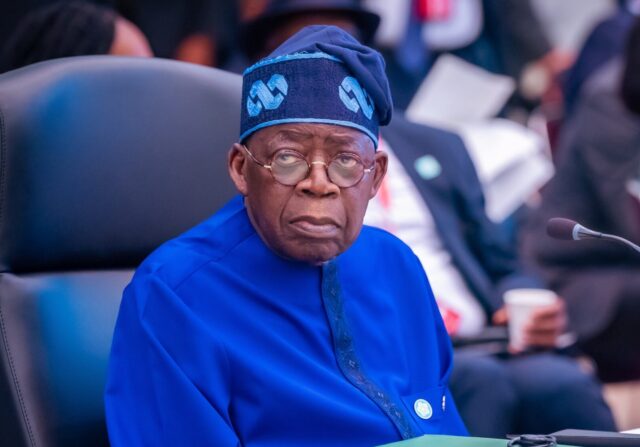
President Bola Ahmed Tinubu has called on African leaders to speak with one voice in condemning the recent wave of Afro-phobic attacks, also known as xenophobia, in South Africa, warning that silence would embolden intolerance against fellow Africans.
Tinubu made the appeal on Sunday at the 69th Ordinary Session of the ECOWAS Authority of Heads of State and Government in Freetown, Sierra Leone, where he was represented by Vice President Kashim Shettima.
The Nigerian leader said African countries must collectively reject attacks targeting citizens of other African nations in South Africa, insisting that a united continental position would send a strong signal that such acts have no place in Africa.
“Nigeria condemns, in the strongest terms, the recent attacks on its citizens and other Africans in the Republic of South Africa,” Tinubu said.
“As already stated by His Excellency, the President of Ghana, ECOWAS should present a united voice in this condemnation and table the matter before the next session of the Authority of Heads of State and Government of the African Union.
“This would send a clear message that this type of intolerance is totally unacceptable under any guise. South Africa should be reminded that the freedom it currently enjoys is the result of the sacrifices and liberation efforts of African countries, including Nigeria.”
The President disclosed that Nigeria had already evacuated more than 1,490 of its citizens affected by the attacks in seven separate evacuation exercises and remained prepared to take further steps if necessary.
He also reaffirmed Nigeria’s backing for the newly developed ECOWAS Compact for the Future of Regional Integration, describing it as a landmark framework designed to rebuild public trust, strengthen regional cooperation and ensure the sub-region remains resilient amid changing geopolitical realities.
According to Tinubu, the compact reflects the shared determination of member states to renew the founding ideals of ECOWAS while creating a more peaceful, prosperous and people-centred community.
“The Compact will strengthen regional solidarity, and build a more resilient, prosperous, peaceful, and people-centred Community capable of meeting the aspirations of its over 400 million citizens,” he said.
The President reiterated Nigeria’s commitment to implementing the compact’s six strategic pillars, noting that the country would continue to champion regional unity, democratic governance and economic integration as one of ECOWAS’ founding members and largest economies.
Addressing the region’s security challenges, Tinubu stressed that sustainable development could not thrive amid insecurity and unconstitutional changes of government.
“Nigeria remains firmly committed to the principles enshrined in the ECOWAS Protocol on Democracy and Good Governance and other regional frameworks,” he said.
“Nigeria supports the Compact’s commitment to constitutional governance, the rule of law, respect for human rights, and zero tolerance for unconstitutional changes of government.”
He reaffirmed Nigeria’s commitment to the proposed ECOWAS Counter-Terrorism Force and the strengthening of the ECOWAS Standby Force, saying enhanced intelligence sharing, joint military operations and preventive diplomacy were essential to combating terrorism and safeguarding regional stability.
The President also pledged Nigeria’s continued support for removing trade barriers, improving cross-border infrastructure and facilitating the free movement of people, goods and services to deepen regional economic integration.
Highlighting the importance of technology, Tinubu welcomed the compact’s emphasis on science, innovation and digital transformation, saying initiatives such as a Digital Single Market, regional artificial intelligence frameworks, cybersecurity cooperation and expanded digital infrastructure would unlock new opportunities for entrepreneurship, financial inclusion and youth employment across West Africa.
He further reaffirmed Nigeria’s commitment to advancing gender equality, promoting women in leadership, investing in education and skills development, and supporting youth entrepreneurship to ensure young people play a central role in shaping the region’s future.
Earlier, outgoing ECOWAS Authority Chairman and President of Sierra Leone, Julius Maada Bio, said the summit provided an opportunity for regional leaders to assess ECOWAS’ progress and chart a new path under the Vision 2050 framework.
Bio said West Africa must embrace strategic reforms to remain competitive in an increasingly uncertain global environment.
“Dependency narrows the very freedom that challenging partnership is meant to strengthen, and in this changing international environment, regional integration is a strategic necessity,” he said.
“It ensures a responsibility that demands foresight, preparation, and collective action. It is shaped by the crisis we build, the capabilities that we build, and the reason we confront before they become crises.”
He also warned that climate change, global conflicts and disruptions to food, fuel and fertilizer supplies were placing increasing pressure on economies across the sub-region.
United Nations Deputy Secretary-General Amina Mohammed reaffirmed the UN’s commitment to supporting ECOWAS and the wider Sahel region in tackling terrorism and other transnational security threats.
“The United Nations Security Council must clearly hear the voice of Africa and stand behind the solutions that Africa offers,” she said.
“We have seen what it looks like in this region. There is new momentum and dialogue across political divides and across geography.”
President of the ECOWAS Commission, Dr Omar Alieu Touray, said the regional bloc remained focused on strengthening governance, accountability and policy coordination among member states while enhancing cooperation against terrorism, violent extremism, organised crime and humanitarian challenges.
“We enhance our cooperation in combating terrorism, climate extremism, organised crime, and other transnational threats that continue to undermine stability and development,” Touray stated.
A major highlight of the summit was the signing of the Intergovernmental Agreement for the African Atlantic Gas Pipeline (AAGP) project, a flagship regional infrastructure initiative expected to deepen energy cooperation and drive economic integration across West Africa.
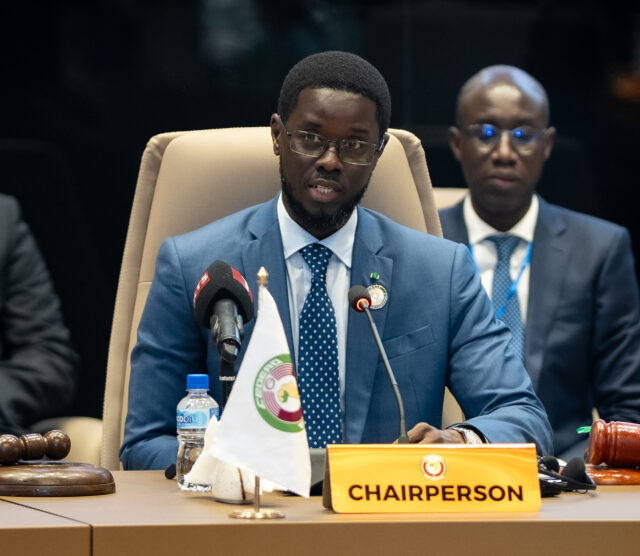
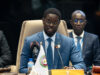
Senegalese President Bassirou Diomaye Faye has been elected Chairman of the Authority of Heads of State and Government of the Economic Community of West African States (ECOWAS), taking over the leadership of the 15-member regional bloc at a time of mounting security, political and diplomatic challenges in West Africa.
Faye was elected on Sunday during the 69th Ordinary Session of the ECOWAS Authority of Heads of State and Government held in Freetown, Sierra Leone, succeeding President Julius Maada Bio of Sierra Leone.
His emergence comes just over a year after Bio assumed the chairmanship from Nigeria’s President Bola Ahmed Tinubu at the 67th Ordinary Session of the Authority in Abuja in June 2025, following Tinubu’s completion of two consecutive terms as chairman of the regional body.
Faye inherits the leadership of ECOWAS at a critical period, with the organisation grappling with escalating insecurity, democratic challenges and the continued withdrawal of Mali, Burkina Faso and Niger from the regional bloc.
One of his immediate priorities is expected to be rebuilding trust with the three Sahel nations while sustaining diplomatic engagement aimed at preserving regional cooperation despite their exit from ECOWAS.
At 46, Faye becomes one of the youngest leaders to chair the regional organisation, a development observers believe could inject fresh momentum into ECOWAS’ reform agenda, particularly in the areas of democratic governance, institutional reforms, youth inclusion, accountability and regional integration.
His election also places Senegal at the forefront of key political, diplomatic and security decisions affecting West Africa.
Reacting to his election, President Faye expressed gratitude to his fellow leaders for the confidence reposed in Senegal and pledged to work towards strengthening regional unity.
“It is with humility that I welcome the trust placed in our country, called to the presiding presidency of ECOWAS,” Faye wrote in a message posted on his official X account.
“I thank my peers, Heads of State and Government, for this mark of trust and for the spirit of fraternity that presided over our work.”
The Senegalese leader also congratulated General Birame Diop on his election as President of the ECOWAS Commission and pledged his administration’s full support.
“I congratulate General of the Army Birame Diop, elected to the presidency of the Commission, and assure him of my full support.”
He concluded his message with a call for greater regional cohesion, declaring: “Long live ECOWAS. Long live a reconciled and united West Africa.”
Faye’s election comes as ECOWAS continues efforts to redefine its role amid shifting political dynamics across the region, particularly following a series of military coups and the formation of the Alliance of Sahel States (AES) by Mali, Burkina Faso and Niger.
His tenure is expected to focus on restoring confidence in regional institutions, strengthening democratic governance, enhancing economic integration and addressing persistent security threats, including terrorism, violent extremism and transnational organised crime, while keeping diplomatic channels open with the breakaway Sahel nations.
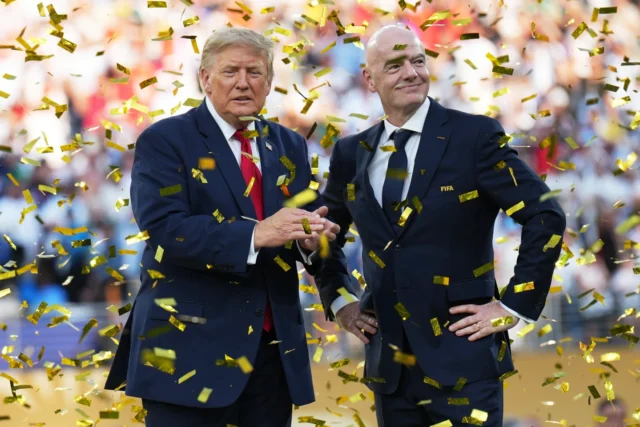
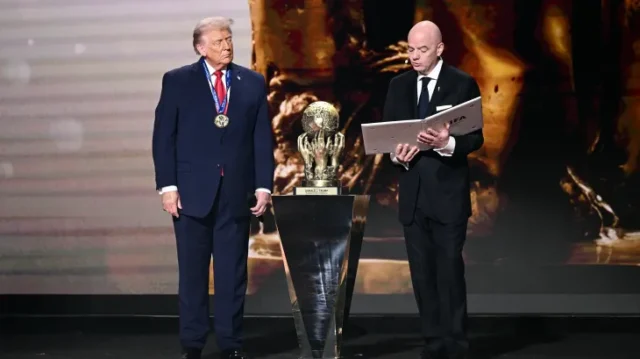
U.S. President Donald Trump (left) and FIFA President Gianni Infantino. Photo: AP
The winners of the 2026 FIFA World Cup will not only lift football’s most coveted trophy and etch their names into sporting history, they will also receive a record $51 million in prize money and, for the first time, championship rings in recognition of their achievement.
As Argentina and Spain prepare to battle for global football supremacy, FIFA has confirmed that the champion will earn the tournament’s highest-ever financial reward, while the runners-up will receive $34 million.
The governing body has significantly increased the tournament’s overall prize fund, distributing a record $871 million among the 48 participating national teams at the expanded World Cup staged across the United States, Canada and Mexico.
The payout represents a substantial increase from the $440 million prize fund shared by the 32 teams at the 2022 World Cup in Qatar, where Argentina received $42 million for winning the title.
FIFA also approved an additional package of more than $100 million in April after several European football associations argued that the cost of participating in a tournament spread across three countries—with extensive travel and accommodation requirements—had increased significantly.
Despite the record prize money, the World Cup champion’s earnings remain modest compared with the financial scale of elite club football.
The $51 million awarded to the winning federation is less than the transfer fee recently paid by Premier League side Brighton for 19-year-old Croatian defender Luka Vušković, who featured sparingly during the tournament. It is also considerably lower than the $115 million earned by Chelsea after winning the expanded FIFA Club World Cup in the United States last year.
Under FIFA’s prize structure, every participating nation receives financial compensation regardless of its performance.
Each of the 48 national associations is guaranteed $12.5 million, comprising $10 million for qualifying and competing in the group stage and an additional $2.5 million to cover pre-tournament training and preparation costs.
The upfront payments were introduced to reduce disputes between players and national football associations over unpaid bonuses before major tournaments.
Prize money then increases progressively as teams advance through the knockout rounds.
The champion receives $51 million, while the runners-up collect $34 million.
England, who defeated France in the third-place playoff, will receive $30 million, while fourth-placed France earn $28 million.
Teams eliminated in the quarter-finals each receive $20 million, those knocked out in the Round of 16 are awarded $16 million, while nations eliminated in the Round of 32 receive $12 million.
Teams finishing between 33rd and 48th place retain the $10 million allocated for reaching the group stage.
Beyond prize money, FIFA also assumes responsibility for several logistical expenses incurred by participating nations.
Tournament regulations require the governing body to provide business-class return flights for national delegations, accommodation and meals for up to 50 officials and players beginning five days before a team’s opening match and continuing until one day after its elimination.
FIFA also pays for domestic transportation throughout the tournament, including dedicated vehicle fleets and equipment transport.
National football associations, however, remain responsible for insurance covering injuries, accidents, illness and travel, as well as incidental hotel expenses and accommodation for delegation members beyond the approved quota.
While the financial rewards are substantial, the World Cup trophy remains the competition’s greatest prize.
Following Sunday’s final, the victorious captain will lift the famous FIFA World Cup Trophy during the presentation ceremony before the team is presented with a gold-plated replica to keep permanently. The original trophy remains in FIFA’s possession.
The distribution of prize money among players is left entirely to each country’s football federation.
For example, the United States Soccer Federation operates under a landmark 2022 collective bargaining agreement that allocates 20 per cent of World Cup prize money to the federation itself, while the remaining 80 per cent is shared equally between the men’s and women’s national teams, making it the first national governing body to guarantee equal World Cup prize payments across both programmes.
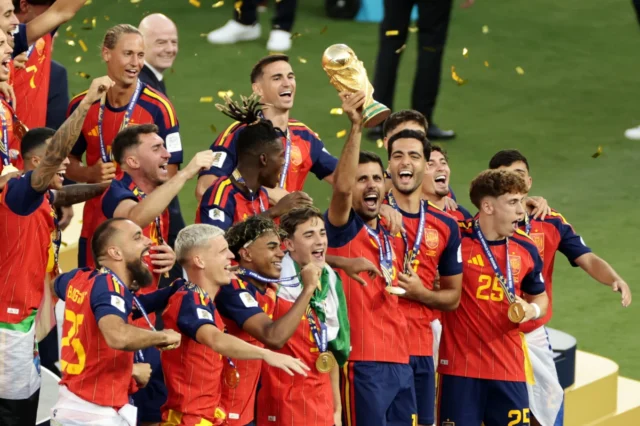
Spain celebrate victory with World Cup trophy. Photo: AP
Spain are world champions once again after defeating defending champions Argentina 1-0 in an enthralling FIFA World Cup final on Sunday, with substitute Ferran Torres scoring the decisive extra-time winner to deny Lionel Messi a second consecutive world title in what is expected to be the final World Cup match of his illustrious career.
Torres struck in the 106th minute to hand Spain their second FIFA World Cup crown, 16 years after lifting their first title in South Africa in 2010. The victory also completed a historic double for the European nation, which now simultaneously holds both the men’s and women’s World Cup titles following the Spanish women’s triumph in 2023.
“It was a goal scored by 47 million people,” Torres said, referring to Spain’s population.
“Maybe not by them — but certainly for them.”
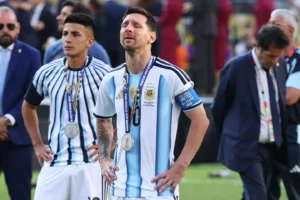
Argentina’s Lionel Messi reacts after losing to Spain on Sunday. Photo: AP
The winning goal came after Argentina had been reduced to 10 men when midfielder Enzo Fernández was sent off late in normal time after receiving a second yellow card for a reckless challenge on Spain defender Pau Cubarsí.
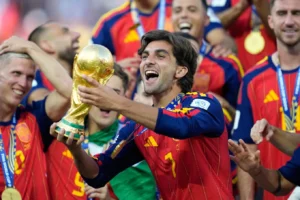
Torres, introduced in the second half, capitalised on a loose ball inside the penalty area before firing a left-footed effort beneath the crossbar, sparking wild celebrations among the Spanish players and supporters.
Spain’s disciplined defence then withstood Argentina’s late attempts to force penalties, sealing a triumph built on one of the most dominant defensive displays in World Cup history.
Luis de la Fuente’s side conceded just one goal in eight matches, setting a new record for the fewest goals allowed by a World Cup-winning team.
“I feel pride, to be honest,” Spain coach Luis de la Fuente said.
“Accompanying them on this journey is an honor.”
The 65-year-old also became the oldest coach to guide a nation to FIFA World Cup glory.
Spain’s goal hero Ferran Torres celebrates with the World Cup trophy on Sunday. Photo: AP
Although the scoreline suggested a closely contested final, Spain controlled proceedings for long periods.
The newly crowned champions registered the first 20 shots of the match before Argentina finally managed their opening attempt during the second half of extra time. Spain also earned nine of the first 10 corner kicks and were repeatedly denied only by an inspired display from Argentina goalkeeper Emiliano Martínez.
The Aston Villa goalkeeper produced a World Cup final-record 12 saves to keep the holders in contention.
“Dibu was nothing short of exceptional,” De la Fuente said, using Martínez’s widely known nickname.
The victory extended Spain’s remarkable unbeaten run to 38 matches, comprising 29 wins and nine draws, eclipsing Italy’s previous European men’s record of 37 unbeaten games between 2018 and 2021.
Spain have now gone more than two years without defeat.
Argentina, seeking to become the first nation since Brazil in 1962 to successfully defend the men’s World Cup title, found no answer to Spain’s relentless possession-based football.
Coach Lionel Scaloni accepted defeat while paying tribute to his players.
“We lost the game, and we accept that,” Scaloni said.
“That doesn’t mean that we will forget everything we’ve done so far, so I’d like to thank my people, my players and the country. I can tell them that we played our hearts out.”
Messi nearly inspired one final dramatic comeback when his corner kick with four minutes remaining before the end of extra time caused panic in Spain’s defence. The ball eventually fell to substitute Giuliano Simeone, whose effort sailed over the crossbar.
“When you have Messi on the other side, well, you are nervous,” Torres admitted.
“At the end of the day, we always depended on us. We always come up with our football, and we showed it again.”
Despite heated exchanges between players and coaching staff following the final whistle, Spain’s squad later displayed a gesture of sportsmanship by forming a guard of honour as Argentina’s players walked towards the podium to receive their runners-up medals from U.S. President Donald Trump and FIFA President Gianni Infantino.
Spain midfielder Rodri, who was named winner of the tournament’s Golden Ball award as the best player of the competition, admitted the magnitude of the achievement had yet to sink in.
“I think now I’m in a cloud,” he said.
The final also marked the likely end of Messi’s extraordinary World Cup journey.
The 39-year-old Inter Miami captain had previously indicated that this tournament would be his last appearance on football’s biggest stage, bringing the curtain down on one of the greatest international careers in history.
Having briefly retired after Argentina’s Copa América final defeat to Chile in 2016 before reversing his decision weeks later, Messi went on to cement his legendary status by leading Argentina to the 2022 FIFA World Cup title, Copa América triumphs in 2021 and 2024, and becoming his country’s most decorated football icon.
Reflecting on his international career before the tournament, Messi had said: “I experienced a lot of things on this pitch, good and not so good. I’ll take the good with me.”
For Spain, however, this World Cup belonged entirely to a team whose tactical discipline, defensive solidity and technical brilliance proved unmatched throughout the tournament.
“I spoke to my players, and they said: ‘Look, we’ve won everything, coach. We’ve won everything,'” De la Fuente said.
“And that is beautiful.”
The final also delivered a spectacular entertainment showcase beyond the football itself. Global music stars Madonna, Justin Bieber, BTS, Shakira and Burna Boy headlined an elaborate halftime show, while actor Jason Sudeikis appeared in character as Ted Lasso. Jennifer Hudson, Post Malone and Tom Cruise also featured in the pre-match closing ceremony before more than 80,000 spectators inside the stadium and an estimated global television audience approaching two billion.
As Rodri reflected after lifting football’s biggest prize, Spain’s mindset throughout the tournament never changed.
“As I told the lads before the game, we have to go for the game, we need to face them, we have to look to their eyes and say we want this game,” he said.
FIFA President Gianni Infantino has declared the 2026 FIFA World Cup a resounding success, praising United States President Donald Trump for his support of the tournament while saying the expanded global showpiece had fulfilled its mission of bringing people together across borders and cultures.
Speaking alongside Trump at Trump Tower in New York on Friday, ahead of Sunday’s World Cup final between Argentina and Spain, Infantino pointed to record-breaking attendance, sold-out stadiums and massive global television audiences as evidence that the biggest World Cup in history had exceeded expectations.
“The American dream, Mr. President, came to reality,” Infantino said. “We united the world.”
The FIFA president thanked Trump for his role in hosting the tournament, insisting the competition would not have achieved the same level of success without the support of the U.S. administration.
“You don’t need people to compliment you, Mr. President, but this World Cup would not have been such an incredible success without you,” Infantino said.
Trump, who hosted Infantino and several international football stars at the reception, described the tournament as “one of the all-time greatest sporting events in history.”
He also wished both finalists well ahead of Sunday’s title decider.
“So good luck to Spain and Argentina on Sunday and may the best team win,” the U.S. president said.
Earlier in the day, Infantino addressed a special session at the United Nations focused on football’s role in promoting youth mental health, where he used the World Cup to highlight sport’s ability to foster unity despite global divisions.
Holding one of the official match balls that will be used in the final, Infantino described it as “a magic object which has the power to unite the world.”
“We hear it many times, don’t we, that we live in a divided world, that we live in an aggressive world, that there are so many things that divide us, that create us problems,” he said.
“But we know as well, and if there is one thing, if there is one thing that this World Cup has shown us and is showing us, we know that there are many more things that bring us together than things that divide us.”
The 2026 tournament has been the largest in FIFA history, expanding from 32 to 48 participating nations and featuring 104 matches across the United States, Canada and Mexico.
With only the third-place playoff between England and France and Sunday’s final remaining, FIFA said virtually all of the 102 matches played so far had attracted sell-out crowds.
Overall attendance is expected to reach approximately 6.7 million spectators, setting a new World Cup record despite earlier concerns over high ticket prices and stricter immigration policies that some feared could discourage international supporters from travelling to North America.
Reflecting on the tournament’s broader impact, Infantino said millions of people had gathered peacefully throughout the competition.
“We have seen millions of people coming together in the last month and a half to the United States, to Canada and to Mexico, but in every corner of the world, coming together in a peaceful way, in a joyful way, wanting to spend time together and wanting to celebrate a moment of community,” he said.
“This is the strongest message ever and this is the message on which we have to build our future — a future of community and a future of unity.”
While the tournament has largely proceeded without major security incidents, it has not been without controversy.
Iran’s national team complained of strict travel restrictions while competing during a period of heightened tensions between Tehran and Washington. FIFA also faced criticism after Infantino overturned the red-card suspension of United States forward Folarin Balogun following lobbying by Trump, who later described his intervention as “making a recommendation.”
Defending the decision, Trump remarked: “Gianni made yet another of his good decisions.”
The competition has also generated diplomatic tensions after the British government urged FIFA to investigate Argentina’s national team over players displaying a banner asserting Argentine sovereignty over the Falkland Islands following their semifinal victory over England.
Despite the controversies, Infantino maintained that football remains one of humanity’s most powerful unifying forces and pledged FIFA’s support for global youth mental health initiatives.
He told delegates at the United Nations that football continues to transcend political, cultural and linguistic barriers.
“In two days, we will know if Spain or Argentina will be the world champion,” Infantino said.
“But what we know already, dear friends, is that football is not just the most popular sport in the world, but football has definitely become that common, that universal language that everyone speaks because everyone wants to come together.”
Attention now turns to MetLife Stadium in East Rutherford, New Jersey, where Argentina and Spain will battle on Sunday for the right to be crowned champions of the expanded 2026 FIFA World Cup.
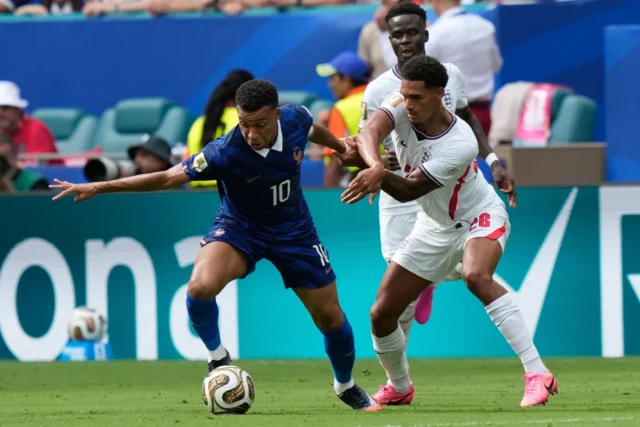
England’s Jarell Quansah (right) challenges France’s Kylian Mbappe (left) during their World Cup third-place playoff match in Florida on Saturday. (AP Photo/Lynne Sladky)
England secured third place at the FIFA World Cup in spectacular fashion on Saturday, defeating France 6-4 in a record-breaking thriller as Bukayo Saka scored a hat-trick and Kylian Mbappé surpassed Lionel Messi’s career World Cup scoring record.
The 10-goal contest became the highest-scoring World Cup match since Hungary’s 10-1 demolition of El Salvador at the 1982 tournament and also set a new benchmark as the highest-scoring third-place playoff in World Cup history.
Saka was the star of the show for the Three Lions, netting in the 37th minute, first-half stoppage time and from the penalty spot in the 87th minute to register the second hat-trick of his England career.
England laid the foundation for victory with a dominant first-half display, racing into a 4-0 lead before the break. Declan Rice and Ezri Konsa joined Saka on the scoresheet as Gareth Southgate’s side overwhelmed France with clinical finishing and relentless attacking football.
France mounted an impressive second-half comeback led by captain Kylian Mbappé, who struck twice to rewrite the World Cup record books. His brace took his career World Cup tally to 22 goals, moving him one ahead of Argentina captain Lionel Messi to become the competition’s all-time leading scorer.
Mbappé also strengthened his grip on the race for the tournament’s Golden Boot, finishing the World Cup with 10 goals—two more than Messi.
Bradley Barcola and Ousmane Dembélé also found the net for France, but their goals proved insufficient to erase England’s commanding advantage.
England continued to threaten throughout the second half despite France’s resurgence, with Saka completing his hat-trick from the penalty spot late in the match before Jude Bellingham wrapped up the scoring in the eighth minute of stoppage time with his seventh goal of the tournament.
The victory handed England their best finish at a FIFA World Cup since lifting the trophy on home soil in 1966, providing a memorable end to their campaign after falling short of reaching the final.
While France were left to settle for fourth place, Mbappé’s individual brilliance ensured he departed the tournament with two major milestones, becoming the World Cup’s all-time leading scorer and the frontrunner for the Golden Boot after another prolific campaign on football’s biggest stage.
The Board of Trustees (BoT) of the Peoples Democratic Party (PDP) has rejected the judgment of the Federal High Court in Abuja dismissing its suit seeking to compel the Independent National Electoral Commission (INEC) to recognise and list members of the party’s Interim National Working Committee (INWC).
The Chairman of the PDP Board of Trustees, Senator Adolphus Wabara, on Friday described the ruling as a miscarriage of justice and vowed to pursue every legal avenue to challenge the decision.
The BoT said it received the judgment “with utter dismay,” arguing that the court failed to compel INEC to comply with what it described as existing judgments of the Court of Appeal and the Supreme Court regarding the leadership of the party.
According to the PDP BoT, the Federal High Court’s decision amounted to a direct challenge to the authority of Nigeria’s superior courts.
“The BoT strongly rejects the decision of the High Court which is a direct affront to the superior authority of the Court of Appeal, the supremacy of the Supreme Court, the integrity of the Institution of the Judiciary and the sanctity of the law,” the statement by Wabara read.
The Board further accused the trial court of exceeding its constitutional powers by making pronouncements that allegedly contradicted decisions already reached by the Court of Appeal and the Supreme Court.
“It is rather strange that the High Court went beyond its bounds and arrogated itself powers to make pronouncements over and above the pronouncements of the Court of Appeal and the Supreme Court by recognizing the actions of individuals whose suspension and expulsion from the party had been upheld by the two superior courts,” the BoT stated.
The PDP also faulted the court for making findings in favour of individuals who were not parties to the suit before it.
“Equally strange is that the High Court went outside the issues before it to make pronouncements in favour of individuals that were not parties in the case,” the statement added.
Maintaining that the ruling was inconsistent with established legal principles, the BoT insisted that it would not allow the judgment to stand unchallenged.
“It is clear that this judgment against the PDP and democracy in Nigeria cannot stand in the face of the law. The BoT is therefore determined to take every step within the ambit of the law to ensure that justice is done in the matter,” Wabara said.
The Board appealed to members and supporters of the opposition party to remain calm and united while it considers its next line of action.
“While urging teeming members and supporters of our party to remain focused, the BoT reassured that it will in a couple of days hold an emergency meeting and inform party members and Nigerians on the way forward,” the statement concluded.