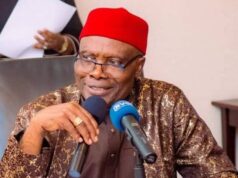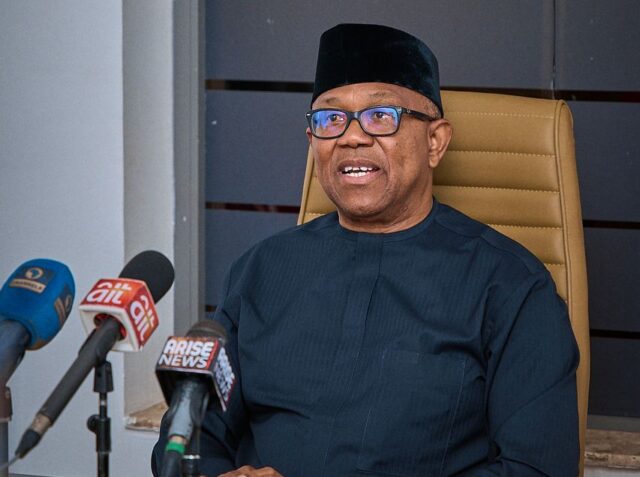
Presidential hopeful Peter Obi has formally accepted his nomination as the presidential candidate of the Nigerian Democratic Congress (NDC), declaring that the 2027 election would be a defining moment for Nigeria’s future and renewing his pledge that “a New Nigeria is possible.”
Speaking at the party’s nomination event in Abuja on Saturday, Obi thanked the leadership of the NDC, party members, supporters and Nigerians across the country for their confidence in his candidacy. The former Anambra State governor described his emergence as the party’s flag bearer as a responsibility that extends beyond personal ambition and one that must focus on restoring hope to millions of Nigerians.
“It is with deep humility that I accept the role of presidential candidate for our party,” Obi said in his acceptance speech. He expressed appreciation to party leaders, including former Bayelsa State Governor Seriake Dickson, members of the National Working Committee and supporters who travelled from different parts of the country to participate in the event.
Obi used the occasion to reiterate one of the central themes of his political movement, insisting that Nigeria still possesses the capacity to overcome its challenges and achieve national renewal.
“I wish to assert unequivocally: a New Nigeria is Possible,” he declared. “This conviction has united us; it must serve as our compass on the challenging road ahead and sustain us through all trials we may face.”
According to Obi, the country’s current difficulties have created widespread uncertainty among citizens, with many families worried about security, economic hardship and the future of their children. He said businesses are struggling, communities are facing increasing hardship and many Nigerians have lost confidence in government institutions.
“Today, our nation finds itself at a crucial juncture, enveloped in uncertainty. Families are anxious about their safety; parents are concerned for their children’s futures; and talented youth increasingly question their prospects in their homeland,” he said.
Despite the challenges, Obi maintained that Nigeria’s future remains bright if citizens unite behind a common purpose and reject divisive politics.
A significant portion of his speech focused on national unity, which he described as a prerequisite for meaningful development and sustainable progress. Obi warned against ethnic, religious and regional divisions, arguing that Nigeria’s diversity should be embraced as a strength rather than exploited as a source of conflict.
“Nigeria cannot advance while fragmented by ethnic, religious, regional, or narrow political divides,” he said. “We may communicate in different languages and practise diverse faiths, but we share a singular destiny under one flag.”
Calling for greater national cohesion, Obi urged Nigerians to replace mistrust with confidence and embrace a shared vision for the country’s future.
“We should build bridges where others erect barriers, replace mistrust with confidence, division with understanding, and resentment with a collective purpose,” he said.
To underscore the importance of unity, Obi quoted renowned historian Will Durant, saying, “A great civilisation is not conquered from without until it has destroyed itself from within.” He added, “We must never self-destruct. We must heal, unify, and progress together.”
The NDC presidential candidate also identified insecurity as one of the most pressing threats facing the country. He argued that worsening security challenges have damaged public confidence and hindered national development.
“In terms of security, the situation in Nigeria has considerably worsened,” Obi said, citing global terrorism impact assessments that ranked Nigeria as the eighth most affected nation in 2022, sixth in 2024 and fourth in 2026.
He contrasted Nigeria’s current security challenges with the country’s historical reputation as a respected contributor to international peacekeeping operations. Obi highlighted the achievements of Nigerian military personnel in missions across Africa, the Middle East and other parts of the world, noting that the country’s armed forces had earned global recognition for professionalism, discipline and operational effectiveness.
According to him, Nigerian troops have played critical roles in peacekeeping and stabilisation efforts in countries including Rwanda, Sudan, Liberia, Sierra Leone, Mali, Western Sahara, the Democratic Republic of Congo, Lebanon, Cambodia, Haiti and Kuwait.
Obi specifically referenced retired Lieutenant General Isaac Obiakor’s leadership role in international peacekeeping missions as evidence of Nigeria’s past standing on the global stage.
The former governor argued that the country must urgently reverse the current security trend and prioritise the protection of citizens.
“We must address insecurity with resolve and urgency, for no nation can thrive while its citizens live in trepidation,” he said. “The primary responsibility of the government is to ensure the safeguarding of lives and property.”
Obi’s acceptance speech marks the beginning of what is expected to be an intense political contest ahead of the 2027 presidential election. By placing national unity, security and hope at the centre of his message, the NDC candidate signalled the themes likely to define his campaign as political parties begin positioning themselves for the race to succeed President Bola Ahmed Tinubu.
With the declaration of his candidacy, Obi has now formally launched his bid to lead Africa’s most populous nation, promising to rally Nigerians around a vision of national renewal and inclusive progress.