The winners of the 2026 FIFA World Cup will not only lift football’s most coveted trophy and etch their names into sporting history, they will also receive a record $51 million in prize money and, for the first time, championship rings in recognition of their achievement.
As Argentina and Spain prepare to battle for global football supremacy, FIFA has confirmed that the champion will earn the tournament’s highest-ever financial reward, while the runners-up will receive $34 million.
The governing body has significantly increased the tournament’s overall prize fund, distributing a record $871 million among the 48 participating national teams at the expanded World Cup staged across the United States, Canada and Mexico.
The payout represents a substantial increase from the $440 million prize fund shared by the 32 teams at the 2022 World Cup in Qatar, where Argentina received $42 million for winning the title.
FIFA also approved an additional package of more than $100 million in April after several European football associations argued that the cost of participating in a tournament spread across three countries—with extensive travel and accommodation requirements—had increased significantly.
Despite the record prize money, the World Cup champion’s earnings remain modest compared with the financial scale of elite club football.
The $51 million awarded to the winning federation is less than the transfer fee recently paid by Premier League side Brighton for 19-year-old Croatian defender Luka Vušković, who featured sparingly during the tournament. It is also considerably lower than the $115 million earned by Chelsea after winning the expanded FIFA Club World Cup in the United States last year.
Under FIFA’s prize structure, every participating nation receives financial compensation regardless of its performance.
Each of the 48 national associations is guaranteed $12.5 million, comprising $10 million for qualifying and competing in the group stage and an additional $2.5 million to cover pre-tournament training and preparation costs.
The upfront payments were introduced to reduce disputes between players and national football associations over unpaid bonuses before major tournaments.
Prize money then increases progressively as teams advance through the knockout rounds.
The champion receives $51 million, while the runners-up collect $34 million.
England, who defeated France in the third-place playoff, will receive $30 million, while fourth-placed France earn $28 million.
Teams eliminated in the quarter-finals each receive $20 million, those knocked out in the Round of 16 are awarded $16 million, while nations eliminated in the Round of 32 receive $12 million.
Teams finishing between 33rd and 48th place retain the $10 million allocated for reaching the group stage.
Beyond prize money, FIFA also assumes responsibility for several logistical expenses incurred by participating nations.
Tournament regulations require the governing body to provide business-class return flights for national delegations, accommodation and meals for up to 50 officials and players beginning five days before a team’s opening match and continuing until one day after its elimination.
FIFA also pays for domestic transportation throughout the tournament, including dedicated vehicle fleets and equipment transport.
National football associations, however, remain responsible for insurance covering injuries, accidents, illness and travel, as well as incidental hotel expenses and accommodation for delegation members beyond the approved quota.
While the financial rewards are substantial, the World Cup trophy remains the competition’s greatest prize.
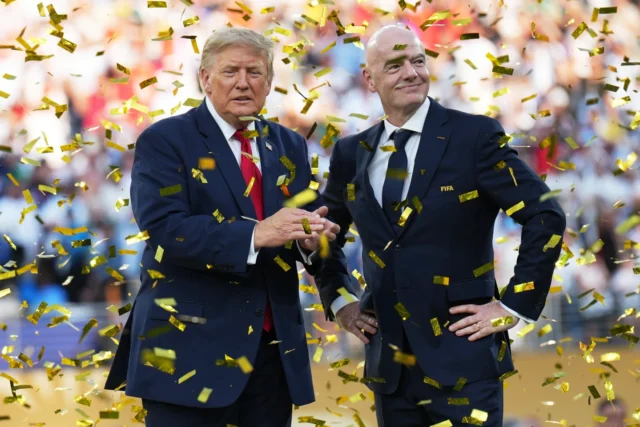
Following Sunday’s final, the victorious captain will lift the famous FIFA World Cup Trophy during the presentation ceremony before the team is presented with a gold-plated replica to keep permanently. The original trophy remains in FIFA’s possession.
The distribution of prize money among players is left entirely to each country’s football federation.
For example, the United States Soccer Federation operates under a landmark 2022 collective bargaining agreement that allocates 20 per cent of World Cup prize money to the federation itself, while the remaining 80 per cent is shared equally between the men’s and women’s national teams, making it the first national governing body to guarantee equal World Cup prize payments across both programmes.
AP