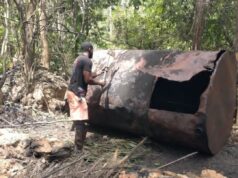
An Ebola treatment facility in eastern Democratic Republic of the Congo has been attacked and partially burned by angry residents, triggering the escape of 18 suspected Ebola patients into the community as authorities battle a rapidly worsening outbreak linked to the deadly Bundibugyo strain of the virus.
The attack occurred late Friday in the town of Mongbwalu, one of the epicenters of the outbreak in Ituri province, and marked the second violent assault on an Ebola treatment center within a week.
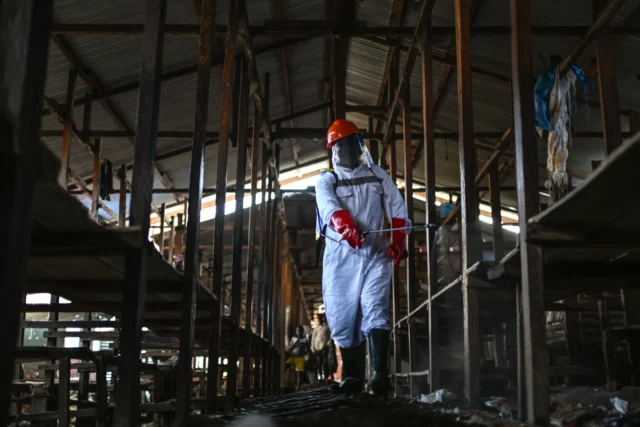
According to Dr. Richard Lokudi, director of the Mongbwalu hospital, residents stormed the facility and set fire to a treatment tent established by Doctors Without Borders for confirmed and suspected Ebola patients.
“We strongly condemn this act, as it caused panic among the staff and also resulted in the escape of 18 suspected cases into the community,” Lokudi told The Associated Press.
Initial reports indicated that no deaths or injuries occurred during the incident, but health officials fear the fleeing patients could accelerate transmission of the virus in surrounding communities.
The violence follows another attack on Thursday in the town of Rwampara, where residents burned down an Ebola treatment center after authorities barred relatives from retrieving the body of a local man suspected to have died from the disease.
Health experts say the bodies of Ebola victims can remain highly contagious after death, making traditional funeral rites and burial ceremonies major drivers of transmission during outbreaks. Authorities have therefore imposed strict protocols on handling suspected Ebola deaths, a move that has fueled anger and distrust among some local communities.
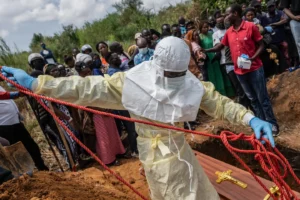
On Saturday, Red Cross officials carried out a communal burial for Ebola victims in Rwampara under heavy security amid mounting tensions between residents and healthcare workers.
David Basima, a burial team leader with the International Federation of Red Cross and Red Crescent Societies, said armed police and soldiers had to supervise the operation while family members watched from a distance as sealed coffins were lowered into graves by workers dressed in protective suits.
Basima said his team “experienced a lot of difficulties, including resistance from young people and the community.”
“We were forced to alert the authorities so that they could come to our aid, just for safety,” he said.
As the outbreak intensifies, authorities in northeastern Congo have banned funeral wakes and public gatherings exceeding 50 people in a bid to contain the spread of the virus.
The World Health Organization has now upgraded the outbreak risk level in Congo from “high” to “very high,” although the organization maintains that the risk of international spread remains low.
WHO Director-General Tedros Adhanom Ghebreyesus said on Friday that 82 Ebola cases and seven deaths had been officially confirmed, warning that the true scale of the outbreak is likely far greater.
“The outbreak is believed to be much larger,” Tedros said.
Health authorities say the outbreak involves the rare Bundibugyo strain of Ebola, for which there is currently no approved vaccine. The virus reportedly spread undetected for weeks in Ituri province after initial tests focused on another, more common Ebola variant returned negative results.
Officials now estimate there are about 750 suspected cases and 177 suspected deaths linked to the outbreak, though those figures are expected to rise as surveillance efforts expand.
Dr. Jean Kaseya, director-general of the Africa Centres for Disease Control and Prevention, stressed that restoring trust between communities and health responders would be essential to containing the outbreak.
The crisis deepened further on Saturday after the Red Cross announced that three of its volunteers in Mongbwalu had died from the virus. The humanitarian agency said the workers were believed to have contracted Ebola on March 27 while handling bodies during a non-Ebola humanitarian operation.
If confirmed, the revelation could significantly alter the timeline of the outbreak, suggesting the virus was circulating weeks earlier than previously believed. Authorities had initially traced the first confirmed death to late April in Bunia, the capital of Ituri province.
Meanwhile, the United States Department of Health and Human Services announced emergency restrictions on green card holders who have recently traveled to Ebola-affected countries, including Congo, Uganda and South Sudan.
Under the new rule published Friday in the Federal Register, permanent U.S. residents returning from the affected countries may face temporary reentry restrictions as part of enhanced Ebola screening, quarantine monitoring and contact-tracing measures.
U.S. health officials argued that the emergency order was necessary to ensure adequate public health safeguards despite bypassing the usual public comment process required for federal regulations.