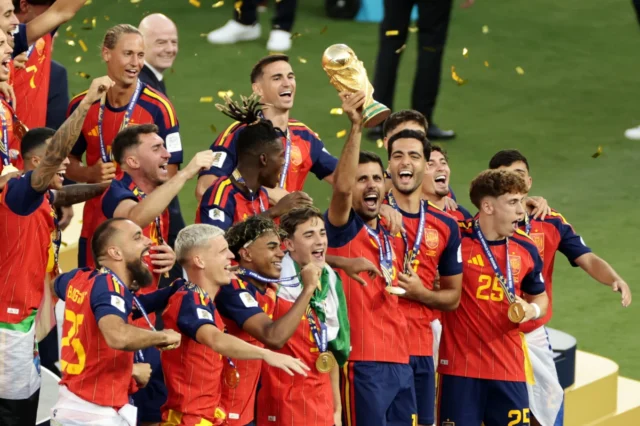
Spain are world champions once again after defeating defending champions Argentina 1-0 in an enthralling FIFA World Cup final on Sunday, with substitute Ferran Torres scoring the decisive extra-time winner to deny Lionel Messi a second consecutive world title in what is expected to be the final World Cup match of his illustrious career.
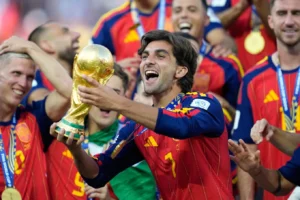
Torres struck in the 106th minute to hand Spain their second FIFA World Cup crown, 16 years after lifting their first title in South Africa in 2010. The victory also completed a historic double for the European nation, which now simultaneously holds both the men’s and women’s World Cup titles following the Spanish women’s triumph in 2023.
“It was a goal scored by 47 million people,” Torres said, referring to Spain’s population.
“Maybe not by them — but certainly for them.”
The winning goal came after Argentina had been reduced to 10 men when midfielder Enzo Fernández was sent off late in normal time after receiving a second yellow card for a reckless challenge on Spain defender Pau Cubarsí.
Torres, introduced in the second half, capitalised on a loose ball inside the penalty area before firing a left-footed effort beneath the crossbar, sparking wild celebrations among the Spanish players and supporters.
Spain’s disciplined defence then withstood Argentina’s late attempts to force penalties, sealing a triumph built on one of the most dominant defensive displays in World Cup history.
Luis de la Fuente’s side conceded just one goal in eight matches, setting a new record for the fewest goals allowed by a World Cup-winning team.
“I feel pride, to be honest,” Spain coach Luis de la Fuente said.
“Accompanying them on this journey is an honor.”
The 65-year-old also became the oldest coach to guide a nation to FIFA World Cup glory.
Although the scoreline suggested a closely contested final, Spain controlled proceedings for long periods.
The newly crowned champions registered the first 20 shots of the match before Argentina finally managed their opening attempt during the second half of extra time. Spain also earned nine of the first 10 corner kicks and were repeatedly denied only by an inspired display from Argentina goalkeeper Emiliano Martínez.
The Aston Villa goalkeeper produced a World Cup final-record 12 saves to keep the holders in contention.
“Dibu was nothing short of exceptional,” De la Fuente said, using Martínez’s widely known nickname.
The victory extended Spain’s remarkable unbeaten run to 38 matches, comprising 29 wins and nine draws, eclipsing Italy’s previous European men’s record of 37 unbeaten games between 2018 and 2021.
Spain have now gone more than two years without defeat.
Argentina, seeking to become the first nation since Brazil in 1962 to successfully defend the men’s World Cup title, found no answer to Spain’s relentless possession-based football.
Coach Lionel Scaloni accepted defeat while paying tribute to his players.
“We lost the game, and we accept that,” Scaloni said.
“That doesn’t mean that we will forget everything we’ve done so far, so I’d like to thank my people, my players and the country. I can tell them that we played our hearts out.”
Messi nearly inspired one final dramatic comeback when his corner kick with four minutes remaining before the end of extra time caused panic in Spain’s defence. The ball eventually fell to substitute Giuliano Simeone, whose effort sailed over the crossbar.
“When you have Messi on the other side, well, you are nervous,” Torres admitted.
“At the end of the day, we always depended on us. We always come up with our football, and we showed it again.”
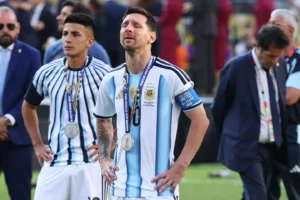
Despite heated exchanges between players and coaching staff following the final whistle, Spain’s squad later displayed a gesture of sportsmanship by forming a guard of honour as Argentina’s players walked towards the podium to receive their runners-up medals from U.S. President Donald Trump and FIFA President Gianni Infantino.
Spain midfielder Rodri, who was named winner of the tournament’s Golden Ball award as the best player of the competition, admitted the magnitude of the achievement had yet to sink in.
“I think now I’m in a cloud,” he said.
The final also marked the likely end of Messi’s extraordinary World Cup journey.
The 39-year-old Inter Miami captain had previously indicated that this tournament would be his last appearance on football’s biggest stage, bringing the curtain down on one of the greatest international careers in history.
Having briefly retired after Argentina’s Copa América final defeat to Chile in 2016 before reversing his decision weeks later, Messi went on to cement his legendary status by leading Argentina to the 2022 FIFA World Cup title, Copa América triumphs in 2021 and 2024, and becoming his country’s most decorated football icon.
Reflecting on his international career before the tournament, Messi had said: “I experienced a lot of things on this pitch, good and not so good. I’ll take the good with me.”
For Spain, however, this World Cup belonged entirely to a team whose tactical discipline, defensive solidity and technical brilliance proved unmatched throughout the tournament.
“I spoke to my players, and they said: ‘Look, we’ve won everything, coach. We’ve won everything,'” De la Fuente said.
“And that is beautiful.”
The final also delivered a spectacular entertainment showcase beyond the football itself. Global music stars Madonna, Justin Bieber, BTS, Shakira and Burna Boy headlined an elaborate halftime show, while actor Jason Sudeikis appeared in character as Ted Lasso. Jennifer Hudson, Post Malone and Tom Cruise also featured in the pre-match closing ceremony before more than 80,000 spectators inside the stadium and an estimated global television audience approaching two billion.
As Rodri reflected after lifting football’s biggest prize, Spain’s mindset throughout the tournament never changed.
“As I told the lads before the game, we have to go for the game, we need to face them, we have to look to their eyes and say we want this game,” he said.
“And then, life gives you the World Cup or not.”
AP