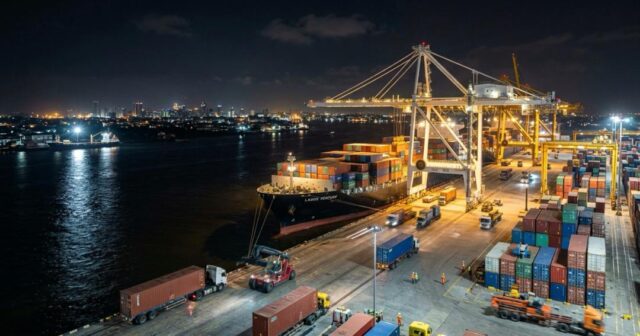
The Federal Government has approved the comprehensive modernisation and upgrade of Onne, Rivers, Delta and Calabar ports as part of a broader plan to expand Nigeria’s maritime capacity and develop alternative gateways for international trade.
Minister of Marine and Blue Economy, Adegboyega Oyetola, disclosed the development on Sunday, saying the latest approval extends the government’s port renewal programme beyond Lagos following the earlier approval for the modernisation and upgrade of Apapa and Tin Can Island ports.
The minister said the expansion was designed to create a more balanced national port system capable of supporting trade, industry, investment and employment across different regions of the country.
“This approval builds on the earlier approval for the modernisation and upgrade of Apapa and Tin Can Island Ports in Lagos, reaffirming our determination to develop a balanced, efficient and globally competitive national port system,” Oyetola said.
He said the government’s strategy was intended to address the concentration of cargo traffic around Lagos by developing efficient alternatives in other parts of the country.
According to him, modernising Onne, Rivers, Delta and Calabar ports would complement ongoing investments in Lagos while providing additional gateways through which goods could enter and leave Nigeria.
“Extending the modernisation programme beyond Lagos will complement ongoing investments in Apapa and Tin Can Island, while helping to reduce the concentration of cargo traffic around Lagos and creating additional efficient gateways for international trade,” the minister said.
Ports to support trade and regional economies
Oyetola said the upgrades would go beyond physical rehabilitation, with improved infrastructure and operational efficiency expected to strengthen cargo handling, shorten vessel turnaround times and improve connections between ports and their surrounding economic corridors.
“Upgraded infrastructure and improved operational efficiency at Onne, Rivers, Delta and Calabar Ports will enhance cargo handling, reduce vessel turnaround times, strengthen regional connectivity and make the movement of goods more predictable and cost-effective,” he said.
He described the four ports as strategically important to Nigeria’s trade and industrial development, saying the Federal Government intends to equip them to handle the demands associated with a growing economy.
“These ports have strategic roles to play in our trade, industrial and regional development, and we are determined to equip them to meet the demands of a growing economy,” Oyetola said.
The latest decision effectively expands the Federal Government’s existing port-modernisation programme to six major existing ports, following the earlier focus on Apapa and Tin Can Island.
The government has also been pursuing a wider strategy involving the development of new deep-sea ports across the country.
Six new deep seaports in wider maritime plan
Oyetola said the modernisation of existing facilities would be accompanied by the development of new deep seaports.
The projects identified by the minister are the Ibom Deep Seaport in Akwa Ibom, Bakassi Deep Seaport in Cross River, Agge Deep Seaport in Bayelsa, Gateway Deep Seaport in Ogun, Ondo Deep Seaport in Ondo and Bonny Deep Seaport in Rivers State.
“Our approach is comprehensive. We are modernising existing ports while facilitating the development of new deep seaports,” Oyetola said.
“Together, these investments will expand Nigeria’s maritime capacity, create stronger economic corridors and position our country as a major maritime and logistics hub in Africa.”
The combination of upgraded conventional ports and new deep-sea facilities is expected by the government to provide greater capacity for handling rising trade volumes and create additional links between coastal communities, industrial centres and inland markets.
Government targets integrated transport network
The minister also outlined a broader vision in which ports would not operate in isolation from other transport infrastructure.
He said the Federal Government wants Nigeria’s ports connected more effectively with roads, railways and inland waterways so that cargo can move efficiently from the point of entry to final destinations.
“Our vision is an integrated maritime and logistics system in which ports, roads, rail, inland waterways and other transport infrastructure work together to enable the seamless movement of cargo,” Oyetola said.
Such integration, he said, should reduce the time and cost Nigerian businesses spend moving goods while improving the attractiveness of the country as a destination for investment.
“We want Nigerian businesses to spend less time and resources moving their goods, while creating an environment that encourages investment and supports job creation,” he added.
The emphasis on multimodal transport comes as the Federal Government seeks to strengthen Nigeria’s marine and blue economy and improve the competitiveness of the country’s logistics system.
Onne and Rivers ports take greater regional significance
The inclusion of Onne and Rivers ports in the upgrade programme is particularly significant for the Niger Delta and the wider South-South economy.
Onne is an important maritime and logistics centre serving the oil and gas industry, while the Rivers port complex provides another potential gateway for cargo serving businesses and consumers across the region.
Government-backed improvements to the facilities could therefore have implications beyond port operations, particularly for manufacturing, energy services, logistics and regional distribution.
For the eastern and southern corridors, a more efficient port network could also provide businesses with alternatives to routing cargo through Lagos.
Calabar and Delta ports also targeted
The inclusion of Calabar Port brings another major facility in the eastern corridor into the Federal Government’s modernisation programme.
Calabar’s location gives it potential importance for trade serving Cross River and neighbouring states, while Delta Port is positioned to support commercial and industrial activity in the Niger Delta.
The Federal Government has framed the upgrades as part of a national strategy rather than a Lagos-versus-other-regions initiative, with the stated objective of distributing maritime capacity more widely across the country.
Modernisation follows wider port reform drive
The new approval comes against the backdrop of an ongoing effort by the Ministry of Marine and Blue Economy to modernise Nigeria’s port infrastructure.
In a September 2026 assessment of the ministry’s activities, Oyetola said port modernisation remained central to the government’s transformation agenda. The ministry said its programme included channel improvements, modern cargo-handling infrastructure and increased digitisation of terminal operations.
The ministry also reported progress in the use of alternative dispute resolution to settle commercial disputes involving maritime stakeholders, with Oyetola saying nearly 300 commercial disputes had been resolved through ADR over a three-year period.
The latest approval therefore represents an expansion of a broader reform programme rather than an isolated infrastructure decision.
FG seeks private-sector and state government partnership
Oyetola said the success of the projects would depend on sustained cooperation between the Federal Government and other stakeholders in the maritime industry.
He listed state governments, terminal operators, investors and shipping companies among those expected to play roles in translating the infrastructure plans into operational improvements.
“The Ministry will continue to work closely with state governments, terminal operators, investors, shipping companies and other stakeholders to ensure that these projects translate into tangible improvements across Nigeria’s marine and blue economy,” he said.
The minister said Nigeria possesses the geographical position, market size and maritime resources required to become a major maritime centre but needs appropriate infrastructure, policies and an enabling investment environment to convert that potential into economic value.
Focus shifts from Lagos-only port development
The expanded approval also signals a broader geographic approach to port investment.
For years, Apapa and Tin Can Island have handled a substantial share of Nigeria’s maritime cargo, making the Lagos corridor a critical component of the country’s logistics network. The Federal Government’s current strategy is to supplement those facilities with stronger ports and new deep-sea terminals elsewhere.
BusinessDay reported that the latest decision brings six existing major ports under the government’s current modernisation plan and follows earlier concerns in maritime circles about the need for greater attention to ports outside Lagos.
The Federal Government is now pursuing two complementary tracks: upgrading existing ports to improve their performance while developing new deep-sea facilities to provide additional long-term capacity.
If implemented effectively, the government expects the combination to strengthen regional trade corridors, improve cargo movement and increase Nigeria’s ability to compete as a maritime and logistics hub in Africa.
For Oyetola, the objective extends beyond rehabilitating individual port facilities.
The minister said the ultimate goal is to establish a national maritime network in which ports and other transport systems work together to lower logistics costs, support businesses, attract investment and generate employment.
“Nigeria has the geography, market and maritime resources to become a leading maritime hub. Our responsibility is to provide the infrastructure, policies and enabling environment required to turn that potential into sustainable economic value,” Oyetola said.