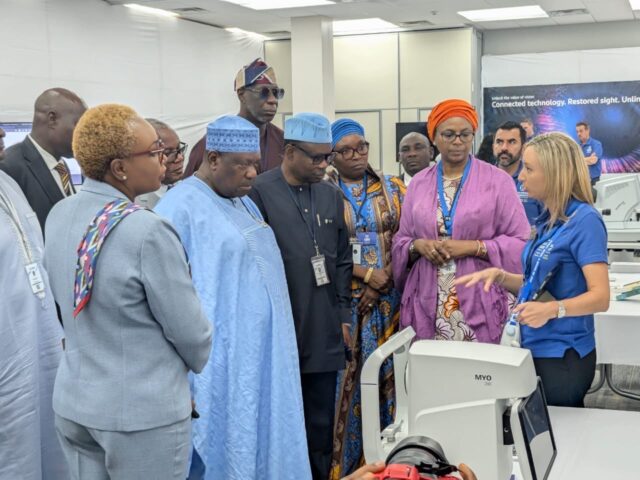
The Federal Government has announced plans to distribute five million pairs of ready-made reading spectacles and provide 25,000 fully subsidised cataract surgeries by 2027 as part of a national drive to reduce avoidable blindness and make eye care more accessible to vulnerable Nigerians.
The Minister of State for Health and Social Welfare, Dr Iziaq Adekunle Salako, announced the targets while delivering Nigeria’s closing address at the Global Summit for Eye Health in St John’s, Antigua and Barbuda, on Tuesday.
The commitments form part of a broader government programme aimed at expanding access to affordable eye care, particularly for women, older people and residents of underserved rural communities.
Salako also outlined longer-term targets, including the continued integration of primary eye care into the Basic Health Care Provision Fund (BHCPF), training 15,000 primary healthcare workers and increasing the active eye care workforce by 20 per cent.
Nigeria is further targeting a 30-percentage-point improvement in Effective Cataract Surgical Coverage by 2030. The minister said the combined interventions are expected to extend access to quality eye care to more than 25 million vulnerable people.
Describing eye health as a critical component of human development, Salako said avoidable vision loss has consequences beyond individual health, affecting education, household welfare, personal safety and national productivity.
He drew attention to the JigiBola eye care initiative introduced in Lagos State about 25 years ago, recalling his involvement in the programme as a young medical officer.
According to him, the initiative’s development into the national Effective Spectacle Coverage Initiative, known as JigiBola 2.0, illustrates how successful state-level interventions can be expanded into nationwide programmes.
The minister also highlighted Nigeria’s participation in the World Health Organisation’s Global Cataract Surgery Initiative, known as SEE 2045, describing it as an opportunity to accelerate efforts to eliminate cataract-related blindness.
He stressed that meeting the country’s eye health targets would depend on sustained domestic funding, stronger public-private partnerships, support from international development partners and accountability for commitments made.
Salako also drew attention to the scale of financial and institutional support announced at the global summit. He cited approximately $60 million in pledges for assistive technology, alongside 15 private-sector commitments valued at more than $468 million and about 143 additional commitments from organisations outside government.
He commended Antigua and Barbuda, Bangladesh, Tanzania and China for their participation in advancing the global eye health agenda.
The summit, held under the theme, “From Commitments to a Shared Horizon of Sight,” brought together governments and other stakeholders to advance international cooperation on eye health.
Salako urged participating countries and development partners to translate their pledges into practical national programmes, arguing that the success of the global initiative should ultimately be measured by the number of people whose sight is protected or restored through accessible, affordable and sustainable services.
For Nigeria, the immediate challenge will be turning the announced targets into effective delivery, ensuring that spectacles reach people who need them and that subsidised cataract operations are accessible to vulnerable patients across the country.