Datti Baba-Ahmed Slams Peter Obi Over ADC Move, Says ‘Leaders Must Fight, Not Walk Away’
Datti

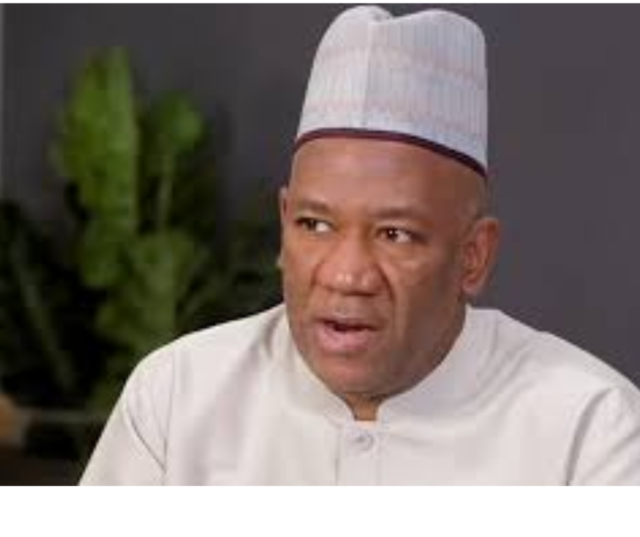
Former vice-presidential candidate of the Labour Party, Yusuf Datti Baba-Ahmed, has publicly criticised his former running mate, Peter Obi, over his decision to leave the party, questioning the leadership approach behind the move.

Speaking in a strongly worded reaction, Baba-Ahmed expressed disappointment at what he described as Obi’s decision to exit the party amid internal disputes rather than confront them. “I stood and earned the wrath of many because I think we would come and reconcile in Labour Party,” he said, adding that he was taken aback to “hear, to read it, and view it in the news” that his former leader had moved on.

Baba-Ahmed argued that leadership requires resilience and confrontation, particularly in moments of political adversity. “A leader must be firm. However gentle you are, as a leader, you must be willing to fight,” he said. “Where’s the toughest place to fight as leader? When they are going to steal your victory, you don’t allow what happened in 2023.”

Referencing the aftermath of the 2023 general election, he claimed there was a “clear constitutional breach,” insisting he was left alone to challenge it. “They left only one person, me, to fight it. Nobody talked about it but me. You don’t do that. You must fight. If you don’t do that, don’t even come out. Stay in your house,” he stated.

While reiterating his criticism of the ruling All Progressives Congress (APC), Baba-Ahmed maintained that Obi bore responsibility to remain within the Labour Party and resolve its internal crisis. “As much as I don’t believe and dislike what APC has been doing against Nigeria, but then someone who got Labour Party ticket so easily should have stayed back to fix the problem of the party however difficult it was,” he said.

He also took issue with Obi’s reported stance on conflict resolution, suggesting it contradicts the demands of national leadership. “I read and watched in the news, here’s my former leader and my boss whom I believed in so much saying wherever there’s a quarrel, he’ll walk away. So there’s a quarrel in Nigeria today, he will walk away? These are the things that don’t add up,” Baba-Ahmed added.

The comments come amid ongoing political realignments ahead of the next election cycle, with Obi’s reported defection to the African Democratic Congress (ADC) continuing to generate debate within opposition ranks. Observers say the public rift highlights deeper fractures within the Labour Party and raises questions about the cohesion of Nigeria’s opposition bloc moving forward.

Trump Orders New Military Operation ‘Project Freedom’ to Secure Strait of Hormuz Shipping Lanes

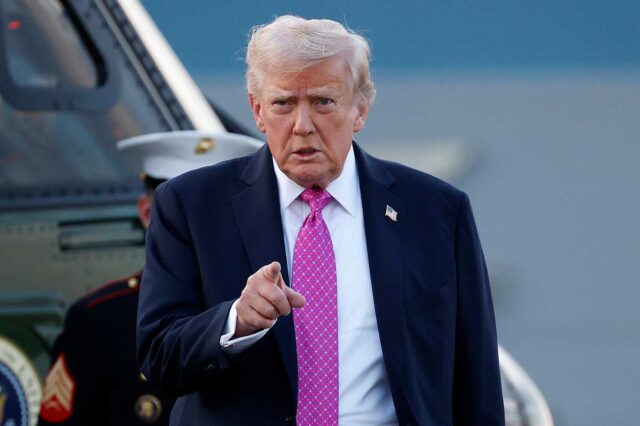
U.S. President Donald Trump

The administration of Donald Trump has announced the launch of a new military initiative aimed at safeguarding commercial shipping through the strategically vital Strait of Hormuz, amid heightened tensions involving Iran.

In a statement issued by United States Department of Defense spokesperson Sean Parnell, it was confirmed that President Trump has directed United States Central Command (CENTCOM) to initiate what has been termed “Project Freedom.”

“President Trump has directed CENTCOM to restart the free flow of commerce through the Strait of Hormuz under the umbrella of PROJECT FREEDOM,” the statement read, underscoring Washington’s intent to counter disruptions in one of the world’s most critical energy corridors.

The Pentagon clarified that the newly announced operation is “separate and distinct” from ongoing military efforts, specifically referencing Operation Epic Fury, which has been active in the broader region. Officials emphasized that Project Freedom is narrowly defined in both scope and duration.

“PROJECT FREEDOM is defensive in nature, focused in scope, and temporary in duration, with one mission: protecting innocent commercial shipping from Iranian aggression,” Parnell stated.

The announcement comes against the backdrop of escalating tensions between the United States and Iran, particularly over security concerns in the Gulf region, where disruptions to shipping lanes have raised global economic alarms. The Strait of Hormuz remains a critical chokepoint through which a significant portion of the world’s oil supply passes, making any threat to its stability a matter of international concern.

While U.S. officials have framed the operation as a protective measure, Tehran has consistently rejected accusations of aggression in the region, warning against what it describes as foreign military interference in its vicinity.

Kled Pulls Out of Nigeria, Cites 95% Fraud Rate, Mass Fake ID Submissions

Data monetisation startup Kled has removed its application from the Nigerian app store and imposed an IP ban on users in the country, citing what it described as an overwhelming surge in fraudulent activity on its platform.

In a statement released by the company, Kled said the decision followed months of internal monitoring which revealed that “Nigeria had a ≈95% fraud rate,” with users allegedly uploading non-usable content such as “pictures of black screens, duplicate photos, internet generated images, AI generated images… at an unimaginable scale.”

The startup, which has been operating outside beta for about four months, noted that it had previously recorded significant growth, claiming it had “paid out hundreds of thousands of people for their data” while users uploaded over one billion assets globally. However, it said the scale and sophistication of fraudulent submissions from Nigeria had become unsustainable for its operations.

Highlighting the tipping point, the company disclosed that its verification systems were recently overwhelmed by identity fraud attempts. “This weekend we were flooded with thousands of fake Japanese passports and identity cards with Nigerians photoshopped onto them in our KYC system. That was the final straw,” the statement read.

Kled compared the situation in Nigeria with other markets, stating that countries such as Malaysia, Indonesia, and the Philippines recorded fraud rates of less than 10 percent despite having significantly larger user bases. The company added that while its fraud detection systems are capable of identifying irregularities, “the level of complexity of these schemes is getting out of hand.”

Despite the crackdown, the company struck a conciliatory tone toward legitimate users in Nigeria, acknowledging early support from the region. “The first thing I would like to say is I have nothing against Nigeria… these were some of our earliest app adopters. Genuinely, thank you all for the support,” the company stated.

Kled explained that the removal is temporary and aimed at allowing time to strengthen its fraud detection and moderation systems. “As a startup we can’t afford to eat the costs of that data overhead, so we temporarily removed the app from the region while we improved our fraud detection and banning system,” it said.

Atiku Sets Agenda for U.S. Visit, Warns Nigeria Faces ‘Full-Blown Crisis’

Atiku Abubakar

Former Vice President Atiku Abubakar has outlined a stark agenda ahead of his proposed visit to the United States, declaring that his engagements will centre on what he described as Nigeria’s deepening crisis of security, governance, and economic stability.

In a statement issued by his media adviser, Paul Ibe, Atiku said the country is confronting a “full-blown internal crisis” that can no longer be “downplayed, politicized, or explained away.” He pointed to escalating violence across multiple regions, warning that the Nigerian state is increasingly failing in its core responsibility of safeguarding lives and property.

According to him, “the situation has moved beyond isolated incidents to a pattern of systemic failure,” with communities overrun, livelihoods destroyed, and citizens left vulnerable. He added that “any government that cannot guarantee basic security forfeits the moral basis of its mandate,” underscoring the urgency of the security challenge.

The former vice president also highlighted worsening economic conditions, describing the hardship facing Nigerians as both severe and avoidable. He cited rising inflation, currency weakness, and declining purchasing power as key pressures, noting that “Nigerians are not just tired, they are being stretched to the limits of endurance.” He attributed the situation in part to policy inconsistency and a lack of strategic direction.

Beyond security and the economy, Atiku raised concerns about the health of Nigeria’s democratic institutions, warning that declining public confidence in governance, accountability, and the electoral process poses a threat to national stability. As the country edges closer to another election cycle, he cautioned that any attempt to undermine transparency would have serious consequences for unity and legitimacy.

Addressing anticipated criticism of his international engagement, Atiku defended his decision to engage global stakeholders, insisting that “telling the truth about Nigeria is not unpatriotic.” He rejected claims that such outreach amounts to inviting foreign interference, arguing instead that Nigeria’s challenges have global implications and cannot be ignored.

He maintained that while “only Nigerians will decide Nigeria’s leadership,” international partners have a legitimate interest in the country’s stability and democratic health. He added that “responsible leadership does not hide from scrutiny, it welcomes it as a pathway to improvement.”

In a direct message to the current administration, Atiku warned against complacency, stating that “power is not an entitlement but a responsibility,” and urged the government to demonstrate a clear strategy for addressing insecurity and economic decline.

He also called on citizens to remain engaged and demand accountability, stressing that “no nation survives in silence.” According to him, meaningful change must come from within, driven by the collective will of Nigerians.

EFCC Arraigns Ex-Skye Bank Chairman Tunde Ayeni Over Alleged N15.6bn Fraud

Tunde Ayeni

The Economic and Financial Crimes Commission (EFCC) has arraigned former Chairman of the defunct Skye Bank Plc, Tunde Ayeni, over an alleged N15.6 billion fraud before the Federal Capital Territory High Court in Apo, Abuja.

Ayeni was brought before Justice Jude Onwuzuruike on Monday, May 4, 2026, on a 17-count charge bordering on criminal breach of trust, misappropriation, and conversion of investors’ funds amounting to N15,665,085,429. The prosecution, led by E.E. Iheanacho (SAN), told the court that the case was ready for arraignment and trial, stating, “We have before the court 17-count charge dated April 28, 2026, we humbly apply that the charge be read to the defendant.”

According to the charge sheet, the alleged offences were committed during Ayeni’s tenure as chairman of the bank’s board between October and November 2014. One of the counts alleges that he misappropriated N3.2 billion from depositors’ funds domiciled in the bank’s suspense account by transferring the money into accounts belonging to Misa Limited with Zenith Bank, in violation of regulatory guidelines.

Another charge claims that the defendant, on or about November 27, 2014, transferred N5.07 billion from the same suspense account to Union Registrars Limited’s account with Union Bank, also in breach of prudential regulations governing financial institutions.

Ayeni pleaded not guilty to all the charges when they were read in court. Following his plea, the prosecution urged the court to fix a trial date and remand the defendant in a correctional facility pending the hearing of his bail application.

Defence counsel, Ahmed Raji Bashir (SAN), informed the court that the charge had been served on his client on a public holiday and urged the court to either release him to the defence or return him to EFCC custody pending the determination of the bail application.

After hearing both parties, Justice Onwuzuruike adjourned the matter to May 13, 2026, for the hearing of the bail application and ordered that the defendant be remanded at the Kuje Correctional Centre.

EFCC Arraigns Fake BDC Operator Over N78.2m Fraud in Onitsha

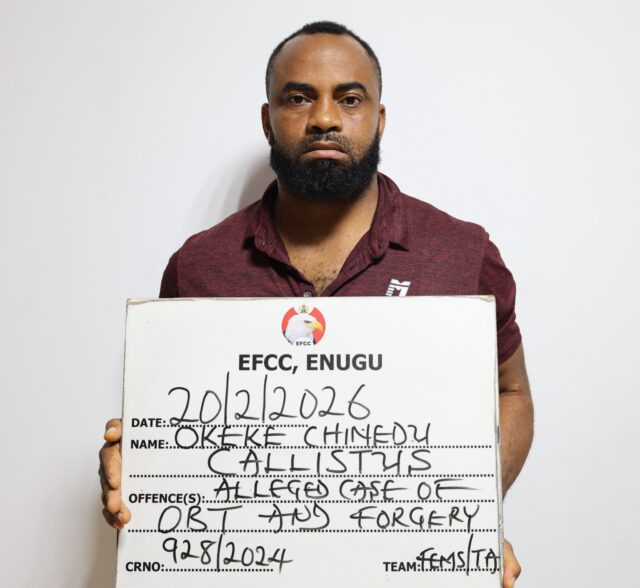
Okeke Ejike Callistus

The Economic and Financial Crimes Commission (EFCC) has arraigned an alleged fake Bureau De Change operator, Okeke Ejike Callistus, before the Anambra State High Court sitting in Onitsha over an alleged N78.2 million fraud.

Callistus was docked before Justice D. A. Onyefulu on a 10-count charge bordering on forgery and stealing. The prosecution told the court that the defendant, who operated under the name Nwachimereze Amen Resources, allegedly defrauded his client of a total sum of N78,295,000 through fraudulent currency exchange dealings.

According to the EFCC, one of the charges states: “Mr. Okeke Ejike Callistus (trading under the name and style of Nwachimereze Amen Resources), sometime on the 2nd of May, 2024, at Onitsha… did commit a felony to wit: stealing by fraudulently converting to your personal use the sum of N62,745,000… being property of Ezegwu Leonard Chinedu… and thereby committed an offence.”

Another count alleges that the defendant, between May 3 and May 7, 2024, fraudulently converted an additional N15,550,000 belonging to the same complainant. The offences, the prosecution noted, contravene provisions of the Criminal Code Law of Anambra State.

The defendant pleaded not guilty to all the charges. Following his plea, EFCC counsel, Assistant Commander Rotimi Enitan Ajobiewe, urged the court to fix a trial date and remand the defendant in the custody of the Nigerian Correctional Service.

However, defence counsel, Hypolite Ohaneche, informed the court of a pending bail application and urged the court to grant his client bail. The prosecution opposed the request, arguing that “there is likelihood of the defendant jumping bail due to the fact that he previously jumped bail granted him by the Commission.”

In his ruling, Justice Onyefulu granted the defendant bail in the sum of N50 million with two sureties. The court stipulated that one of the sureties must present a valid tax clearance certificate, while both must be relatives of the defendant, reside within the court’s jurisdiction, and possess valid National Identification Numbers.

The EFCC said the defendant was arrested following a petition by the complainant, who alleged that he entrusted Callistus with N78.2 million for onward transfer to a business partner in China. Instead of completing the transaction, the defendant reportedly remitted only part of the funds and issued telex documents purportedly from “ABA Bank of Cambodia” for the balance.

Investigations later revealed that the documents were fake. The Commission added that during interrogation, the defendant admitted receiving the funds but acknowledged diverting part of the money for personal use.

PDP NEC Installs Turaki-Led Interim NWC After Supreme Court Ruling

The Peoples Democratic Party (PDP) has moved to stabilise its internal structure following recent legal setbacks, with its National Executive Committee (NEC) appointing an Interim National Working Committee (INWC) to steer the affairs of the party.

At its 103rd meeting held on May 4, 2026, the NEC—acting with a two-thirds majority—approved the immediate inauguration of the interim leadership, citing the need to strengthen party administration and ensure strict adherence to its constitution in the wake of the Supreme Court judgment that has intensified leadership disputes within the opposition party.

The newly constituted INWC is headed by Kabiru Tanimu Turaki (SAN) as Chairman, with Taofeek Gboladejo Arapaja serving as Secretary. Other members include Hamza Akuyam Koshem, Daniel Ambrose Woyengikuro, Ihedewa Richard Nnabugwu, Isa Abubakar, Okechukwu Obiechina Daniel, Theophilus Dakas Shan, Ini Ememobong, Adewale Idowu Aribisala, Bara’u Shafi’i, Ogbu Anthonia Chinenyenwa, and Umar Dan Aji.

Party sources indicated that the interim body has been mandated to oversee executive operations and provide administrative direction pending the resolution of lingering disputes and the emergence of a substantive leadership. The move is widely seen as a response to the legal and political uncertainty that has trailed the party’s national convention and leadership structure in recent months.

The party said the decision was framed as a corrective step aimed at preserving unity and restoring confidence among party stakeholders. “This transition marks a significant step in maintaining the stability and structural integrity of the party,” the statement accompanying the announcement read.

NIS Debunks Passport Payment Scam Claims, Warns Nigerians Against Third-Party Platforms

The Nigeria Immigration Service (NIS) has strongly refuted circulating claims alleging irregularities in its passport application and payment process, insisting that its system remains secure, transparent, and accessible only through its official online portal.

In a public notice issued on Monday, the Service dismissed reports suggesting that a religious organisation is involved in its payment process, describing such claims as false and misleading. The agency stressed that all passport-related applications and payments must be conducted exclusively via its authorised platform, warning Nigerians to avoid any third-party channels.

“The NIS operates a secure, transparent, and government-approved passport application system, which is accessible exclusively through its official portal,” the statement read. “This remains the only authorized platform for all passport-related payments and processing activities for Nigerians both at home and in the diaspora.”

The Service categorically denied any partnership with religious bodies, private entities, or individuals acting as intermediaries, noting that any such claims do not reflect its operational structure. “Recent allegations suggesting that the name of a religious organization appears in the Service’s payment process are entirely false and do not reflect the structure, integrity, or processes of the NIS,” the agency stated.

Amid growing concerns over online fraud and impersonation, the NIS warned that any third-party payment links or platforms claiming to process passport applications on its behalf are fraudulent. It urged members of the public to exercise caution and rely solely on its official portal for all transactions.

The Service also confirmed that it has launched an investigation into the origin of the false claims, indicating that preliminary findings point to deliberate attempts to mislead the public. “The Nigeria Immigration Service has taken note of this purported allegation and is currently investigating the matter to uncover the sources of this false claim,” the statement added, noting that those found responsible would face appropriate sanctions.

Reaffirming its commitment to regulatory compliance, the agency stated that it works only with licensed and accredited payment service providers clearly listed on its official platform. It cautioned that payments made outside approved channels are done at the user’s risk, with no liability on the part of the Service for any resulting loss.

The NIS further urged Nigerians to avoid dealings with unauthorised agents or websites, reiterating that it does not recognise any alternative payment arrangements. It assured the public that efforts are ongoing to strengthen its systems and safeguard users against fraud and misrepresentation.

South Africa Hikes Fuel Prices from May 6 as Oil Surge, Strait of Hormuz Crisis Bite

The South African Department of Mineral Resources and Energy has announced a fresh adjustment in fuel prices, set to take effect from Wednesday, citing rising global oil prices and persistent geopolitical tensions as key drivers of the increase.

The government explained that the adjustment reflects both international and domestic market realities, in line with South Africa’s monthly fuel pricing framework. The country relies heavily on imported crude oil and refined petroleum products, making local pump prices highly sensitive to global supply dynamics and associated importation costs.

Central to the latest increase is the sharp rise in global crude oil prices. The average Brent crude benchmark climbed from $93.67 to $101 per barrel during the review period, largely driven by escalating tensions between the United States and Iran, as well as disruptions linked to the closure of the Strait of Hormuz. The situation has constrained global supply and triggered a ripple effect across energy markets.

International petroleum product prices have also surged in tandem with crude oil, with diesel and illuminating paraffin recording steeper increases than petrol. Authorities attributed this to stronger demand and reduced output from the Persian Gulf region. As a result, the Basic Fuel Price components rose significantly, contributing R2.04 per litre for petrol, R4.96 per litre for diesel, and R4.21 per litre for paraffin.

The government noted that exchange rate movements played only a marginal role in the latest adjustment, as the rand remained largely stable against the US dollar, shifting slightly from 16.64 to 16.65 during the period under review. This translated to a negligible impact on overall fuel pricing.

In addition, the implementation of the self-adjusting slate levy mechanism has further influenced the new pricing structure. The cumulative slate balance for petrol and diesel stood at a negative R14.173 billion at the end of March 2026, prompting the introduction of a levy of 122.70 cents per litre to offset the shortfall.

Despite the upward pressure, authorities have introduced temporary relief measures to cushion consumers. In response to the ongoing global energy crisis linked to the US-Iran conflict, the Minister of Finance, in consultation with the energy ministry, approved a reduction in the general fuel levy by 300 cents per litre for petrol and 393 cents per litre for diesel. This relief will remain in place from May 6 until June 2, 2026.

The statement also confirmed revised pricing for liquefied petroleum gas imported through Saldanha Bay in the Western Cape, with the Maximum Refinery Gate Price set at R18,375.72 per metric ton and the Maximum Retail Price fixed at R40.85 per kilogram.

NRC Raises Alarm Over Rising Attacks on Abuja-Kaduna Trains

The Nigerian Railway Corporation (NRC) has condemned a growing wave of attacks on train services along the Abuja-Kaduna rail corridor, warning that the incidents pose serious risks to passenger safety, railway personnel, and critical national infrastructure.

The latest attack occurred around Kilometer 177 on the corridor, where unidentified individuals reportedly gathered along the track and pelted stones at a moving train, damaging the windscreen of the leading locomotive. The corporation described the development as part of a disturbing pattern of repeated assaults on its operations in recent weeks.

According to the NRC, similar incidents have been recorded across multiple locations, including Gidan Busa and Sarki Gora Village in the Kakau District of Chikun Local Government Area of Kaduna State. Management disclosed that attacks have now been reported in more than six locations along the route within a short period, compounding operational challenges for one of Nigeria’s busiest rail lines.

The corporation said the repeated incidents “pose serious danger to railway operations, passengers, and operational personnel,” adding that the attacks not only threaten lives but also amount to economic sabotage. It warned that such acts are capable of disrupting national transportation and undermining significant government investments in the railway sector.

Despite the security concerns, the NRC confirmed that train services along the corridor have continued, albeit under heightened safety measures and strict operational vigilance. The corporation commended its personnel for maintaining professionalism under pressure, ensuring that passengers are transported safely amid the ongoing threats.

Management also acknowledged the role of security agencies working alongside railway authorities to secure the corridor. “The Corporation specially acknowledges the efforts and support of security operatives working tirelessly with the NRC to secure railway corridors and safeguard passengers and railway assets despite the persistent attacks,” the statement said.

In response to the escalating situation, the NRC said it is intensifying collaboration with security agencies, community leaders, and other stakeholders to enhance surveillance, track down perpetrators, and bring them to justice. It emphasized that stronger local cooperation is essential to curbing the menace.

The corporation urged residents living along railway corridors to remain vigilant and support efforts to protect public infrastructure by reporting suspicious activities. It also called on communities to discourage acts of vandalism and attacks on trains, stressing that collective action is critical to safeguarding the nation’s rail system.

Warning of broader implications, the NRC noted that continued attacks could disrupt smooth service delivery if not urgently addressed. It reiterated its commitment to providing safe, secure, and efficient rail transport services across the country, assuring passengers that all necessary steps are being taken to protect lives and railway assets.

EDITOR PICKS

Recent Posts