Ajayi Shines as Super Eagles Dig In Early, Group C Race Intensifies at AFCON 2025

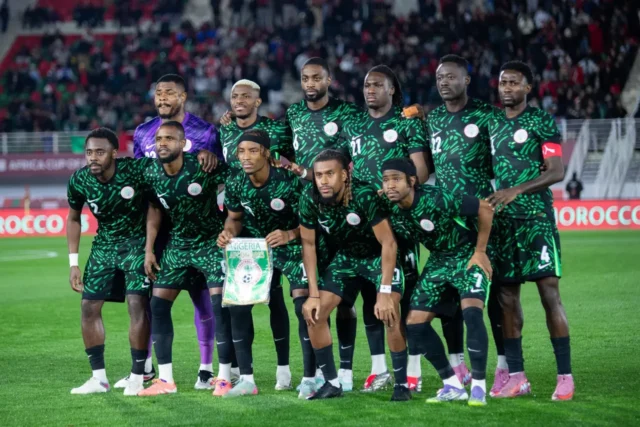
Nigeria's Super Eagles celebrate after scoring the first goal against Tanzania on Tuesday. Credit: cafonline

Nigeria’s push for a knockout place at the 2025 Africa Cup of Nations in Morocco gathered pace as the Super Eagles claimed a hard-fought victory to remain firmly in the qualification hunt in a fiercely contested Group C.

At the heart of Nigeria’s win was Semi Ajayi, whose commanding performance at the back and crucial goal earned him Man of the Match honours. Ajayi opened the scoring and set the tone for a night that tested Nigeria’s resolve as much as its quality.

“It’s an amazing feeling to score for your country, and in such a game it gives us the possibility of getting a good start,” Ajayi said after the match. “We had an amazing tournament in Côte d’Ivoire and we are using that as a standard. We are a team — we don’t need to get goals only from the attackers — and it’s pleasing to contribute to the success of the team.”

Nigeria briefly wobbled after Tanzania found an equaliser, but the Super Eagles responded almost immediately, showing the maturity that took them deep into the last AFCON. Ajayi admitted there was still room for improvement but was encouraged by the overall display. “There are a lot of positives to take from the game and some things to fix, and we will work on that to kill games going forward,” he added.

Head coach Eric Chelle echoed that assessment, welcoming the three points while acknowledging that sharper game management will be crucial as the group tightens. “We are satisfied with the three points. That is the most important,” Chelle said. “For the moment, I want to focus on the positives. The second part of the game shows clearly that there is still some work to be done — especially when it comes to killing the game. We are aware of this, and we will work on it.”

Nigeria’s victory kept them firmly in the mix behind Tunisia, who moved top of Group C after a 3–1 win over Uganda. The North Africans struck early through Elyes Skhiri, with Elias Achouri adding goals before and after the break. Uganda, however, had the final say as Denis Omedi pulled one back deep into added time, a goal that could yet matter in a group where goal difference may prove decisive.

Despite defeat, Tanzania left the pitch with renewed belief after pushing Nigeria for long spells. Their coach, Miguel Ángel Gamondi, felt his side exceeded expectations against one of the tournament favourites. “I think Tanzania played better than many people expected,” Gamondi said. “Nigeria had a lot of possession, but we neutralised them well through our tactical system. They did create chances, but most of them came from individual quality — which is not surprising. Overall, I believe we surprised a lot of people with the quality of our performance against Nigeria today.”

As the group stands, Tunisia lead, Nigeria sit close behind, and both Uganda and Tanzania remain under pressure with little margin for error. With heavyweight clashes still to come, including Nigeria’s looming test against the group leaders, Group C is shaping into a tense battle where composure, efficiency and small moments — like Ajayi’s decisive contribution — could determine who advances and who falls short at AFCON 2025.

Makinde Draws Battle Line with Wike, Rejects Support for Tinubu in 2027

Oyo State Governor Seyi Makinde

Oyo State Governor Seyi Makinde has escalated his public break with former ally and Federal Capital Territory (FCT) Minister Nyesom Wike, reiterating his refusal to support President Bola Ahmed Tinubu’s anticipated bid for re-election in 2027 and framing the dispute as a test of democratic autonomy within the Peoples Democratic Party (PDP).

Speaking during a media chat in Ibadan on Tuesday, Makinde offered a vivid personal narrative to underscore the depth of his differences with Wike — including a revealing point about their contrasting career trajectories. Recalling his own early success in business, Makinde said:

“Within one year, I made $1 million in my pocket. I was 29 in 1997. Wike, perhaps at that time, had just left law school…”

The anecdote was used by Makinde to highlight how his independent successes shaped his rise in both business and politics and to signal fundamental personal and political differences with Wike.

The immediate trigger for the widening rift, according to Makinde, occurred in a meeting attended by President Tinubu, Wike, and other senior figures. Makinde said he was taken aback when Wike told the President he would “hold the PDP for him” ahead of the 2027 elections — a pledge the Oyo governor insists was unsolicited and beyond the minister’s mandate.

“I was in a meeting with President Tinubu, Nyesom Wike, and others when Wike volunteered to hold the PDP for Tinubu against 2027, and I was in shock,” Makinde said, adding emphatically, “Wike can support the president in 2027, but I will not.”

While acknowledging that Wike has the right to offer personal political support to Tinubu, Makinde argued that no individual — not even a senior PDP member — should determine political allegiance for others within the party. He framed his own stance as a defence of multiparty democracy and an effort to prevent Nigeria from sliding toward a de facto one-party state.

“The President did not ask him to do this; he volunteered. Wike is within his rights to support Tinubu,” Makinde said, “but those of us who want to ensure the survival of multiparty democracy and the PDP should also be allowed to make our own decisions.”

Makinde’s comments underscore the deepening factionalism within the PDP — a party rocked this year by internal tensions, defections, and leadership disputes. The governor’s faction is pushing for party autonomy and a robust opposition to the ruling All Progressives Congress (APC). Wike, on the other hand, has signalled a more conciliatory approach toward Tinubu, insisting he remains in the PDP while openly backing the President’s agenda.

Both figures were among the G5 governors — a bloc of PDP leaders that controversially supported Tinubu’s 2023 election bid before fracturing over internal disagreements and power struggles within the opposition party.

Makinde said he attempted to resolve the disagreement with Wike privately, including through mutual associates, but that efforts were unsuccessful — prompting a firm public break.

In addition to rejecting any plan to organise for Tinubu, Makinde has affirmed his own political ambition, signalling his belief that he is qualified for the presidency should he decide to contest in 2027. He cited his tenure as a two-term governor and professional experience as part of his credentials.

For now, Makinde says his priority remains protecting the PDP’s relevance and ensuring a competitive democratic landscape in Nigeria. As he put it, the choice of who to support in the coming election — whether within or outside the PDP — is a matter of personal and political principle.

CAF Overhauls AFCON: Tournament to Be Held Every Four Years After 2028

CAF president Patrice Motsepe

The Africa Cup of Nations (AFCON), Africa’s flagship international football tournament, will shift from its long-established biennial schedule to a four-year cycle beginning after the 2028 edition, the Confederation of African Football (CAF) has confirmed. The landmark decision was announced on Saturday by CAF president Patrice Motsepe on the eve of the 2025 AFCON kick-off in Morocco.

The change marks one of the most significant structural reforms in African football in decades, ending a tradition of staging the continental championship every two years since 1968, with only a brief exception between the 2012 and 2013 editions. Under the new plan, the tournament will adopt a quadrennial rhythm, mirroring other major global competitions such as the FIFA World Cup and the UEFA European Championship.

Motsepe explained that while the next AFCON finals—scheduled for 2027 in Kenya, Tanzania and Uganda—will proceed as planned, and another edition is set for 2028, the shift to a four-year cycle will take effect after 2028. “Our focus now is on this AFCON, but in 2027 we will be going to Tanzania, Kenya and Uganda, and the AFCON after that will be in 2028,” Motsepe said. “Then after the FIFA Club World Cup in 2029 we will have the first African Nations League…with more prize money, more resources and more competition. As part of this arrangement, the AFCON now will take place once every four years.”

The move comes amid longstanding pressure to harmonise Africa’s football calendar with global competitions and reduce clashes with domestic leagues, particularly in Europe, where many of the continent’s top players are based. Historically, the timing of AFCON has often forced clubs to release African stars mid-season, a point of friction increasingly cited by national associations, top clubs and FIFA officials.

CAF acknowledged that AFCON has traditionally been a major revenue driver for African football associations, accounting for an estimated 80 per cent of income. To offset the financial impact of fewer editions, the federation plans to launch an annual African Nations League beginning in 2029, modelled after UEFA’s Nations League format. The new competition is expected to enhance revenue streams and provide regular competitive fixtures for national teams outside the AFCON cycle.

In addition to the scheduling overhaul, CAF has boosted prize money for the current AFCON, with the winners set to receive $10 million—an increase from $7 million in the previous edition.


Trinidad and Tobago Backs United States as US–Venezuela Tensions Intensify in the Caribbean

Trinidad & Tobago Prime Minister Kamla Persad-Bissessar

Prime Minister Kamla Persad-Bissessar has firmly reaffirmed Trinidad and Tobago’s support for the United States amid escalating tensions between Washington and Caracas, as concerns mount over electronic warfare and military posturing in the Caribbean.

Speaking at a supper hosted at the Diplomatic Centre on Thursday, Persad-Bissessar sought to reassure citizens that the government remains fully alert to regional developments and that there is no immediate cause for public alarm. She said the safety and stability of Trinidad and Tobago remain at the forefront of her administration’s priorities.

Addressing growing rhetoric within the country linked to the US–Venezuela standoff, the Prime Minister criticised what she described as “hypocrisy and unkindness” from individuals calling for confrontation with the United States. She stressed that Trinidad and Tobago maintains a strong and strategic bilateral relationship with Washington.

“Trinidad and Tobago stands with the United States,” Persad-Bissessar said, highlighting that the U.S. remains the country’s largest trading partner. She contrasted this with Trinidad and Tobago’s limited commercial engagement with Venezuela, noting that trade with Caracas accounts for just 0.0003 of total trade volume. “These are the facts,” she said.

The Prime Minister also warned against actions or statements that could negatively affect Trinidad and Tobago nationals living in or travelling to the United States. She revealed that more than 350,000 Trinidad and Tobago citizens hold U.S. visas, over 250,000 reside in the United States, and approximately 20,000 have dual citizenship. “I do not want anyone to lose their U.S. visa,” she said, urging citizens to act responsibly and recognise the realities of the country’s international partnerships.

Persad-Bissessar underscored the strategic importance of the United States to Trinidad and Tobago’s national security, arguing that Washington remains the only country currently capable of offering decisive military protection if the nation were threatened. “Understand where our help comes from. Understand who can protect and defend Trinidad and Tobago,” she said, adding that the U.S. possesses the military power, equipment and resources necessary to do so. “Trinidad and Tobago first.”

Her remarks come as tensions between the United States and Venezuela continue to escalate, with growing evidence of electronic warfare activity in the Caribbean. Data and security assessments indicate that both militaries have been jamming satellite navigation signals, including GPS systems, as part of defensive measures against potential attacks. Aviation and maritime experts warn that such disruptions increase the risk of accidents across the region’s busy air and sea routes.

The jamming incidents reflect rising military brinkmanship between U.S. President Donald Trump and Venezuelan President Nicolás Maduro, heightening anxiety among Caribbean nations located near the geopolitical flashpoint.

Joshua Knocks Out Jake Paul, Reignites Feud With Fury

Anthony Joshua delivered a thunderous statement in the ring and on the microphone as he stopped social media star-turned-boxer Jake Paul inside eight rounds, before turning his attention squarely back to longtime rival Tyson Fury in a fiery post-fight challenge that has reignited heavyweight boxing’s most anticipated showdown.

In the build-up to the bout, Joshua had dismissed Fury’s absence from the ring, questioning the former world champion’s commitment to fighting. “He can sit around doing Instagram videos, but he’s not the one getting in the ring. Jake is,” Joshua said days before the contest. “Why am I sitting around waiting for a guy that likes to do more Instagram videos than fight? I’m looking for real fighters. Tyson’s not a real fighter in my eyes.”

Joshua backed up his words with a decisive performance, overcoming a 15-month layoff to dominate Paul before finally ending the fight with a crushing right hand. While acknowledging that the bout did not unfold exactly as planned, the former unified heavyweight champion said the objective was always clear.

“It wasn’t the best performance. The end goal was to get Jake Paul, pin him down, and hurt him. It took longer than expected, but the right hand finally found the destination,” Joshua said after the fight. He also credited his opponent’s toughness, adding, “Jake Paul has done really well tonight. He got up time and time again. But he came up against a real fighter.”

The victory appears to mark a turning point for Joshua as he looks ahead to a busy 2026. “We shook off the cobwebs and can’t wait to roll into 2026,” he said, before launching into a direct and provocative message for Fury. “If Tyson Fury wants to put down his Twitter fingers and come and fight one of the realest fighters out there, step in the ring with me next if you’re a real bad boy. Don’t do all of the talking — ‘AJ this’, ‘AJ that’. Let’s see you in the ring and talk with your fist.”

Joshua also revealed the mindset that drove his aggressive approach in the fight, insisting he was determined to impose himself physically and mentally. “I said I need to give this guy a system breakdown. I said I’m going to take his soul. I said I’m going to see it leaving his body round after round. I got the job done within the time limit of eight rounds,” he said, downplaying any concern about how the bout might shape his long-term standing in the sport. “I don’t care about legacy. All the legacy is there to do is last for 50 years, and once it’s done, it’s done.”

For Paul, the defeat was a sobering reminder of the gap between elite heavyweight boxing and his rapid rise through the sport. Speaking candidly after the stoppage, he admitted the punishment he endured. “I got my ass beat, but that’s what this sport is all about,” Paul said. “I think my jaw is broken.”

Trump Media Strikes $6bn Merger Deal as Oracle-Led Consortium Set to Acquire TikTok US

Two of the year’s most significant deals in U.S. tech and media were confirmed this week, pushing the boundaries of digital platforms and future energy investment: Trump Media & Technology Group agreed to merge with fusion energy firm TAE Technologies in a deal valued at more than $6 billion, while TikTok’s U.S. business is being sold to a consortium led by Oracle, Silver Lake and MGX in a long-running effort to keep the platform operating in the United States.

In a strategic pivot announced Thursday, Trump Media — the publicly traded parent of former President Donald Trump’s social media platform Truth Social — inked an all-stock merger with TAE Technologies, a California-based developer of nuclear fusion energy technology. The boards of both companies have approved the transaction valued at over $6 billion, set to close in mid-2026 pending shareholder and regulatory approval. The merged company is expected to be co-led by Trump Media and TAE executives and intends to begin construction of a 50-megawatt utility-scale fusion power plant as early as 2026, marking a high-profile entry into commercial fusion power — a sector long touted as the “holy grail” of clean energy. The stock of Trump Media surged sharply on the announcement, reflecting investor enthusiasm for its new direction.

The merger represents a dramatic shift for Trump Media beyond its struggling social media operations, which reported substantial financial losses last year. By partnering with a nuclear fusion developer backed by major investors — including Google and Chevron Technology Ventures for TAE — the combined company aims to address the growing energy demands of AI infrastructure, data centres and decarbonisation goals while aligning media influence with futuristic technology development.

Meanwhile, TikTok’s U.S. business cleared another major hurdle in its long-running effort to comply with U.S. national security and ownership requirements. TikTok and its Chinese parent ByteDance have signed binding agreements with a consortium of investors including Oracle Corporation, private equity firm Silver Lake, and Abu Dhabi–based investment vehicle MGX to form a new U.S. entity under the name TikTok USDS Joint Venture LLC. Under the agreements, which are expected to close by January 22, 2026, these investors will collectively hold a controlling stake — part of a broader ownership structure designed to ensure compliance with U.S. regulatory demands and to avert a potential nationwide ban on the platform.

The new venture will be governed by a majority-American board of directors and will assume responsibility for key operational functions, including data protection, algorithm security, content moderation and software assurance — all aimed at addressing longstanding concerns that TikTok’s management could expose U.S. user information or be influenced by foreign interests. Oracle will also manage the storage of U.S. user data locally, and the platform’s recommendation algorithm will be retrained using American data to minimise potential external manipulation. ByteDance will retain a minority 19.9 per cent stake in the new entity, alongside other affiliate investors.

The TikTok restructuring follows intense political and legal pressure, including bipartisan efforts by the U.S. Congress and executive actions aimed at compelling divestiture or risking a ban on the app within the U.S. market, where TikTok counts over 170 million users. The consortium arrangement — underwritten by major global tech investors and sovereign funds — is widely seen as a path to preserving TikTok’s American presence while satisfying lawmakers’ security mandates.

Davido. French Montana Headline Star-Studded AFCON Concert

Davido

As anticipation reaches a crescendo for the TotalEnergies CAF Africa Cup of Nations (AFCON) 2025, organisers have unveiled a spectacular musical line-up featuring global stars French Montana and Nigerian superstar Davido at a high-profile concert in Morocco ahead of the tournament’s kick-off. The event is being positioned as one of the most ambitious entertainment programmes ever staged alongside the continent’s premier football festival.

Scheduled for Saturday evening, December 20, at the OLM Souissi Fan Zone in Rabat, the concert will kick off from 6:00 p.m. local time with a diverse roster of artists blending African and international sounds. French Montana, a Moroccan-born rapper who has risen to global fame from his base in the United States, will perform in what organisers describe as a symbolic homecoming amid one of the biggest cultural spectacles on the African calendar.

The show’s co-headliner, Davido, brings the power of Afrobeats to the stage, underscoring the genre’s growing global influence. The Nigerian singer, whose catalogue includes hits from acclaimed albums such as A Good Time and Timeless, has become an emblem of contemporary African music and will also perform at the event. His appearance adds a significant cultural dimension to the build-up ahead of the opening match of AFCON 2025, set for Sunday, December 21 in Rabat.

The concert’s lineup also includes Moroccan rising star Douaa Lahyaoui, whose fusion of pop and local sounds has captured widespread attention, emerging artist Says’z, and French-Moroccan hitmaker Lartiste, known for his genre-crossing style. Together, these performers reflect the organisers’ ambition to celebrate African unity, creativity and youth culture as part of the broader AFCON experience.

The football-meets-music event has been organised by the Confederation of African Football (CAF) in partnership with TotalEnergies and the Kingdom of Morocco, aimed at transforming the days before the tournament starts into a continental celebration of culture and sport. Official fan zones like the one in Rabat are expected to become hubs of activity, offering live music, entertainment and a chance for fans from across Africa and beyond to gather ahead of the football action.

Morocco, which hosts the 35th edition of AFCON, has seen teams and supporters arrive across the kingdom in recent days as excitement builds for Africa’s most prestigious football tournament. The opening concert not only sets a festive tone but also highlights how cultural programming is being woven into the sporting spectacle, blending tradition, modern sounds and global appeal.

Tinubu Presents ₦58.18trn 2026 Budget as Revenue, Deficit, Capital Spending Take Centre Stage

President Bola Ahmed Tinubu presenting the 2026 Budget Proposal at the National Assembly on Friday.

President Bola Ahmed Tinubu on Friday presented a ₦58.18 trillion 2026 Appropriation Bill to a joint session of the National Assembly, outlining ambitious revenue projections, elevated capital spending and a sizeable fiscal deficit as his administration seeks to consolidate recent economic reforms and stabilise public finances.

The proposed budget, themed “Budget of Consolidation, Renewed Resilience and Shared Prosperity,” projects total government revenue of ₦34.33 trillion against total expenditure of ₦58.18 trillion, resulting in a deficit of ₦23.85 trillion, equivalent to 4.28 per cent of Nigeria’s Gross Domestic Product. President Tinubu said the figures reflect a balance between fiscal realism and the need to sustain growth, protect vulnerable citizens and fund critical national priorities.

Of the total spending, ₦26.08 trillion has been earmarked for capital expenditure, a figure that underscores the government’s push to accelerate infrastructure development and productivity, while recurrent non-debt expenditure stands at ₦15.25 trillion. Debt servicing alone is projected to consume ₦15.52 trillion, highlighting the continued pressure Nigeria’s debt obligations place on public finances.

The president anchored the 2026 budget assumptions on a crude oil benchmark price of 64.85 dollars per barrel, daily oil production of 1.84 million barrels, and an average exchange rate of ₦1,400 to the US dollar. He told lawmakers that the projections were deliberately conservative, aimed at strengthening fiscal credibility and reducing exposure to external shocks.

Tinubu noted that the government’s fiscal position has shown signs of improvement in 2025, with revenue performance reaching ₦18.6 trillion as of the third quarter, representing 61 per cent of the annual target, while expenditure stood at ₦24.66 trillion, or 60 per cent of projections. He acknowledged, however, that capital budget implementation remained weak during the transition period, with only ₦3.10 trillion, about 17.7 per cent of the 2025 capital allocation, released by the third quarter as attention shifted to completing rolled-over 2024 projects.

Despite these challenges, the president said macroeconomic indicators were moving in the right direction. Nigeria’s economy grew by 3.98 per cent in the third quarter of 2025, inflation eased to 14.45 per cent in November from over 24 per cent earlier in the year, and external reserves rose to about 47 billion dollars, their highest level in seven years. He said these improvements provided a stronger base for the 2026 fiscal plan.

In sectoral terms, the budget allocates ₦5.41 trillion to defence and security, reflecting continued focus on internal stability, while education is set to receive ₦3.52 trillion and health ₦2.48 trillion. Infrastructure spending is projected at ₦3.56 trillion, as the government seeks to unlock private investment and address long-standing deficits in transport, energy and logistics.

President Tinubu stressed that improved revenue mobilisation would be critical to sustaining the budget, pointing to the implementation of new national tax laws, reforms in the oil and gas sector and stricter oversight of government-owned enterprises. He said all revenue-generating agencies have been directed to meet their targets, supported by end-to-end digitisation to curb leakages and strengthen accountability.

Looking ahead, Tinubu pledged stricter discipline in budget execution in 2026, with clear instructions issued to the finance and budget authorities to ensure spending aligns with appropriations and timelines. He told lawmakers that the true test of the budget would not be in its size or projections, but in its delivery and impact on citizens’ lives.

Plateau Gov. Mutfwang Joins APC, Ireti Kingibe Dumps LP for ADC

Plateau State Governor Caleb Mutfwang

In a major political realignment ahead of the 2027 general elections, Governor Caleb Mutfwang of Plateau State has officially defected from the Peoples Democratic Party (PDP) to the All Progressives Congress (APC), while Senator Ireti Kingibe made history by becoming the first serving senator to defect to the African Democratic Congress (ADC).

APC National Chairman Professor Nantewe Yilwatda announce Mutfwang’s defection at the APC National Caucus Meeting held at the Presidential Villa in Abuja on Thursday. Yilwatda confirmed that Mutfwang’s move marks a significant boost for the ruling party as it intensifies preparations for the 2027 electoral cycle.

Governor Mutfwang’s shift to the APC ends his longstanding association with the PDP, where he rose to prominence as governor of Plateau State following his election in 2023.

Senator Ireti Kingigbe (2nd left) during her induction into ADC

In a brief statement following the announcement, Mutfwang expressed optimism about his new political direction, saying he believed the APC’s platform aligns better with his vision for accelerated development in Plateau State. He also reiterated his commitment to ensuring continuity of governance and delivering on key projects in the state.

Meanwhile, in a parallel development, Senator Ireti Kingibe, who represents the Federal Capital Territory (FCT) in the 10th Senate, officially defected from the Labour Party (LP) to the African Democratic Congress (ADC). Kingibe’s defection is noteworthy as she becomes the first serving senator to join the ADC, reflecting growing interest in the party as an alternative to Nigeria’s dominant political giants.

Kingibe, a respected voice in the Senate known for her advocacy on governance, social development and institutional reforms, said her decision to join the ADC was driven by a desire to advance inclusive politics and deepen democratic engagement. In a statement shared with journalists after the announcement, she underscored the need for political platforms that resonate with the aspirations of diverse constituencies, particularly young Nigerians and women.

Putin Labels Ukraine Funding Move ‘Daylight Robbery’

Russia President Vladimir Putin

Russian President Vladimir Putin has scathingly criticised the European Union’s handling of frozen Russian assets, calling what he described as proposed European actions a form of “daylight robbery” and warning they could undermine confidence in the eurozone’s financial system and provoke serious consequences.

Putin made the remarks during his annual end-of-year press conference in Moscow, where he addressed a wide range of issues including the ongoing war in Ukraine, NATO expansion and economic policy. On the contentious issue of Russian sovereign assets frozen in the EU following Russia’s 2022 invasion of Ukraine, Putin rejected Western plans to use those funds to support Kyiv. He said that such a move would amount to blatant theft and erode trust in European financial markets. “It’s daylight robbery,” Putin said, arguing that European policymakers had crossed a red line by contemplating the use of Moscow’s frozen reserves without consent.

The comments come against the backdrop of tense negotiations in Brussels, where EU leaders have been trying to agree on mechanisms to sustain Ukraine’s economic and military effort. After lengthy deliberation, the bloc agreed this week to provide Ukraine with a €90 billion interest-free loan backed by EU borrowing, instead of tapping the approximately €210 billion worth of Russian central bank assets immobilised in Europe. Western officials framed the loan as a politically viable compromise that keeps the assets frozen while still meeting Kyiv’s financing needs.

European Commission President Ursula von der Leyen

European Commission leaders, including Ursula von der Leyen, had pushed for a “reparations loan” concept that would eventually use Russian reserves layered into the bloc’s lending strategy, but legal and political concerns—especially from Belgium, where most of the assets are held—stalled the plan. Belgian authorities warned that direct use of frozen reserves could expose the country to liabilities and legal challenges.

Putin’s remarks echoed long-standing Russian objections to Western handling of its assets. Moscow has repeatedly maintained that any attempt to use or repurpose the frozen funds constitutes theft, a claim Kremlin officials have flagged as not only unlawful but also damaging to international property rights. In September, Russian officials even threatened legal action against EU states that might seize the funds, saying they would pursue “all possible ways” to challenge such moves.

The EU’s decision to opt for a loan rather than direct confiscation appears in part to have defused the immediate dispute over asset use, but Putin’s “daylight robbery” characterisation underscores lingering mistrust. He warned that undermining confidence in the safety of sovereign reserves held in the eurozone could have broader repercussions for international finance, pointing not only to Russian funds but also to reserves of other major energy producers stored in European financial institutions.

The issue remains a flashpoint in the wider geopolitical battle over Ukraine’s future and Western unity. Ukrainian President Volodymyr Zelenskyy welcomed the EU’s agreement on direct support as a critical signal of sustained backing from Europe, even as internal divisions surfaced during the negotiations.

With Putin’s government concurrently pursuing a $230 billion lawsuit against Belgium’s Euroclear depository in Moscow over the handling of frozen assets, legal and diplomatic tensions are poised to persist well into 2026, even as Brussels and its allies strive to balance support for Ukraine with legal safeguards and financial stability.

EDITOR PICKS

Recent Posts