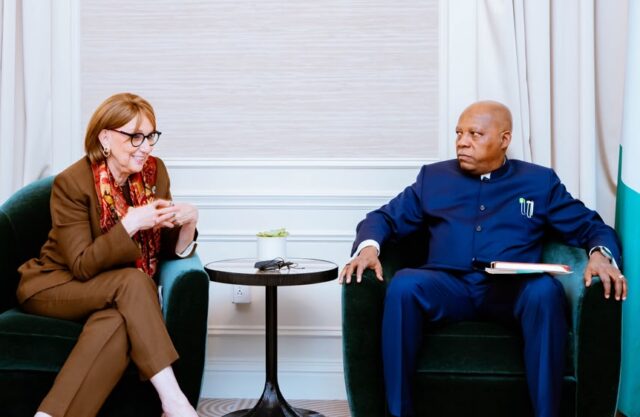
Nigeria’s position in the contest for the next United Nations Secretary-General will be guided by equity, justice and fairness, Vice President Kashim Shettima has told Costa Rican candidate Rebeca Grynspan, while stressing that Africa’s demand for a stronger voice in global decision-making must also be taken into account.
Shettima made the position known during a meeting with Grynspan in New York shortly before returning to Nigeria after leading the country’s delegation to the 81st United Nations General Assembly.
The Vice President said Nigeria would favour a candidate committed to multilateralism and greater African representation in international decision-making institutions. He said Nigeria’s longstanding relationship with Latin America, conflict prevention and gender inclusion would also be among the considerations surrounding its position.
“Thank you for seeking Nigeria’s perspective for your candidature of the United Nations Secretary-General. Nigeria and Costa Rica share a common historical background connecting both countries and their regions,” Shettima said.
“We also have a cordial relationship with Latin America, and we do not wish to jeopardise it. Beyond our historical ties and relations rest our interest in conflict prevention, multilateralism, and the peace of our nations,” he added.
Africa’s place in global governance
Shettima used the engagement to restate Nigeria’s position that the international system needs to reflect the political, economic and demographic realities of the 21st century.
He pointed to the changes that have taken place since the establishment of the post-World War II global governance system in 1945, arguing that Africa’s growing population and role in international affairs have not been adequately reflected in the structure of global decision-making.
Nigeria had already used the 81st UN General Assembly to renew its call for permanent African representation on the UN Security Council. In the national statement delivered on President Bola Tinubu’s behalf, Shettima reiterated Nigeria’s demand for reform of the Council and greater African representation.
The Vice President therefore linked Nigeria’s consideration of candidates for the UN’s top diplomatic position to the broader question of reforming multilateral institutions.
Grynspan, who is seeking the UN Secretary-General position, told Shettima that her candidacy was rooted in the need to reform the organisation and make it more responsive to the concerns of developing countries, particularly those in the Global South.
“Coming from the Global South, I represent the interest and demands of the region. I also have a soft spot for Africa. I know the continent and its aspirations,” she said.
The Costa Rican diplomat said she wanted to lead an agenda that placed peace at the centre of the United Nations’ work and promised to give attention to Africa’s longstanding demand for permanent representation on the Security Council.
Grynspan is the former Vice-President of Costa Rica and currently serves as Secretary-General of the United Nations Conference on Trade and Development. Her campaign says she is seeking a UN renewal agenda focused on making the organisation more useful, agile and accountable.
Contest comes as UN faces pressure for reform
The discussions over the next Secretary-General are taking place as the UN confronts renewed questions about the effectiveness of the multilateral system.
The current Secretary-General, António Guterres, is approaching the end of his tenure. In his final address to the 2026 General Assembly, Guterres called for stronger global governance on artificial intelligence, an end to conflicts and reforms to international institutions.
The wider 81st General Assembly has also been dominated by calls for changes to global governance arrangements, including the composition of the Security Council.
For Nigeria, the issue has a particular significance because Abuja has consistently advocated permanent African representation on the Council. The Tinubu administration has identified reform of international institutions and stronger African representation as priorities for its multilateral diplomacy.
Nigeria, Netherlands deepen financial inclusion cooperation
Separately, Shettima used his final engagements in New York to discuss Nigeria’s financial inclusion agenda with Queen Máxima of the Netherlands, who serves as the UN Secretary-General’s Special Advocate for Financial Health.
Nigeria and the Netherlands agreed to deepen cooperation in financial inclusion, with the Dutch side offering expertise and experience in financial health to support programmes aimed at expanding access to financial services, particularly for women and vulnerable Nigerians.
Shettima welcomed the proposed cooperation, describing financial health as an important component of Nigeria’s broader development strategy.
He linked financial inclusion to education, security and poverty reduction, while pointing to existing government interventions including conditional cash transfers and agricultural programmes.
The Vice President also highlighted the contribution of financial technology companies, saying government policies had created an environment in which some of Africa’s leading fintech firms could play a significant role in bringing excluded Nigerians into the formal financial system.
Shettima defends Tinubu’s economic reforms
The meeting also provided an opportunity for Shettima to defend the economic reforms introduced by the Tinubu administration since taking office in 2023.
The Vice President said the reforms were necessary in view of the economic conditions inherited by the administration.
His comments came amid the government’s broader push to expand the fiscal space, improve financial access and strengthen the resilience of households and businesses.
Queen Máxima acknowledged the economic growth recorded by Nigeria under the current administration and recognised efforts to expand financial inclusion, according to a statement issued by the Vice President’s office.
She pledged Netherlands’ support for Nigeria’s financial-health initiatives through the sharing of expertise in areas including insurance, credit guarantees and data generation.
The Queen said the objective of financial health initiatives is to strengthen the resilience of citizens, protect their investments and expand access to insurance.
She also urged businesses to regard the financial health of their customers as an important factor in their own long-term sustainability.