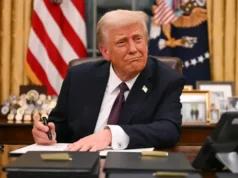
President Donald Trump’s administration has formally requested $87.6 billion in emergency supplemental funding from Congress, seeking billions of dollars for military operations linked to the conflict with Iran, assistance for American farmers, Ebola response efforts in Africa and key infrastructure projects across the United States.
The funding request, submitted by White House Budget Director Russell Vought in a letter to House Speaker Mike Johnson, arrives amid growing political debate over the administration’s military engagement with Iran and follows a symbolic congressional resolution urging President Trump to end hostilities unless lawmakers explicitly authorize further military action.
Vought urged lawmakers to swiftly approve what he described as “important and urgent requests,” with the bulk of the proposed package dedicated to defense-related expenditures stemming from the conflict that erupted after U.S. and Israeli strikes on Iran in late February.
According to the proposal, approximately $67 billion would be allocated to the Pentagon. The request includes $21 billion for munitions and military capabilities, $17.3 billion for operational expenses and $12.1 billion earmarked for classified defense programs. The administration is also seeking nearly $768 million for the Department of Energy to support nuclear and energy security initiatives related to Iran, alongside $300 million for embassy security and construction projects in countries surrounding Iran.
The emergency funding package is significantly lower than the figure previously suggested by Defense Secretary Pete Hegseth, who indicated in March that the Pentagon could require as much as $200 billion to sustain the war effort.
Despite the reduced request, the proposal is expected to face substantial resistance on Capitol Hill. Many Democrats remain opposed to the conflict and have questioned both its legality and strategic objectives, while some Republicans have expressed concerns about the mounting financial burden and the administration’s long-term plans.
Senate Minority Leader Chuck Schumer sharply criticized the request, accusing the president of seeking additional funds after leading the nation into what he described as a “reckless war.”
Similarly, Senator Patty Murray, the ranking Democrat on the Senate Appropriations Committee, argued that the administration initiated the conflict without congressional approval or broad public backing and is now asking taxpayers “to pick up the tab.”
Beyond defense spending, the supplemental package includes more than $11 billion in aid for American farmers impacted by trade disruptions and broader economic fallout, some of which has been linked to the administration’s tariff policies.
The proposal also earmarks $1.4 billion for efforts to combat Ebola outbreaks in the Democratic Republic of Congo, Uganda and other affected regions. Health officials have warned that the spread of the disease remains a significant global concern requiring continued international support and intervention.
Infrastructure projects also feature prominently in the request. The administration is seeking $1 billion for the renovation of New York City’s Penn Station and an additional $500 million for restoration and construction initiatives in Washington, D.C.
The latest request comes despite Republicans having already approved $150 billion in additional Pentagon funding through President Trump’s tax and spending legislation passed last year without Democratic support.
The political battle over the supplemental funding package is expected to intensify in the coming weeks. In the Senate, major spending legislation typically requires 60 votes to advance, meaning the administration may need support from Democrats unless Republicans pursue an alternative legislative pathway.
The debate also carries significant political implications ahead of the November midterm elections, with some vulnerable Republican lawmakers facing pressure over potential votes to finance a conflict that has become increasingly controversial among sections of the American public.
As negotiations continue between Washington and Tehran over a potential long-term settlement, the administration maintains that the requested funds are necessary to support national security objectives, stabilize affected sectors of the economy and address pressing domestic and international challenges.