At least 57 migrants have died after an unprecedented surge saw about 60,000 people cross from Morocco into Spain’s North African enclave of Ceuta within just 24 hours, overwhelming local authorities and triggering a major humanitarian and security crisis.
The extraordinary influx, described by local officials as unsustainable, prompted Spain to deploy the military and additional police units to Ceuta as thousands of migrants swam across the sea, breached border barriers and flooded the tiny Spanish territory, whose population stands at about 84,000.
Ceuta President Juan Jesús Vivas said the scale of the crossings was unlike anything the enclave had experienced before.
“The situation that Ceuta is going through is absolutely unsustainable,” Vivas told reporters.
Spanish authorities, however, put the number of arrivals slightly lower, estimating that about 50,000 migrants crossed into Ceuta from Morocco between Thursday and Friday. The Interior Ministry said around 37,500 had already returned voluntarily to Morocco by Friday afternoon, with hundreds more leaving every hour as conditions inside the enclave deteriorated.
The crisis turned deadly as migrants attempted the dangerous journey by sea or rushed through border crossings. Many reportedly swam nearly five kilometres from the Moroccan towns of Fnideq and Belyounech to reach Spanish territory.
Authorities said some victims drowned during the crossing, while others died in a stampede near the Tarajal Beach border barrier as crowds struggled to enter Ceuta. The shoreline was later strewn with discarded shoes, clothing, flotation devices and other belongings abandoned during the chaotic crossing.
The Spanish government immediately reinforced security by deploying armed forces and additional police personnel to restore order, while Moroccan security forces clashed with migrants on the opposite side of the border, using water cannons, tear gas and warning shots in attempts to stop further crossings, according to rights groups.
Spanish Prime Minister Pedro Sánchez travelled to Ceuta on Friday, describing the mass crossing as a serious violation of Spain’s sovereignty.
“The border breach is a violation of Spain’s territorial integrity,” Sánchez said.
The Spanish leader blamed organised human trafficking networks for exploiting vulnerable migrants by spreading misleading information following a recent ruling by Spain’s Supreme Court.
According to Sánchez, smugglers falsely claimed that migrants arriving by sea could no longer be immediately deported after the court ruled that those reaching Spain by sea should not be summarily returned, unlike migrants intercepted while crossing land borders or scaling border fences.
“The interpretation of the Supreme Court’s ruling spread like wildfire over the past few hours through the networks of human trafficking organizations,” Sánchez said, adding that smugglers “deceive so many young people and ultimately lead many of them to their deaths.”
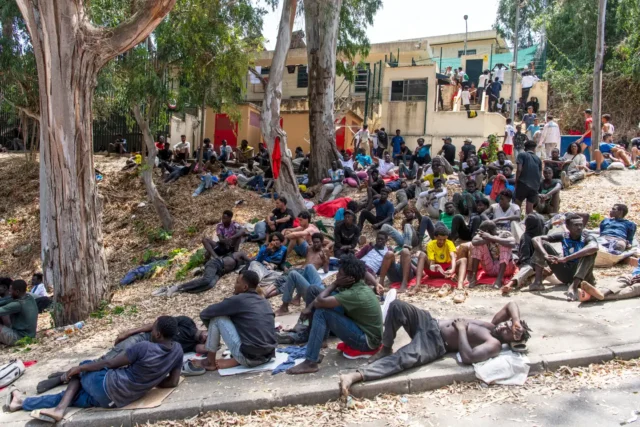
The humanitarian situation inside Ceuta deteriorated rapidly as thousands of migrants, including many unaccompanied minors, were left sleeping in parks, streets and public spaces.
Rachid Sbihi, who heads a workers’ association representing Spain’s Civil Guard officers, described the conditions as dire.
“It’s chaotic,” Sbihi said, calling the situation “a serious humanitarian crisis.”
Many migrants interviewed after reaching Ceuta said they had fled worsening economic hardship in Morocco in search of employment opportunities in Spain but quickly decided to return after finding no support or accommodation.
“There’s nothing at home. I’d have to work 12-hour shifts for a meager wage. That’s why I came here,” 21-year-old Abdulah Buji from Tetouan told the Associated Press.
“But I haven’t found any opportunities here either, so I have to go back,” he added.
Morocco’s Ambassador to Spain, Karima Benyaich, insisted the crisis did not reflect her country’s migration policy.
“We have always prioritized legal, orderly and safe migration for all,” Benyaich said, although she declined to explain what triggered the unprecedented movement of people.
The crisis has also drawn strong reactions from European leaders.
European Commission President Ursula von der Leyen described the scenes from Ceuta as unacceptable, stressing the need to protect the European Union’s external borders.
“We cannot allow anyone to come to our Union without abiding by our rules,” von der Leyen said.
“Dangerous crossings must stop immediately. Smuggling networks must be dismantled. And returns must be swift, as our rules allow.”
The mass crossings have also spread to Melilla, Spain’s second autonomous enclave in North Africa, where migrants clashed with Moroccan police while attempting to breach the border. Local reports indicated that protesters threw stones, set police vehicles ablaze and injured several security personnel, while dozens of migrants were arrested.
The crisis has begun affecting neighbouring European countries. Italy temporarily reinstated border controls on travellers arriving from Spain under the Schengen Agreement, while France announced it would strengthen border checks along its frontier with Spain to monitor potential secondary migration.
The United States also expressed support for Spain. In a statement posted on X, the U.S. State Department backed “the people of Spain, and all Europeans, against this egregious violation of their sovereignty and human rights.”
The department further argued that “this unacceptable incident is the direct result of the Spanish Government’s deliberate efforts to enable and facilitate mass illegal migration into Europe.”
Sánchez rejected attempts to link the crisis to his government’s migration reforms, including a programme introduced earlier this year granting residency and work permits to hundreds of thousands of undocumented migrants already living in Spain.
“This crisis in Ceuta has nothing to do with the regularization of migrants adopted by the Government of Spain, as is being falsely claimed by some,” the Spanish government said in a statement.
AP