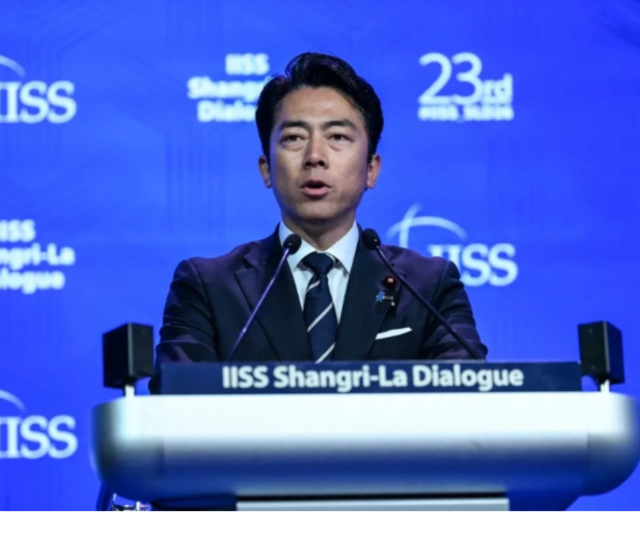
Japanese Defence Minister Shinjiro Koizumi has firmly rejected accusations that Japan is embracing a new era of militarism, instead pointing to China’s rapidly expanding military capabilities as a growing source of concern for the Asia-Pacific region and the wider international community.
Speaking on Sunday at the Shangri-La Dialogue security summit in Singapore, Koizumi defended Japan’s post-war security record while criticising Beijing’s increasing defence spending and what he described as a lack of transparency surrounding China’s military development.
“China continues to increase its defence spending at a high level,” Koizumi said during his address. He added that “China’s external approach and military activities are matters of serious concern for Japan and the international community at the same time.”
Responding directly to criticism from Chinese officials who have accused Tokyo of pursuing “neo-militarism,” Koizumi challenged what he described as a double standard in the international discourse surrounding regional security.
“Think about it. There’s a country that has a huge arsenal of nuclear weapons and strategic bombers. Japan has neither of such weapons, and yet Japan is labelled ‘new militarism’?” he said.
The exchange marks the latest escalation in increasingly strained relations between Asia’s two largest economies. Tensions have deepened in recent months amid growing disputes over regional security, Taiwan, and military modernisation.
Koizumi argued that Japan’s conduct since the end of World War II demonstrates its commitment to peace and international cooperation. He cited Tokyo’s adherence to international law, support for the United Nations Charter and efforts to uphold what he described as a “free and open international order.”
The remarks came weeks after China’s Ministry of Foreign Affairs urged Asia-Pacific countries to remain vigilant against what it called Japan’s “neo-militarism.” In May, Beijing called on regional nations to “jointly resist the reckless actions of Japan’s neo-militarism,” reflecting growing concern within the Chinese leadership over Tokyo’s evolving defence posture.
China’s delegation at the Singapore forum also used the platform to challenge Japan’s security policies. Major General Meng Xiangqing questioned whether Japan had fully reckoned with its wartime history and suggested this continued to affect perceptions across Asia.
“I deeply doubt whether a country that has not thoroughly eradicated the toxic legacy of militarism is qualified to talk extensively about defence cooperation on international occasions and whether it can win the trust of the international community, especially the Asian countries it once invaded,” Meng said.
Relations between Tokyo and Beijing have deteriorated sharply since November, when Japanese Prime Minister Sanae Takaichi warned that a hypothetical Chinese military attack on Taiwan could potentially trigger a Japanese military response. The comments fuelled tensions between the two countries and intensified debate over regional security arrangements.
Despite his criticism of China’s military activities, Koizumi insisted that Japan remains committed to engagement and dialogue. He expressed disappointment that Beijing did not send its defence minister to this year’s Shangri-La Dialogue but stressed that Tokyo remains open to communication.
“We keep the door open,” Koizumi said, reaffirming Japan’s commitment to dialogue with China and other regional actors as part of efforts to preserve peace and stability in the region.