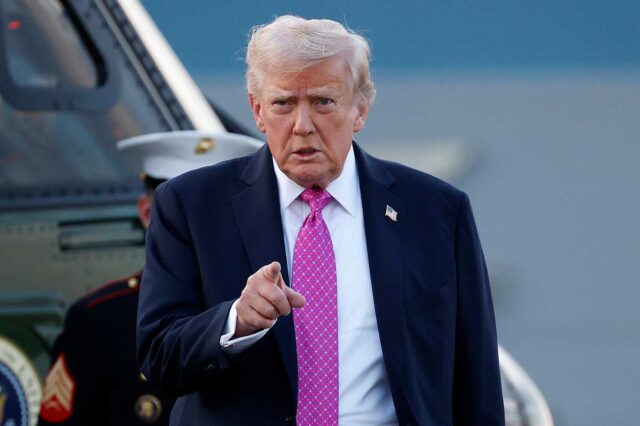
U.S. President Donald Trump has issued one of his strongest warnings yet to Iran, declaring that the American military has been prepared to unleash an overwhelming response if Tehran carries out alleged threats to assassinate him.
In a post on his Truth Social platform on Saturday, Trump claimed Iran had continued to threaten his life and asserted that standing military directives were already in place to ensure devastating retaliation in the event of an attack.
According to the President, “1,000 missiles are Locked and Loaded and aimed at the Islamic Republic of Iran, with thousands more to immediately follow, should the Iranian Government act on its threat.”
The remarks came amid heightened tensions between Washington and Tehran following the recent conflict that began with coordinated U.S. and Israeli strikes on Iran in late February. The operation resulted in the death of Iran’s Supreme Leader, Ayatollah Ali Khamenei, whose funeral ceremonies this week drew large crowds across the country.
Iran’s new Supreme Leader, Mojtaba Khamenei, used the occasion to reiterate Tehran’s vow to avenge his father’s death, insisting that retaliation remained a national obligation.
“We pledge to take revenge for the pure blood of you and all the martyrs of these two wars from the criminal and disgraceful killers,” Khamenei said in remarks broadcast on Iranian state television.
“This revenge is the will of our nation and must certainly be carried out,” he added.
While Trump’s statement suggested the existence of pre-authorised military retaliation, constitutional and national security experts noted that the United States has no legal or operational mechanism allowing military strikes to be launched automatically upon the death of a sitting president.
Under the U.S. Constitution, presidential authority would immediately pass to Vice President JD Vance under the provisions of the 25th Amendment and the Presidential Succession Act of 1947. As commander-in-chief, Vance would have full authority to determine whether and how to respond militarily, including whether to follow any directives previously issued by Trump.
Garrett M. Graff, author of Raven Rock: The Story of the U.S. Government’s Secret Plan to Save Itself — While the Rest of Us Die, said the United States has never adopted an automatic retaliatory system of that nature.
“The U.S. has, for a whole variety of reasons, never utilized a technical ‘dead man’s switch,'” Graff said.
Although the United States maintains extensive continuity-of-government plans designed to preserve federal authority during catastrophic events such as nuclear attacks, those contingency arrangements do not provide for automatic military retaliation following the death of a president.
The White House did not immediately respond to requests for clarification on whether Trump had formally issued standing military directives or how such instructions would be handled if he were assassinated.
The latest exchange follows reports of renewed Iranian threats against Trump. During funeral processions for the late Ayatollah Khamenei, mourners were seen carrying banners and posters calling for the deaths of both Trump and Israeli Prime Minister Benjamin Netanyahu.
The Wall Street Journal also reported this week that Israeli officials had alerted the United States to fresh Iranian plots targeting the American president. Although the White House declined to comment on the report, Trump appeared to allude to the intelligence during this week’s NATO summit in Turkey.
“They want to take out the U.S. leader — me,” Trump told reporters.
Former Pentagon Deputy Press Secretary Sabrina Singh said intelligence agencies have long regarded Iranian threats against senior U.S. officials as credible.
“Iran wanting to target senior American leaders is something that we know is happening,” Singh said.
She added: “You have to take these as credible threats.”
The renewed war of words underscores the deepening hostility between Washington and Tehran following months of military confrontation and political escalation. With both sides exchanging increasingly uncompromising rhetoric, international observers continue to monitor the situation amid concerns that any direct attack or miscalculation could trigger a broader regional conflict.
AP