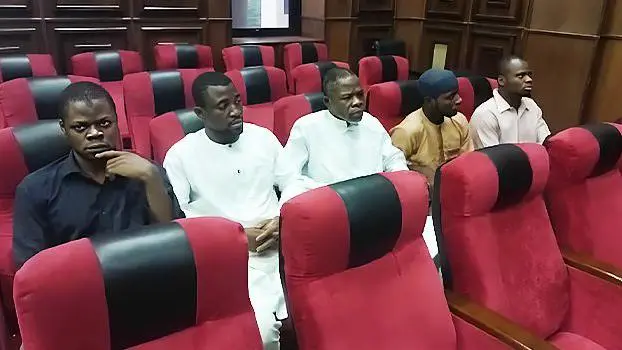
Four men convicted for their roles in the deadly attack on Saint Francis Catholic Church in Owo, Ondo State, have been sentenced to death by hanging by the Federal High Court in Abuja, bringing a major legal chapter in one of Nigeria’s deadliest terrorist attacks to a close.
Delivering judgment on the case, Justice Emeka Nwite found four of the five defendants guilty on all nine counts contained in the terrorism charges filed against them by the Department of State Services (DSS). The court convicted Idris Abdulmalik Omeiza, 25; Al Qasim Idris, 20; Jamiu Abdulmalik, 26; and Abdulhaleem Idris, 25, for offences linked to the June 5, 2022 massacre that claimed the lives of more than 40 worshippers during a Sunday Mass.
The fifth defendant, Momoh Otuho Abubakar, 47, was discharged and acquitted after the court ruled that the prosecution failed to establish his involvement in the attack beyond reasonable doubt.
Justice Nwite held that the DSS successfully proved its case against the four convicts, finding them guilty of terrorism-related offences under the Terrorism (Prevention and Prohibition) Act. The charges included membership of a proscribed terrorist organisation identified as Al-Shabab, described during the trial as an affiliate of the Islamic State West Africa Province (ISWAP), conspiracy to commit acts of terrorism, hostage-taking, kidnapping, and participation in the killings that occurred during the church attack.
The judge ruled that the prosecution had established the guilt of the four defendants beyond reasonable doubt, while noting that the evidence presented against the fifth defendant did not meet the legal threshold required for conviction.
The prosecution linked the convicted men to the attack through multiple strands of evidence, including witness identifications, mobile phone tracking records, cell tower data and confessional statements. Investigators alleged that the suspects were members of a terrorist network operating primarily in Okene, Kogi State.
The defendants were arraigned in August 2025 and pleaded not guilty to all charges. Over the course of the trial, the DSS presented 11 witnesses and tendered 23 documents as exhibits before the court.
Among those who testified were survivors of the church attack, including one witness who appeared in court from a wheelchair after reportedly losing both legs and an eye during the assault. Other witnesses included a Catholic priest who was conducting Mass when the attack occurred, church members, operatives of the Western Nigeria Security Network, popularly known as Amotekun, and DSS investigators with expertise in digital forensics.
Several witnesses testified under protective measures and were identified using coded identities due to security concerns surrounding the case.
Lead prosecution counsel, Ayodeji Adedipe, had urged the court to impose the maximum punishment available under the law, arguing that the scale and brutality of the attack warranted the severest penalty.
During the defence stage, most of the accused persons testified on their own behalf and challenged the admissibility of their confessional statements. The court subsequently conducted a trial-within-a-trial after the defence alleged that the statements were obtained under duress.
The defendants claimed they were stripped, beaten and subjected to torture, including electric shocks to sensitive parts of their bodies, to compel them to confess to involvement in the attack. They further alleged that security operatives threatened them with death if they failed to cooperate.
Some of the accused also told the court that they were promised rewards if they implicated the fifth defendant, Momoh Otuho Abubakar, as the operational leader behind the Owo church massacre.
Despite the allegations, the court admitted the confessional statements and ultimately found sufficient evidence to convict four of the defendants while clearing the fifth accused.
The Owo church attack remains one of the most horrific acts of terrorism in Nigeria’s recent history. The assault shocked the nation and drew widespread condemnation from religious leaders, civil society groups and the international community. Although no organisation formally claimed responsibility at the time, security agencies had long suspected the involvement of extremist groups linked to the Islamic State network operating within the region.
With the judgment, authorities say justice has been delivered for many of the victims and families affected by the massacre, though the scars left by the attack continue to resonate nearly four years after the tragedy unfolded.