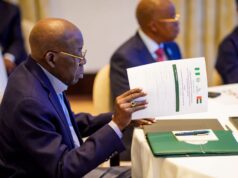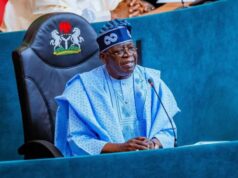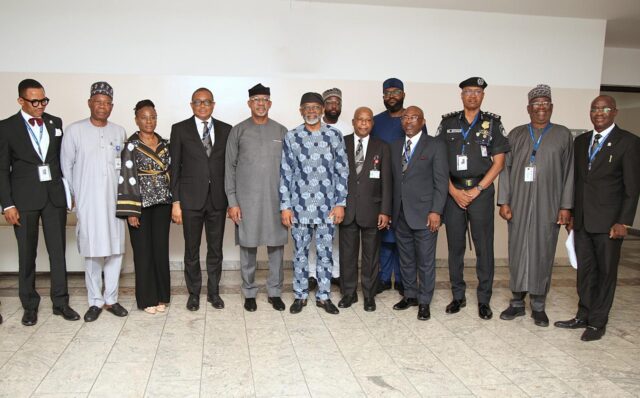
President Bola Ahmed Tinubu has inaugurated the Presidential Working Group on the National Policing Bill, marking another major step towards the establishment of state police in Nigeria following the National Assembly’s passage of the Constitution Alteration (State Police) Bill, 2026.
The inauguration, held on Tuesday at the Presidential Villa in Abuja, was performed on the President’s behalf by his Chief of Staff, Femi Gbajabiamila. The committee has been tasked with drafting the legal framework that will operationalise state police across the federation once the constitutional amendment receives final approval.
The development comes a day after President Tinubu transmitted the Constitution Alteration Bill to the National Assembly, proposing a dual policing structure that will allow the Federal Police Service and 36 State Police Services to operate side by side as part of a broader effort to reform Nigeria’s security architecture.
Speaking at the inauguration, Tinubu explained that while the constitutional amendment establishes the legal basis for state police, a separate National Policing Bill is required to make the new policing structure operational.
“The Constitution Amendment Bill establishes the framework for dual policing, but it does not operationalise it. That work is left to the National Policing Bill,” the President said.
He disclosed that the proposed legislation would establish the standards and safeguards needed to ensure effective implementation of state policing across the country.
“The proposed National Policing Bill will include provisions on minimum policing standards, state readiness certification, federal-state coordination, accountability, human rights safeguards and fiscal conditions,” Tinubu stated.
The President said the working group had been constituted to prevent delays once the constitutional amendment process is completed.
“The Working Group has been constituted to produce a technically robust, implementation-ready draft National Policing Bill for transmission to the National Assembly,” he said.
Emphasising the urgency of the assignment, Tinubu added: “We must not wait until the constitutional process is concluded before beginning this important assignment.”
The committee is chaired by Gbajabiamila and includes the Attorney-General of the Federation and Minister of Justice, the President of the Nigerian Bar Association (NBA), the Chairman of the Nigeria Governors’ Forum (NGF), the National Security Adviser, the Inspector-General of Police, the Chairman of the NGF Committee on State Police, with a dedicated secretariat providing administrative support.
Speaking on behalf of the Nigeria Governors’ Forum, Ogun State Governor Dapo Abiodun pledged the full support of state governors for the proposed reform, saying governors would work with their respective Houses of Assembly to ensure speedy ratification of the constitutional amendment.
He described state police as a response to years of public demand for decentralised and community-based policing.
“This bill has answered the cries of Nigerians about cascading policing and removing it from the Exclusive Legislative List,” Abiodun said.
The governor also pointed to the success of regional security initiatives such as Amotekun in the South-West as evidence that community policing can strengthen national security.
According to him, the introduction of state police would significantly boost the country’s security manpower.
“If each state deploys about 6,000 personnel, we will add nearly 200,000 officers to complement the existing federal police,” he said.
Abiodun further praised the President for initiating implementation plans before the constitutional amendment process is concluded.
“This inauguration demonstrates the proactiveness of the Executive in preparing for effective implementation,” he added.
Attorney-General of the Federation and Minister of Justice, Lateef Fagbemi (SAN), described the initiative as timely given the country’s prevailing security challenges.
“There is no denying the fact that we are in a critical moment security-wise, and all hands must be on deck,” Fagbemi said.
He appealed to state governors to ensure the constitutional amendment is promptly ratified by their respective state legislatures.
“I appeal to the governors to do their utmost to ensure the early passage of the constitutional amendment because this is a shared responsibility,” he said.
Also speaking, Nigerian Bar Association President Afam Osigwe reaffirmed the legal body’s support for the establishment of state police, arguing that Nigeria’s growing security challenges require a more decentralised policing system.
“Nigeria can hardly be effectively policed by one national police. We fully support the constitutional amendment providing for state police,” Osigwe said.
He, however, cautioned that the enabling law must contain adequate safeguards against abuse of power.
“We must ensure we do not create a monster. The right legal framework must guarantee accountability and prevent oppression,” he stated.
Osigwe also pledged the NBA’s support for the committee in drafting legislation that strengthens security while protecting citizens’ constitutional rights.
The inauguration was attended by Attorneys-General and Commissioners for Justice from Plateau, Lagos and Ondo states, representatives of the Inspector-General of Police and the National Security Adviser, as well as other senior government officials, underscoring the broad institutional backing for what could become one of Nigeria’s most far-reaching security reforms since the return to democratic rule.