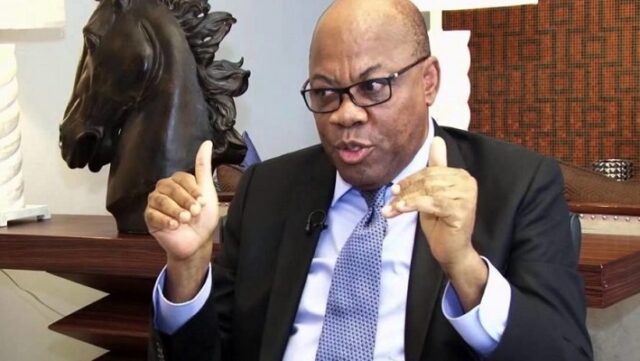
A growing standoff between the Dangote Petroleum Refinery and the Nigerian Midstream and Downstream Petroleum Regulatory Authority (NMDPRA) has sparked a broader national debate about Nigeria’s oil governance framework, with former Nigerian Bar Association president Dr. Olisa Agbakoba (SAN) warning that the dispute goes far beyond a commercial disagreement.
In a strongly worded statement, Agbakoba said the impasse strikes “at the heart of a fundamental development question: the sovereignty of Nigeria’s governance process over its hydrocarbon resources.” He argued that the difficulties facing the $20 billion Dangote Refinery—despite its status as one of the largest single-train refineries in the world—highlight deep structural problems in how Nigeria manages its oil and gas sector.
“The paradox is striking,” Agbakoba said. “Nigeria now has a $20 billion refinery—one of the world’s largest—yet we continue importing petroleum products.” According to him, the continued importation of fuel despite massive domestic refining capacity reflects a system that frustrates local value addition while sustaining dependence on foreign supply chains.
The former NBA president accused regulatory actions of undermining transformative private investment, noting that a private investor has built infrastructure the country has long lacked but is now facing obstacles from institutions meant to enable such progress. “When government policy actively frustrates transformative local investment, we must question whether our economic strategy serves national interest or perpetuates dependency,” he said.
At the core of Agbakoba’s argument is what he described as Nigeria’s continued reliance on a “Contract Oil” model, where crude oil is extracted and exported with little domestic value addition. Under this system, he said, jobs, industrial capacity and wealth creation are effectively outsourced. “We export raw crude only to import refined products at premium prices, perpetuating dependency rather than fostering development,” he stated.
Agbakoba contrasted Nigeria’s approach with that of Saudi Arabia, which he described as practising “Development Oil” by using petroleum resources as a catalyst for national transformation. He pointed out that Saudi Arabia has built extensive downstream capacity, a large maritime fleet and firm control of its petroleum value chain, while Nigeria—Africa’s largest oil producer—operates without comparable infrastructure.
Citing Section 44(3) of the Nigerian Constitution, Agbakoba stressed that oil and gas resources are vested in the federal government to be managed for the welfare and security of Nigerians. “When regulatory actions frustrate investments that create local capacity, generate employment, and reduce import dependency, they violate constitutional obligation,” he said. He described the situation in which a domestic refinery struggles to secure crude supply while fuel import licences continue to be issued as a “fundamental failure” of that responsibility.
The dispute comes amid ongoing public exchanges between the Dangote Group and the NMDPRA over crude supply arrangements, import permits and regulatory compliance. While the regulator has repeatedly said its actions are guided by law and market stability considerations, industry analysts say the disagreement has exposed long-standing tensions between policy objectives and implementation in Nigeria’s downstream sector.
Agbakoba warned that the stakes are national rather than corporate. “This is not merely about one refinery or one company—it is about whether Nigeria will continue the failed Contract Oil approach that has produced seven decades of resource curse, or embrace Development Oil principles that align hydrocarbon management with constitutional obligations and national development imperatives,” he said.