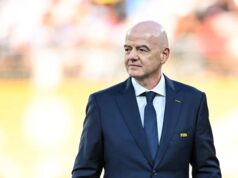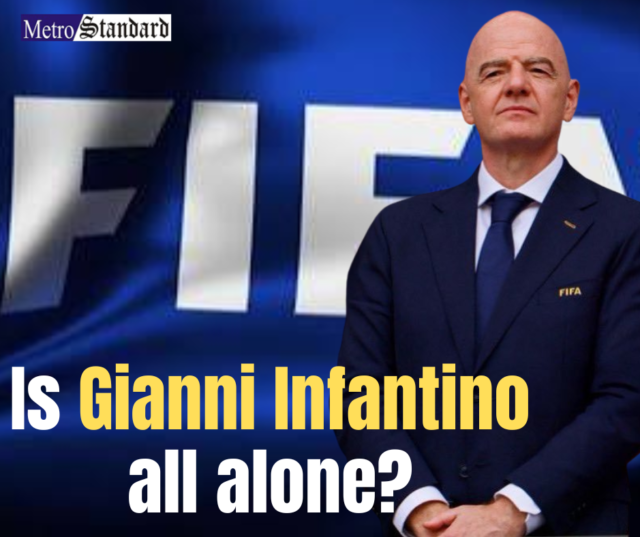
FIFA President Gianni Infantino has abandoned his controversial proposal to sell a stake in the commercial rights of the FIFA World Cup and other global competitions to private investors after facing an unprecedented backlash from football governing bodies across Europe, Asia and North America, as well as senior officials within FIFA.
In a dramatic reversal announced on Friday, Infantino said the proposal, which had threatened to plunge world football into crisis, would no longer proceed because it had become too divisive.
“Having listened carefully to all the views, it has become clear that the project has created divisions of a nature that, regardless of the level of support, are no longer in the interest of the objective set out in the first place,” Infantino said in a statement.
“Our purpose has always been — and will always be — to unite and improve. As a result, this proposal will not proceed.”
The decision marks a significant climbdown for the FIFA president, whose plan to establish a $20 billion commercial company to manage the World Cup and other FIFA competitions had sparked fierce opposition just days after it was unveiled.
Under the proposal, FIFA intended to spin off its commercial assets—including the men’s and women’s World Cups and Club World Cups—into a new subsidiary, with private investors acquiring a 20 per cent stake. The proposed “anchor investor” was identified as a New York-based investment firm founded by Joshua Kushner, the younger brother of Jared Kushner, son-in-law of U.S. President Donald Trump.
The proposal quickly united football’s major confederations against FIFA.
On Thursday, UEFA’s 55 member associations unanimously rejected the plan and threatened to boycott the FIFA World Cup and all other FIFA competitions if the proposal remained on the table. The Asian Football Confederation (AFC) and the Confederation of North, Central America and Caribbean Association Football (CONCACAF) subsequently joined the opposition, effectively isolating FIFA’s leadership.
In a strongly worded statement, UEFA insisted that football’s biggest tournament was not a commercial asset to be sold.
“Some things are simply too important to sell,” UEFA said.
“The FIFA World Cup belongs to football. It always will. And so long as Europe has a voice, it will never be for sale.”
The mounting resistance was compounded by an internal revolt within FIFA itself.
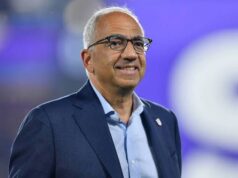
Carlos Cordeiro, a senior adviser to Infantino, former Goldman Sachs banker and FIFA’s representative on the White House Task Force for the World Cup, resigned on Friday in protest, saying he could not support the proposal.
“I cannot stand by while FIFA considers selling a stake in the World Cup,” Cordeiro said in a statement.
His resignation followed a lengthy public statement in which he described the proposal as “a bad deal for FIFA’s Member Associations, a bad deal for football, and a bad deal for the long-term future of the game.”
Cordeiro argued that FIFA already possessed ample financial resources, noting that the governing body had billions of dollars in reserves and no debt, making the sale unnecessary.
Hours before Infantino abandoned the plan, FIFA had attempted to calm growing concerns by insisting that “Nobody is selling football.”
However, pressure intensified further when FIFA Chief Operating Officer Kevin Lamour publicly distanced himself from the proposal.
In comments to The Associated Press, Lamour said many FIFA officials had been kept in the dark about the project and criticised the way it had been developed.
“It is the project of one person,” Lamour said.
“Not only must this project not go ahead … but the time has now come for football political leaders to ask themselves the right questions and make the right decisions.”
The collapse of the proposal came before FIFA’s next scheduled competition, the FIFA Women’s Under-20 World Cup in Poland, beginning on September 5. UEFA had already warned that its member associations would boycott the tournament if FIFA proceeded with the sale.
The abandoned proposal has become one of the most significant political setbacks of Infantino’s presidency.
Since assuming office in 2016, the FIFA president has overseen sweeping commercial reforms and expansion of global competitions, including the enlarged 48-team FIFA World Cup and expanded Club World Cup. However, the attempted sale of a stake in the World Cup generated unusually broad resistance from football confederations, national associations and senior FIFA officials alike.
Although Infantino was re-elected unopposed in 2019 and 2023 and remains eligible to seek one final four-year term under FIFA statutes, the failed initiative has raised fresh questions about his leadership and decision-making.
AP