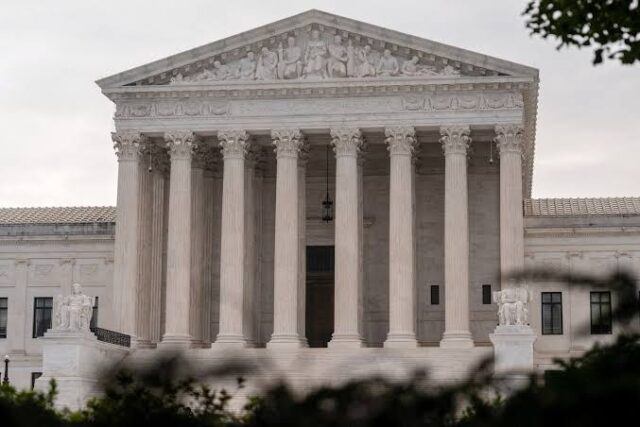
The United States Supreme Court has ruled that children born on American soil to parents who are unlawfully or temporarily present in the country are entitled to automatic U.S. citizenship under the Fourteenth Amendment, dealing a major legal blow to President Donald Trump’s executive order seeking to restrict birthright citizenship.
In a decision issued on June 30, 2026, in the case Trump, President of the United States, et al. v. Barbara et al., the nation’s highest court held that children born in the United States to undocumented or temporary immigrants are “subject to the jurisdiction” of the United States and are therefore citizens at birth under the Citizenship Clause of the Fourteenth Amendment.
The case centered on Executive Order No. 14160, signed by President Trump on January 20, 2025, and titled “Protecting the Meaning and Value of American Citizenship.” The order argued that children born in the United States to parents who were unlawfully or temporarily present in the country were not “subject to the jurisdiction” of the United States and therefore did not qualify for automatic citizenship under either the Constitution or the Immigration and Nationality Act.
Several affected families challenged the executive order in court on behalf of their children, contending that it violated the Fourteenth Amendment. A federal district court agreed with the plaintiffs, provisionally certified a nationwide class of children who would have been denied citizenship under the order, and issued a preliminary injunction blocking its enforcement. The Supreme Court subsequently agreed to hear the case before judgment.
In its ruling, the Supreme Court affirmed the lower court’s position, stating that “Children born in the United States to parents unlawfully or temporarily present are ‘subject to the jurisdiction’ of the United States and are citizens at birth under the Fourteenth Amendment’s Citizenship Clause.”
The Court explained that the Citizenship Clause must be interpreted within its historical and legal context, drawing from English common law and the framers’ intention to repudiate the infamous Dred Scott v. Sandford decision, which denied citizenship to people of African descent before the Civil War.
The landmark judgment effectively blocks the implementation of President Trump’s executive order and reaffirms the long-standing constitutional principle that birth on U.S. soil generally confers citizenship, regardless of a child’s parents’ immigration status.
The decision is expected to have far-reaching implications for U.S. immigration policy and future legal debates over the scope of the Fourteenth Amendment, while preserving birthright citizenship as one of the country’s foundational constitutional guarantees.