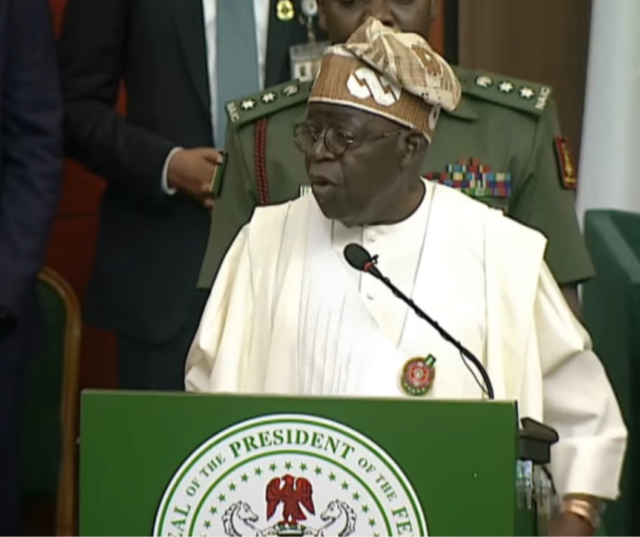
President Bola Ahmed Tinubu on Friday presented a ₦58.18 trillion 2026 Appropriation Bill to a joint session of the National Assembly, outlining ambitious revenue projections, elevated capital spending and a sizeable fiscal deficit as his administration seeks to consolidate recent economic reforms and stabilise public finances.
The proposed budget, themed “Budget of Consolidation, Renewed Resilience and Shared Prosperity,” projects total government revenue of ₦34.33 trillion against total expenditure of ₦58.18 trillion, resulting in a deficit of ₦23.85 trillion, equivalent to 4.28 per cent of Nigeria’s Gross Domestic Product. President Tinubu said the figures reflect a balance between fiscal realism and the need to sustain growth, protect vulnerable citizens and fund critical national priorities.
Of the total spending, ₦26.08 trillion has been earmarked for capital expenditure, a figure that underscores the government’s push to accelerate infrastructure development and productivity, while recurrent non-debt expenditure stands at ₦15.25 trillion. Debt servicing alone is projected to consume ₦15.52 trillion, highlighting the continued pressure Nigeria’s debt obligations place on public finances.
The president anchored the 2026 budget assumptions on a crude oil benchmark price of 64.85 dollars per barrel, daily oil production of 1.84 million barrels, and an average exchange rate of ₦1,400 to the US dollar. He told lawmakers that the projections were deliberately conservative, aimed at strengthening fiscal credibility and reducing exposure to external shocks.
Tinubu noted that the government’s fiscal position has shown signs of improvement in 2025, with revenue performance reaching ₦18.6 trillion as of the third quarter, representing 61 per cent of the annual target, while expenditure stood at ₦24.66 trillion, or 60 per cent of projections. He acknowledged, however, that capital budget implementation remained weak during the transition period, with only ₦3.10 trillion, about 17.7 per cent of the 2025 capital allocation, released by the third quarter as attention shifted to completing rolled-over 2024 projects.
Despite these challenges, the president said macroeconomic indicators were moving in the right direction. Nigeria’s economy grew by 3.98 per cent in the third quarter of 2025, inflation eased to 14.45 per cent in November from over 24 per cent earlier in the year, and external reserves rose to about 47 billion dollars, their highest level in seven years. He said these improvements provided a stronger base for the 2026 fiscal plan.
In sectoral terms, the budget allocates ₦5.41 trillion to defence and security, reflecting continued focus on internal stability, while education is set to receive ₦3.52 trillion and health ₦2.48 trillion. Infrastructure spending is projected at ₦3.56 trillion, as the government seeks to unlock private investment and address long-standing deficits in transport, energy and logistics.
President Tinubu stressed that improved revenue mobilisation would be critical to sustaining the budget, pointing to the implementation of new national tax laws, reforms in the oil and gas sector and stricter oversight of government-owned enterprises. He said all revenue-generating agencies have been directed to meet their targets, supported by end-to-end digitisation to curb leakages and strengthen accountability.
Looking ahead, Tinubu pledged stricter discipline in budget execution in 2026, with clear instructions issued to the finance and budget authorities to ensure spending aligns with appropriations and timelines. He told lawmakers that the true test of the budget would not be in its size or projections, but in its delivery and impact on citizens’ lives.