The International Olympic Committee (IOC) has approved a sweeping new policy on gender eligibility, effectively barring transgender women from competing in female categories at future Olympic Games, in a move that marks one of the most significant shifts in global sports governance.
The decision, finalised after months of review, introduces stricter eligibility criteria aimed at what the IOC describes as protecting “fairness, safety and integrity” in women’s competition. Under the new framework, eligibility for female events will be determined through biological classification, including a one-time genetic screening process.
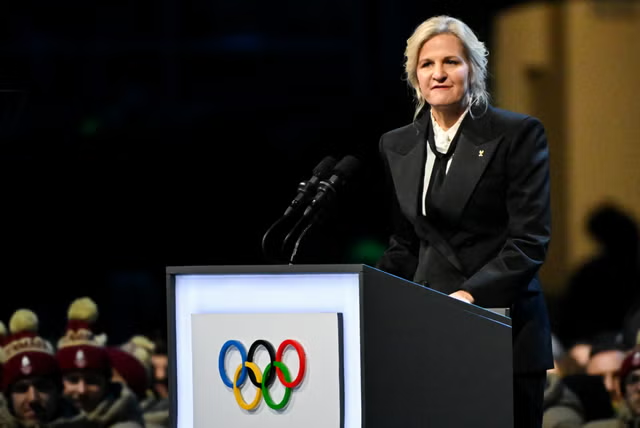
IOC President Kirsty Coventry defended the policy, emphasising the competitive realities of elite sport. “At the Olympic Games, even the smallest margins can be the difference between victory and defeat,” she said, adding that “it would not be fair for biological males to compete in the female category.”
The new rules are expected to take effect ahead of the 2028 Olympic Games in Los Angeles, aligning the IOC more closely with a growing number of international sports federations that have already adopted stricter eligibility standards. The policy will apply across all Olympic sports, replacing the previous system in which individual federations set their own rules, often resulting in inconsistent approaches.
The IOC has framed the move as “evidence-based and expert-informed,” pointing to scientific research suggesting that athletes who have undergone male puberty may retain physical advantages in strength, endurance, and power.
However, the decision is likely to intensify an already polarised global debate. Advocacy groups and human rights organisations have raised concerns about exclusion and discrimination, arguing that transgender athletes should not be denied the opportunity to compete at the highest level. On the other hand, supporters of the policy maintain that it is necessary to preserve competitive balance and fairness in women’s sport.
The IOC has sought to strike a balance by reiterating that access to sport remains a fundamental right at grassroots and recreational levels, even as it tightens eligibility criteria for elite competition.