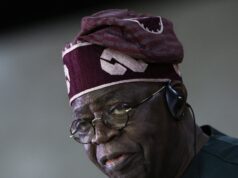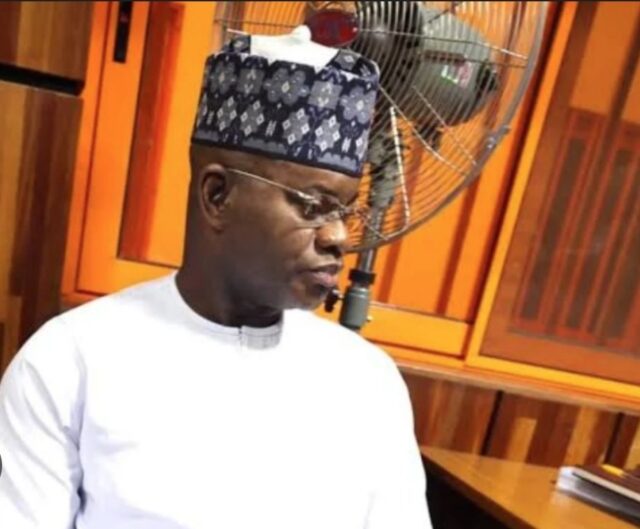
The Federal Capital Territory (FCT) High Court in Maitama, Abuja, has dismissed an application filed by former Kogi State Governor, Yahaya Adoza Bello, challenging the court’s jurisdiction to hear the ₦110.4 billion alleged fraud case instituted against him by the Economic and Financial Crimes Commission (EFCC).
Justice Maryanne Anenih delivered the ruling on Tuesday, June 16, 2026, rejecting Bello’s request to strike out the 16-count charge filed against him and two co-defendants, Umar Shuaibu Oricha and Abdulsalami Hudu. The defendants are facing allegations bordering on criminal breach of trust and money laundering involving ₦110.4 billion.
Bello had urged the court to dismiss the charge marked FCT/CR/778/2024, arguing that the FCT High Court lacked the territorial jurisdiction to entertain the matter. He also contended that the proceedings amounted to an abuse of court process because a related charge was already pending before the Federal High Court in Abuja.
However, prosecution counsel, Kemi Pinheiro, SAN, opposed the application, describing it as a deliberate attempt to delay the trial. He argued that the offences contained in the charge were offences under the Penal Code and therefore fell squarely within the jurisdiction of the FCT High Court.
Pinheiro further told the court that several properties allegedly acquired with proceeds of the offences were located within Abuja, giving the court the territorial jurisdiction required to hear the matter.
Addressing Bello’s claim of abuse of court process, the senior advocate maintained that the case before the FCT High Court was fundamentally different from the one pending before the Federal High Court. According to him, the FCT case centres on allegations of criminal breach of trust and conspiracy under the Penal Code, while the Federal High Court matter relates to alleged violations of the Money Laundering (Prohibition) Act.
He argued that the two cases differ both in substance and legal foundation and therefore could not amount to an abuse of court process. The prosecution also noted that the parties involved in both cases were not identical, as Bello is standing trial alone before the Federal High Court but is facing charges alongside two co-defendants before the FCT High Court.
In her ruling, Justice Anenih agreed with the prosecution’s submissions and held that the court possessed the necessary jurisdiction to entertain the charge. She also ruled that the proceedings did not constitute an abuse of court process and dismissed Bello’s application for lacking merit.
The court similarly dismissed an application filed by the third defendant, describing it as equally unmeritorious.
Following the ruling, the trial proceeded with the EFCC calling its 16th witness, Baba Isah Usman Baffa, who testified about the sale of a commercial property at Sherrif Plaza, Abuja.
Led in evidence by prosecution counsel Chukwudi Enebeli, SAN, Baffa told the court that Ali Bello had approached his company to purchase a shop at the plaza. According to the witness, “he came to our office, made enquiries about the shops and indicated interest in buying one. We gave him the prospective form and the requirements. He met the requirements, we gave him an account number and he made the payment.”
Baffa disclosed that Shop B13 was sold to Ali Bello for ₦66 million. He said an initial payment of ₦40 million was made into the company’s FCMB account, while the balance of ₦26 million was paid later. He added that an allocation letter was subsequently issued and the property formally allocated to the buyer.
Under cross-examination by defence counsel P.B. Daudu, SAN, the witness stated that he could identify Ali Bello if he saw him and confirmed that documents were exchanged during the transaction. He also revealed that he had previously testified concerning the same property before the Federal High Court in Abuja.
When asked whether he knew Yahaya Bello personally, Baffa responded that he knew him only as “a public figure.”
The prosecution later called its 17th witness, estate agent and commodity trader Shenu Bello, who testified about several property transactions allegedly linked to Ali Bello and other members of the Bello family.
The witness told the court that he facilitated the purchase of a property at Plot 1773, Guzape District, Abuja, for ₦48 million and another property at Plot 31, Guzape District, acquired for ₦100 million.
He further testified that a property located at Plot A02/176, Block 488B, Lome Street, Wuse Zone 7, Abuja, was purchased by Dr. Faruk Bello for ₦105 million.
Regarding a property at No. 1 Ikogosi Spring Road, Maitama, Abuja, the witness stated that Faruk Bello acquired it from Efab Estate for ₦550 million.
“It was paid in United States dollars, in cash,” the witness told the court, adding that his commission on the transaction was also settled in cash.
The witness also testified about a property at Plot 1981, Dalla Hills, Maitama, where he said he introduced Ali Bello to Metro Dec Construction Limited, the company handling development on the site. He disclosed that he made several payments on Ali Bello’s behalf to the contractor, including ₦5.5 million, ₦9.8 million, ₦8 million and $6,000.
He further informed the court that Ali Bello acquired a property located at Property No. 1058/1058, Cadastral Zone A08, Wuse II, Abuja, popularly known as Durban Street, for ₦650 million from FSC Food Limited.
“I got him that property at Durban Street, we negotiated the property and it was bought at ₦650 million from FSC Food Limited,” the witness testified.
Following the witness’s examination-in-chief, defence counsel sought an adjournment to prepare for cross-examination. The prosecution opposed the request, arguing that the witness had spent less than 20 minutes in the witness box and had not introduced any new issues.
After hearing both parties, Justice Anenih adjourned proceedings until June 17, 2026, for the continuation of the trial.
The ruling marks another significant development in the high-profile corruption case as the EFCC continues to present evidence and witnesses in its bid to prove allegations of financial misconduct against the former governor and his co-defendants.