Nigeria Boosts Deals, Partnerships at IATF 2025
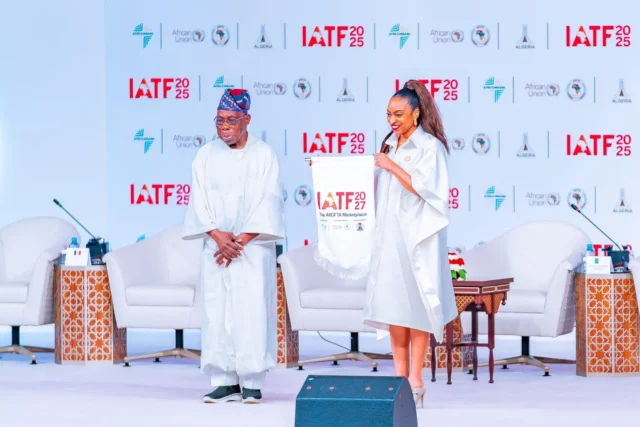
Chairman IATF Advisory Council, former Nigeria President Chief Olusegun Obasanjo (left) and Nigeria Minister of Industry, Trade and Investment, Dr. Jumoke Oduwole, at the IATF 2025 in Algiers, Algeria

The Intra-African Trade Fair (IATF) 2025 in Algeria has reaffirmed its status as Africa’s premier investment gateway, and Nigeria has emerged as one of its top beneficiaries. As business leaders and government representatives from across the continent converged under the fair’s banner of “Gateway to New Opportunities,” Nigerian enterprises secured a strong foothold in forging strategic deals, signing memoranda of understanding, and brokering cross-border partnerships.

At the heart of Nigeria’s presence stood the Dangote Group, which was formally welcomed as an Official Premier Partner of IATF 2025. Dabbling extensively in sectors such as cement, fertilisers, petrochemicals, refined petroleum, sugar, salt, and logistics, Dangote exemplifies Nigeria’s industrial muscle and its capacity to shape continental value chains. Afreximbank, which supported Dangote’s transformative ventures like the Refinery and Fertiliser Complex, hailed the partnership as reinforcing “a self-reliant, prosperous Africa where intra-African trade is the cornerstone of growth.”

On the trade front, Nigerian businesses have an impressive track record. In previous editions of IATF, Nigeria accounted for about $11 billion in signed deals—more than any other participant—and a combined $100 billion in deals has been recorded across three editions of the fair. Across the continent, IATF has generated some $120 billion in trade and investment commitments to date.

IATF 2025’s own forecast remains ambitious: $44 billion in dealflow, drawing over 2,000 exhibitors and 35,000-plus visitors from across 140 countries.

Beyond Dangote, strategic partners such as Arise Integrated Industrial Platforms (Arise IIP)—a joint venture between Africa Finance Corporation, Equitane, and Afreximbank—were also named Premier Partners. Their mission is to build local industrial parks and processing zones to turn raw materials into export-ready products. The move underscores Nigeria’s interest in deepening industrialisation across the continent.

The fair also spotlighted Nigeria’s improving export landscape. The Minister of Industry, Trade, and Investment, Dr. Jumoke Oduwole, revealed that Nigerian exports have surged by over 13 percent year-on-year, thanks to expanding trade corridors and AfCFTA’s implementation. Key exports now reaching across Africa include ceramics, garments, pharmaceuticals, and agro-products.

As for infrastructure, Nigerian delegates left Algiers energized. High-impact projects like the Trans-Saharan Highway, the Nigeria-Algeria gas pipeline, and regional fibre-optic networks were centrepieces of discussion. These corridors promise to slash logistics costs, unlock North African markets, and solidify Nigeria’s position as a hub for continental trade.

In sum, Nigeria’s participation at IATF 2025 illustrates more than presence—it reflects leadership. From securing high-value industrial partnerships with Dangote Group and Arise IIP, to outperforming peers in trade deals, and riding export growth, Nigeria is writing a new chapter in intra-African commerce. The business community would do well to watch these developments—not just as headlines, but as pathways to opportunity.

Jaiz Bank: Leading Nigeria’s non-interest banking revolution

The continued growth and recent strategic developments of Jaiz Bank mark a significant milestone in Nigeria’s financial sector, particularly within the niche of non-interest banking. Established in 2011 as Nigeria’s first non-interest bank, Jaiz Bank has steadily grown to become a dominant player in this space, committed to Islamic banking principles alongside ethical conventional banking products.

The bank’s vision and enduring commitment to its core promise, “Our only interest is you”, embody its customer-centric approach, emphasizing exceptional service, innovation, and trust. These values have underpinned Jaiz Bank’s leadership position in Nigeria’s competitive non-interest banking landscape.

Jaiz Bank strategically positions itself as a market leader in non-interest banking, aiming to deepen its impact on financial inclusion and expand its footprint within Nigeria. The bank has achieved notable business milestones, with a strong financial performance that highlights its growth trajectory. In the first half of 2025, Jaiz Bank reported a profit after tax of ₦14.45 billion, a 90% increase compared to the same period the previous year. Gross income from financing and investments rose by 32% to ₦44.01 billion.

At the end of 2024, the bank’s total assets were approximately ₦1.08 trillion, nearly doubling from ₦580 billion in 2023, supported by a robust shareholders’ equity of ₦71.47 billion. Deposits surged to ₦904.79 billion, almost doubling from ₦466.57 billion in 2023, and gross earnings increased by 75.44% to ₦82.87 billion. Profit before tax rose to ₦24.44 billion, and earnings per share improved to 66.38 kobo, reinforcing Jaiz Bank’s position as a financially sound and rapidly expanding institution.

“Through innovative digital banking, a strong ethical foundation, and a clear customer focus, Jaiz Bank is carving out a sustainable competitive advantage that is poised to capture increasing market share and potentially extend its reach beyond Nigeria in the future.“

A key competitive advantage for Jaiz Bank is its investment in technology and digital innovation. Through platforms like Jaiz Digital and its growing network of agent banking outlets, Jaiz Bank is enhancing accessibility and convenience for a diverse range of customers—including the traditionally underserved—while promoting wider financial inclusion across the country.

Jaiz Bank’s product suite features a range of innovative non-interest financial products such as Murabaha financing, Ijara leasing, and Mudaraba savings accounts, all tailored to meet the evolving needs of retail and corporate customers without compromising Islamic banking principles.

This identity strengthens Jaiz Bank’s position in Nigeria’s crowded banking market, where conventional interest-based banks dominate but demand continues to grow for ethical, Sharia-compliant services. Jaiz Bank’s vision to be Nigeria’s foremost Islamic bank and a leader in ethical finance positions it as a catalyst for financial inclusion and empowerment nationwide.

“Jaiz Bank is carving out a sustainable competitive advantage that is poised to capture increasing market share and potentially extend its reach beyond Nigeria in the future.“

Ultimately, Jaiz Bank’s ongoing efforts are more than operational or branding initiatives—they represent a bold affirmation of its pioneering role in Nigeria’s non-interest banking sector. Through innovative digital banking, a strong ethical foundation, and a clear customer focus, Jaiz Bank is carving out a sustainable competitive advantage that is poised to capture increasing market share and potentially extend its reach beyond Nigeria in the future.

This combination of strong financials, innovative products, and a clear mission underpins Jaiz Bank’s leadership in the evolving Nigerian non-interest banking landscape, making it a model institution within the broader African Islamic finance sector.

Dilapidated schools in Oyo State: A call for urgent government intervention

Education is the bedrock of every society, and the condition of our schools is a reflection of the value we place on the future of our children. It is with deep concern that I draw the attention of the Oyo State Government, stakeholders in the education sector, and the general public to the alarming state of public primary and secondary schools across the state.

A striking example is Ratibi Muslim Primary and Secondary School, located in Oluyoro Oke-Ofa Ibadan. Once a center of learning and community pride, the school faces severe infrastructural decay. The classrooms are dilapidated, roofs are leaking, windows and doors are broken, while students sit in overcrowded, poorly ventilated spaces that are unsafe and inconducive for learning.


Teachers, despite their dedication, are handicapped by the lack of basic teaching materials and a safe learning environment. Pupils and students are forced to endure conditions that not only hinder academic excellence but also expose them to health and safety risks.

This situation is not peculiar to Ratibi Muslim Schools alone but is a widespread challenge across public schools in Oyo State. If urgent steps are not taken, the state risks jeopardizing the future of thousands of children, thereby undermining the human capital development of the state.


I therefore call on His Excellency, Governor Seyi Makinde, and the Oyo State Ministry of Education to:

1. Embark on urgent renovation and rehabilitation of Ratibi Muslim Primary and Secondary School and other public schools in similar condition.

2. Provide modern learning facilities such as furniture, libraries, laboratories, and ICT resources.

3. Strengthen monitoring and maintenance structures to ensure schools remain in good condition.

4. Prioritize the welfare of teachers and students, ensuring they are adequately equipped to fulfill their roles.

Education is a right, not a privilege. Every child in Oyo State deserves access to quality education in a safe, conducive environment. The time to act is now.

Amb. Mallam Ibrahim Agunbiade

Taalib Jami’ei, Islamic Propagation Rabwa Saudi Arabia

agunbiadeib@gmail.com

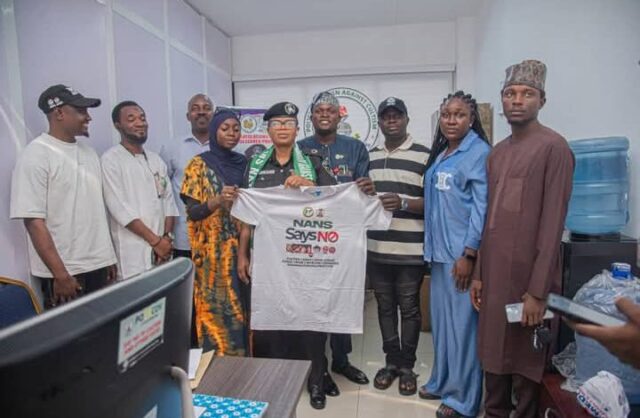
NANS decorates police anti-cultism’s ACP Okuwobi as Anti-Social Vices Ambassador

By ABIRHIRE THOMAS

The National Association of Nigerian Students (NANS), on Tuesday August 20, 2025, paid a courtesy visit to the Police Campaign Against Cultism and Other Vices (POCACOV), Nigeria Police Force Headquarters in Abuja, where strategic discussions were held on strengthening collaboration to tackle youth involvement in crime and social vices.

The delegation, led by Senator Comrade Oladimeji Uthman, Executive Director of Administration and Planning represented the National President, was warmly received by Assistant Commissioner of Police (ACP) Olabisi Okuwobi, who appreciated the proactive role of NANS in youth mobilization for national development.

The student leadership applauded POCACOV’s strides in crime prevention and expressed their readiness to collaborate on projects that will redirect young people from crime, drugs, cultism, and other negative influences.

In recognition of her dedication and commitment, ACP Olabisi Okuwobi was decorated as an Anti-Social Vices Ambassador by the delegation.

Speaking during the visit, ACP Okuwobi highlighted that POCACOV “remains an integral driver of the Inspector-General of Police (IGP)’s Crime Prevention Agenda, which focuses on community partnership and youth engagement to prevent crime before it occurs; education and sensitization as tools to counter cultism, substance abuse, and other violent crimes; gender inclusion and youth empowerment as sustainable pathways to safer communities.”

She emphasized that the synergy between POCACOV and NANS aligns with the IGP’s vision of “policing through prevention, which is policing for the people” thereby ensuring that Nigerian youths become key stakeholders in building a safer and more secure society.

This visit marks a significant step in adancing the national crime prevention framework and fostering a new culture of responsibility and resilience among Nigerian students.

EDITOR PICKS

Recent Posts