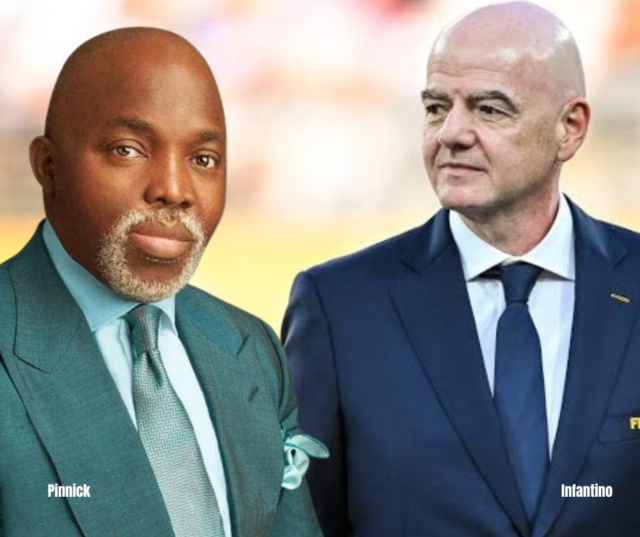
Former President of the Nigeria Football Federation (NFF), Amaju Pinnick, has thrown his support behind FIFA’s proposal to sell a 20 per cent stake in the FIFA World Cup and other international competitions, insisting the initiative should be assessed on its merits rather than dismissed as controversial.
Pinnick, who currently serves as Deputy Chairperson of FIFA’s Men’s National Teams Competitions Committee, defended the proposal during an appearance on Arise Television’s The Morning Show on Thursday, saying FIFA President Gianni Infantino has a proven track record of implementing reforms that have strengthened football administration and increased funding for member associations.
FIFA unveiled the proposal earlier this week as part of plans to allow private investors to acquire minority stakes in the World Cup and other FIFA competitions. The move has sparked criticism from the Union of European Football Associations (UEFA) and other stakeholders, who have raised concerns about the commercialisation of football’s biggest tournaments.
Responding to the criticism, Pinnick urged stakeholders to allow the proposal to go through FIFA’s decision-making process before passing judgment.
“First, I will say that I am not totally equipped to speak on this issue. I have not seen any mail to that effect. One thing I know is that Gianni does not just wake up and give a proposal. He consults extensively,” Pinnick said.
The former CAF Executive Committee member recalled his first meeting with Infantino during the Swiss football administrator’s campaign for the FIFA presidency, revealing that he initially doubted promises to substantially increase financial support for national football associations.
“He told me, ‘Now you receive $200,000. Once I get elected, you will now start receiving $1.25 million.’ I said, ‘That is a big lie.’ But when he got elected, he immediately started paying $1.25 million. For a cycle, each football association was getting about $6 million,” he said.
According to Pinnick, the latest investment proposal reflects the same reform-oriented approach that has characterised Infantino’s tenure at FIFA.
“Gianni is making a proposal. As president of FIFA or the head of an organisation, you have the right to make a proposal. It behoves members to accept it or reject it. We shouldn’t call everything a controversy,” he stated.
Pinnick argued that FIFA’s 211 member associations stand to benefit significantly if the proposal is eventually approved, noting that increased revenue could reduce dependence on government funding for football development.
“The shareholders are the member football associations, Nigeria, Niger, Ghana, South Africa and others. These are the main beneficiaries,” he said.
He added that the proposal could potentially generate up to $20 million for each member association, in addition to existing financial support under FIFA’s Forward Programme.
“If, for example, you have $40 million, trust me, you don’t need government to run football. What people should be concerned about is the integrity of the funds, the integrity of the people involved, the consortium or company, and how the funds are utilised,” Pinnick said.
Addressing fears that private investors could wield undue influence over FIFA’s governance and sporting decisions, Pinnick argued that football has consistently evolved through reforms that initially faced resistance.
“When VAR was introduced, there was a lot of criticism. Today, VAR has come to stay,” he noted.
Pinnick also dismissed suggestions that interactions between political leaders and FIFA officials necessarily amount to interference, commenting on reports that United States President Donald Trump contacted Infantino over a refereeing decision during the recent FIFA World Cup.
“If the President of America calls Gianni, will Gianni not pick up his call? Definitely, he will. But because the President of America called Gianni, it becomes a story. I know what he did; he did according to the books and the statutes,” Pinnick said.