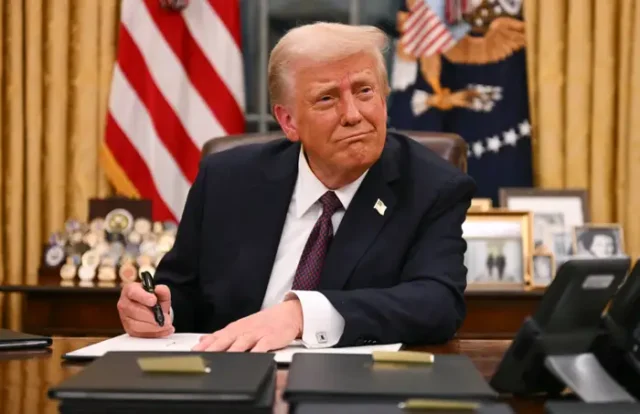
Tensions between the United States and Iran escalated sharply on Monday as President Donald Trump declared that Tehran would “pay the price” for delaying negotiations over its nuclear programme, while Iranian Foreign Minister Abbas Araghchi accused Washington of attempting to manipulate the United Nations nuclear watchdog for political purposes.
In a series of strongly worded remarks posted on Truth Social, Trump claimed Iran’s military capabilities had been severely degraded and suggested the country had missed an opportunity to reach a favorable agreement with Washington.
“They have been completely defeated. Iran is all talk and no action. The Bully of the Middle East is DEAD!!!” Trump wrote.
The U.S. president also reiterated earlier claims about the state of Iran’s armed forces, saying the country’s military was a “complete and total mess” and that its navy and air force “doesn’t even exist anymore.”
“They’ve taken too long to negotiate a deal that would have been great for them, now they will have to pay the price!!!” Trump added, without providing further details.
The comments came as Iran intensified diplomatic efforts ahead of discussions at the International Atomic Energy Agency (IAEA) Board of Governors meeting in Vienna, where a U.S.-drafted resolution targeting Tehran’s nuclear programme is expected to be debated.
In a letter addressed to foreign ministers of countries represented on the IAEA board, Iranian Foreign Minister Abbas Araghchi urged member states not to allow the agency to become what he described as a political tool of Washington.
Araghchi characterized the proposed resolution as “politically motivated” and “made in bad faith,” arguing that the United States bears responsibility for the current standoff over Iran’s nuclear activities.
He warned against allowing the nuclear watchdog to be used as a “US political instrument” and insisted that Washington should not be permitted to exploit the institution to justify what he called “illegal measures” against Iran.
The diplomatic clash unfolded against a backdrop of growing regional tensions following Iranian attacks targeting Kuwait, Bahrain and Jordan, actions that have drawn widespread condemnation from Gulf states and international observers.
Qatar became the latest country to denounce the attacks, describing them as a direct violation of the sovereignty of the affected nations and a threat to regional stability.
In a statement, Qatar’s Foreign Ministry said the attacks represented a “flagrant violation” of the sovereignty of Kuwait, Bahrain and Jordan and constituted a “clear breach of international law.”
The ministry stressed “the need to spare the region the consequences of such unjustified attacks and to work toward de-escalation in order to restore security and stability at both the regional and international levels.”
Qatar also reaffirmed its “full solidarity” with the three countries and expressed support for “all measures they take to preserve their sovereignty and security.”