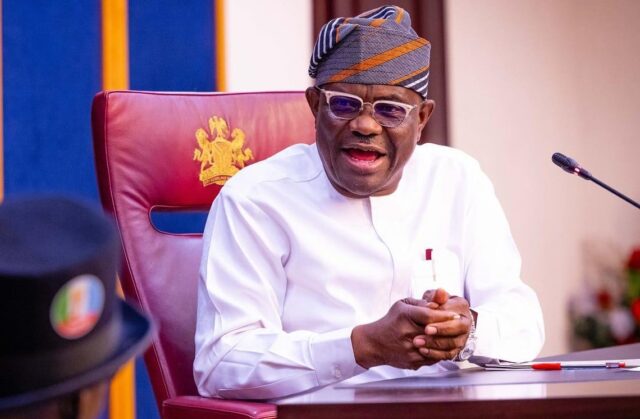
Federal Capital Territory (FCT) Minister, Nyesom Wike, has hailed President Bola Ahmed Tinubu’s leadership, describing it as courageous, visionary and transformative, with ongoing infrastructure projects across Nigeria serving as evidence of a determined effort to bridge the country’s long-standing development deficit.
Wike made the remarks on Saturday while delivering a lecture titled “Leadership and Infrastructure Development in Nigeria: Lessons for Future Leaders” at the 36th Convocation Ceremony of the University of Port Harcourt.
The former Rivers State governor said Nigeria was currently witnessing a rare period of purposeful leadership, driven by a clear commitment to infrastructure development as a catalyst for economic growth, national integration and social progress.
According to him, President Tinubu has demonstrated an uncommon readiness to take difficult decisions and mobilise resources toward addressing the nation’s critical infrastructure challenges.
“What the present moment offers is a rare and defining possibility, a window in which purposeful leadership can begin, in earnest, to narrow the enduring gap between Nigeria’s vast potential and its historically uneven performance,” Wike said.
“In this regard, the evidence increasingly suggests that President Bola Ahmed Tinubu has demonstrated, beyond reasonable doubt, the courage to confront difficult choices, the capacity to mobilise national resources, and the will to pursue infrastructure as a serious instrument of transformation.”
The minister argued that infrastructure remains one of the most important indicators of effective leadership, noting that investments in roads, railways, power, housing and digital connectivity form the backbone of sustainable development.
While acknowledging that some of the projects currently under execution were inherited from previous administrations, Wike said the Tinubu government had injected fresh momentum, strategic direction and urgency into their delivery.
He noted that projects which previously existed as isolated initiatives were now being integrated into a broader national development framework designed to boost productivity, expand economic opportunities and strengthen national cohesion.
Wike cited several flagship projects as evidence of the administration’s commitment to reshaping Nigeria’s economic landscape. These include the Lagos-Calabar Coastal Highway, the Sokoto-Badagry Super Highway, the Abuja-Kaduna-Zaria-Kano Road, the East-West Road and the network of access roads linked to the Second Niger Bridge.
He also highlighted ongoing investments in the railway sector, including the rehabilitation of the Port Harcourt-Maiduguri railway corridor and efforts to expand standard-gauge rail networks across the country.
In the power sector, the FCT minister pointed to the implementation of the Presidential Power Initiative in partnership with Siemens, alongside rural electrification projects and mass metering programmes aimed at improving electricity supply and boosting consumer confidence.
According to Wike, the administration’s energy transition agenda is also positioning Nigeria for future growth. He singled out the Presidential Compressed Natural Gas (CNG) Initiative and the National Hydrogen Policy as key interventions designed to align the country with emerging global energy trends.
Beyond physical infrastructure, he commended government investments in housing, aviation, broadband expansion, security architecture and education. He specifically referenced the Nigeria Education Loan Fund (NELFUND), describing it as a significant initiative aimed at expanding access to higher education for Nigerian students.
Wike further defended the removal of fuel subsidy, describing it as one of the boldest and most consequential policy decisions of the Tinubu administration.
“Transformative leadership often requires the courage to choose long-term stability over short-term comfort,” he stated.
According to the minister, the policy has increased fiscal resources available to federal, state and local governments, enabling greater investments in infrastructure and development projects across the country.
President Tinubu has consistently maintained that infrastructure development is central to his Renewed Hope Agenda, with his administration pursuing large-scale investments in transportation, energy, housing and digital infrastructure as part of efforts to stimulate economic growth and improve living standards.
Wike’s remarks come amid continued government efforts to accelerate the execution of strategic infrastructure projects nationwide, which officials say are aimed at unlocking economic opportunities, creating jobs and enhancing connectivity across Nigeria.