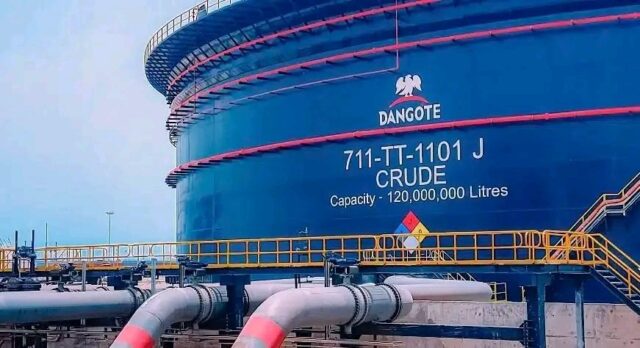
The Dangote Petroleum Refinery has moved to quash growing speculation that it has shut down operations, assuring Nigerians that petrol production and supply remain steady even as key maintenance work continues.
In a statement issued on Tuesday, the refinery confirmed that routine maintenance on major units, including the Crude Distillation Unit, began in early December 2025 and is expected to conclude in late January 2026. Despite the work, the refinery said production has not halted.
“Contrary to unfounded rumours circulating in the market, Dangote Refinery is not shut down,” the statement read. “Production continues uninterrupted at an average of 40 to 50 million litres of petrol per day, and current stock levels are sufficient to meet over 20 days of national demand.”
The clarification comes as some industry watchers and traders raised doubts about reported fuel volumes, pointing to the refinery’s Residue Fluidised Catalytic Cracking (RFCC) unit — crucial for maximizing petrol output — being offline during the maintenance period.
One such sceptic, petroleum industry analyst K.D. Ivi-Oreh, questioned the refinery’s figures, noting that without the RFCC unit fully operational, claimed production levels might not align with technical capacity. “There’s a need for independent verification by regulators,” Ivi-Oreh said, adding that transparency would help quell market anxieties.
But Dangote’s management defended its performance, highlighting the refinery’s contribution to reducing dependence on imported fuel. “Since commencing operations, the refinery has successfully cut petrol imports by over 60 per cent and played a stabilizing role in the market,” the statement noted.
The refinery also addressed pricing concerns. While some retail outlets have seen petrol prices spike to as high as ₦800 per litre, Dangote said petrol sold directly from its gantry was going for ₦699 per litre — a significant discount and an indicator of localized supply strength.
Nigerian motorists and market participants have closely watched Dangote Refinery’s performance since it began commercial operations, as the facility is central to efforts to eliminate petrol importation and reduce prices at the pump. Rumours of a shutdown had sparked concern among commuters and traders alike, with fear that supply disruptions would push pump prices higher and strain household budgets.
Responding to the anxiety, the refinery urged the public and stakeholders to rely on verified information and official statements. “We remain committed to supporting national energy security,” the company said, urging consumers and industry observers to disregard misinformation.