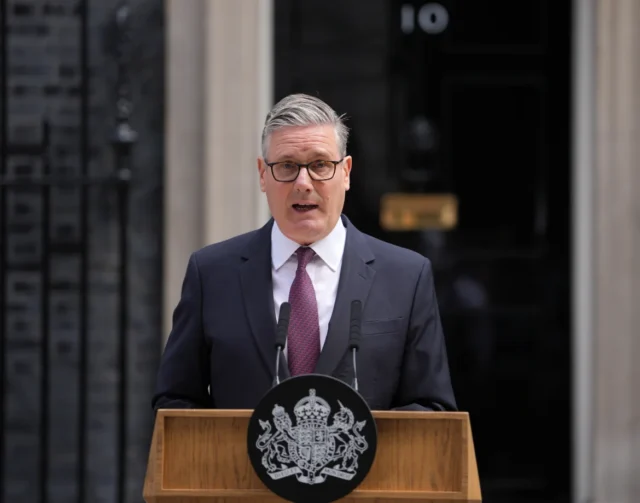
British Prime Minister Keir Starmer has announced his resignation after mounting pressure from within the Labour Party, bringing an abrupt end to a premiership that began with a landslide election victory in 2024 but gradually became overshadowed by economic challenges, political setbacks and declining public support.
Starmer made the announcement outside 10 Downing Street on Monday, confirming that he would remain as caretaker prime minister until Labour selects a new leader. The resignation comes just two years after he swept to power on promises of stable leadership, economic recovery and renewed public confidence in government.
The Prime Minister acknowledged that his position had become untenable after losing the confidence of a significant portion of Labour lawmakers, particularly following the return of former Greater Manchester Mayor Andy Burnham to Parliament in a special election victory that many viewed as a catalyst for change within the party.
Addressing the nation, Starmer said: “The question my party is asking now is whether I am best placed to lead us into the next general election. I have heard the answer of my parliamentary party to that question, and I accept that answer with good grace.”
The outgoing prime minister also disclosed that he had informed King Charles III of his decision before making the public announcement.
Starmer’s departure marks yet another chapter in a turbulent period for British politics, making him the sixth UK prime minister in the past decade to leave office before completing a full term. His resignation comes on the eve of the 10th anniversary of the United Kingdom’s vote to leave the European Union, a decision that continues to shape the country’s political and economic landscape.
Attention has quickly shifted to Burnham, who is widely regarded as the overwhelming favourite to succeed Starmer. Burnham confirmed his intention to contest the Labour leadership shortly after the Prime Minister’s announcement.
“I will put myself forward as part of this process,” Burnham said in a statement posted on social media.
His path to the leadership appeared to become even clearer after former Health Secretary Wes Streeting, who had been considered Burnham’s strongest potential challenger, publicly endorsed him.
The endorsement has fuelled speculation that Burnham could become Labour leader without a contested election, especially as party rules require candidates to be sitting Members of Parliament. Burnham is expected to be sworn in as an MP later on Monday following his recent parliamentary by-election victory.
Starmer’s resignation follows months of growing dissatisfaction within Labour ranks. Although he secured a commanding electoral victory in July 2024, his government struggled to deliver the economic growth it had promised while facing criticism over public services and the rising cost of living.
His administration was further weakened by a series of controversies, including criticism surrounding the appointment of Peter Mandelson as the UK’s ambassador to the United States. Political analysts say Labour has also suffered from losing support to both the Green Party and Reform UK, the anti-immigration party led by Nigel Farage, which has gained momentum in recent opinion polls.
Even before the formal announcement, U.S. President Donald Trump weighed in on Starmer’s future, linking his departure to disagreements over immigration and energy policy.
“Keir Starmer will resign as Prime Minister of The United Kingdom. He failed badly on two very important subjects- IMMIGRATION AND ENERGY (OPEN NORTH SEA OIL!). I wish him well! President DJT,” Trump wrote on his social media platform.
Despite domestic difficulties, Starmer earned significant international recognition during his time in office. He played a prominent role in strengthening European support for Ukraine in its war against Russia and worked closely with allies to navigate diplomatic and economic challenges arising from the conflict in the Middle East.
Ukrainian President Volodymyr Zelenskyy paid tribute to the outgoing British leader, thanking him for his support and cooperation.
In a message posted on X, Zelenskyy said Starmer’s efforts and partnership had “helped make our Europe and our protection of life stronger.”
European Commission President Ursula von der Leyen also praised Starmer’s international leadership and legacy.
“It can take many leaders years to grow into the statesman you became in just two years,” she wrote. “European and Ukrainian security is stronger because of you. Thank you, dear Keir.”
While many Labour lawmakers have rallied behind Burnham, some members of the party have voiced concerns over the manner of Starmer’s exit. London MP Neil Coyle criticised what he described as “the prospect of an utter stitch-up & the media circus being rewarded.”
Political analysts believe Burnham’s appeal stems largely from his perceived ability to reconnect Labour with voters increasingly drawn to Reform UK and other alternatives. Olivia O’Sullivan of Chatham House said many within the party view Burnham as someone capable of offering a clearer political vision and rebuilding support in areas where Labour’s position has weakened.
However, she cautioned that a change in leadership does not automatically guarantee a significant policy shift.
“It’s absolutely correct that that is not the same thing as offering a radically different set of policies or even a particularly clear policy program,” O’Sullivan said.
Labour nominations for the leadership race are set to open on July 9, with the party aiming to have a new leader in place before Parliament returns from its summer recess on September 1. Should Burnham emerge as the sole candidate, the transition could be completed as early as mid-July, ushering in a new era for Britain’s governing party after one of the most dramatic political upheavals in recent years.