The United States carried out airstrikes targeting Islamic State (ISIS) militants in northwest Nigeria on Christmas Day, President Donald Trump announced, saying the action was aimed at halting what he described as widespread killings of Christians by extremists. The operation, conducted in Sokoto State, was confirmed by both the U.S. military’s Africa Command (AFRICOM) and Nigeria’s Ministry of Foreign Affairs as part of ongoing security cooperation between the two nations.
In a post on his social media platform, Truth Social, Trump said, “Tonight, at my direction as Commander in Chief, the United States launched a powerful and deadly strike against ISIS Terrorist Scum in Northwest Nigeria, who have been targeting and viciously killing, primarily, innocent Christians, at levels not seen for many years, and even centuries!” He added that he had previously warned the militants that “if they did not stop the slaughtering of Christians, there would be hell to pay, and tonight, there was.” Trump also posted, “May God Bless our Military…MERRY CHRISTMAS to all, including the dead Terrorists,” signaling potential follow-on action if the violence continued.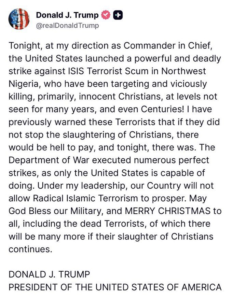
AFRICOM said the strikes were carried out “at the request of Nigerian authorities” and targeted multiple ISIS militants, though specific casualty figures have not been publicly released. The command’s statement on X noted the operation was conducted in Sokoto State, where ISIS affiliates — including factions of the Islamic State Sahel Province (ISSP) — have been active.
Nigeria’s Ministry of Foreign Affairs confirmed the strikes in its own statement, emphasising that the actions resulted from structured security cooperation with international partners, including the United States of America, to counter terrorism and violent extremism. The ministry said the collaboration involved intelligence sharing and strategic coordination carried out in accordance with international law and respect for Nigeria’s sovereignty.
A spokesperson for the ministry, Kimiebi Imomotimi Ebienfa, reiterated that Nigeria’s counter-terrorism efforts prioritise the protection of all civilians — Christians, Muslims and others — and uphold national unity. “Terrorist violence in any form — whether directed at Christians, Muslims or other communities — remains an affront to Nigeria’s values and to international peace and security,” the statement said.
The coordinated action follows weeks of increasingly sharp public criticism by Trump of Nigeria’s handling of violence attributed to militant groups. The U.S. President, who has previously labelled the situation a “genocide” against Christians and even threatened to cut aid or deploy military force, framed the strikes as part of a broader effort to defend religious communities. Senior U.S. defense officials, including Defense Secretary Pete Hegseth, praised the collaboration with Nigerian authorities and warned of further operations if extremist attacks persist.
While the Trump administration has placed Nigeria on a list of countries of particular concern under the International Religious Freedom Act, Nigerian officials have consistently rejected characterisations of the violence as singularly targeting Christians. Abuja has maintained that extremist attacks affect people of diverse faiths and that the security crisis reflects complex insurgencies involving numerous armed groups. Nonetheless, the government welcomed the precision nature of the strikes within the framework of bilateral cooperation.
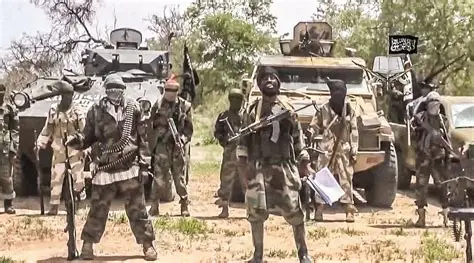
The joint operation highlights the complex and evolving security landscape in Nigeria, where multiple militant groups, including ISIS affiliates and Boko Haram factions, continue to pose threats across vast swathes of the country. Nigeria has been battling insurgency and violent extremism for more than a decade, with civilians from many backgrounds bearing the brunt of the conflict.
As investigations continue, Nigeria said it will sustain and deepen collaboration with international partners to weaken terrorist networks, disrupt their funding and logistics, and strengthen the country’s security institutions and intelligence capabilities.