Police Smash Criminal Networks, Arrest 22 Suspects in Coordinated Multi-State Operations
The Nigeria Police Force has recorded significant operational gains following a series of intelligence-driven raids across multiple states, leading to the arrest of 22 suspects linked to armed robbery, kidnapping, banditry, car snatching, impersonation and drug trafficking.

In a statement released on Thursday, the Force said the operations were carried out by operatives of its Special Tactical Squad, acting on credible intelligence to dismantle organised criminal networks operating across state lines. The coordinated actions, according to the police, underscore renewed efforts to curb violent crime and economic sabotage nationwide.

During the raids, operatives recovered six firearms, including AK-47 and AK-49 rifles, a sub-machine gun, a pump-action gun and an LAR rifle, alongside assorted ammunition. The police also seized several vehicles, motorcycles, illicit drugs and other incriminating exhibits believed to have been used in the commission of various crimes.

A major breakthrough was recorded along the Kaduna–Abuja Expressway, where operatives intercepted 13 brand-new motorcycles suspected to be linked to criminal logistics. A suspect connected to economic sabotage was arrested at the scene, with investigations ongoing to trace the source and intended use of the motorcycles.

In the Federal Capital Territory, police operatives apprehended an escapee from the Kuje Custodial Centre, while another suspect was arrested for impersonating a police officer. Similar operations led to additional arrests in Edo, Lagos, Ogun and Nasarawa States, further disrupting criminal activities across the regions.

Commending the officers involved, the Inspector-General of Police, Kayode Egbetokun, praised their professionalism and resolve, describing the outcome as evidence of effective intelligence-led policing. “These successes demonstrate the Nigeria Police Force’s unwavering commitment to protecting lives and property, dismantling criminal networks and sustaining nationwide security operations,” Egbetokun said.

The IGP also called on members of the public to continue supporting law enforcement efforts. “We urge citizens to provide timely and credible information to assist ongoing operations. Policing is a collective responsibility, and public cooperation remains critical to achieving lasting security,” he added.

The police said all suspects are currently in custody and will be charged to court upon the conclusion of investigations, as the Force intensifies operations to rid communities of criminal elements across the country.
Israel Becomes First Country to Recognise Somaliland as Independent State

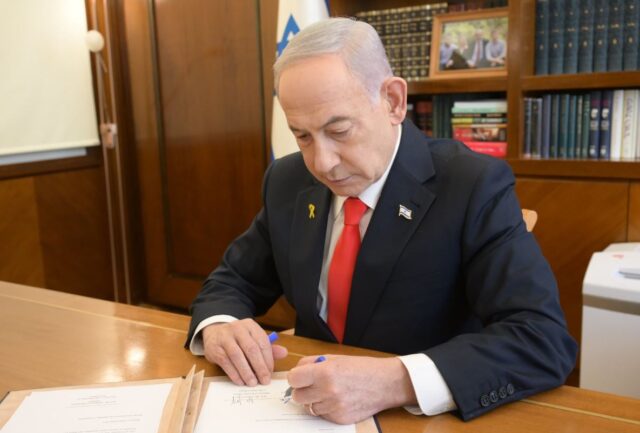
Israeli Prime Minister Benjamin Netanyahu

In a landmark development with far-reaching geopolitical implications, Israel has officially recognised the Republic of Somaliland as an independent and sovereign state, ending the breakaway region’s three-decade quest for international legitimacy.

Israeli Prime Minister Benjamin Netanyahu, Foreign Minister Gideon Sa’ar, and Somaliland President Abdirahman Mohamed Abdullahi signed a joint declaration of mutual recognition on Friday, formalising the historic decision.

“It is with great pride that we announce today the official recognition of the Republic of Somaliland as an independent and sovereign state,” Prime Minister Netanyahu said in a statement released by his office. The declaration, which was signed virtually by the three leaders, marks the first time a United Nations member state has recognised Somaliland since it declared independence from Somalia in 1991.

Netanyahu described the move as “seminal and historic,” reflecting deepening ties between the two nations. He congratulated President Abdullahi for his leadership and commitment to stability, peace, and prosperity in the Horn of Africa and extended an official invitation for him to visit Israel. “We intend to work together on economic development, agriculture, health, technology, and strengthening bilateral cooperation,” the Israeli leader said.

President Abdirahman Mohamed Abdullahi welcomed the recognition, calling it a “historic moment” for Somaliland and a vindication of its decades-long pursuit of statehood. Abdullahi expressed gratitude to Netanyahu and Sa’ar for their decision, underscoring that the recognition would help advance not only diplomatic standing but also economic growth and regional stability. He said the move would deepen cooperation between the two nations, particularly in sectors critical to development.

Foreign Minister Gideon Sa’ar highlighted that the agreement follows a year of sustained dialogue between Israel and Somaliland. He said relations would extend beyond formal recognition to include the establishment of embassies and the appointment of ambassadors, further institutionalising ties between the countries. Sa’ar said the partnership aims to promote bilateral relations, foster regional stability, and create broad economic opportunities.

The declaration was framed by Israeli officials as part of diplomatic progress inspired by the Abraham Accords, the U.S.-brokered normalization agreements that began in 2020 under President Donald Trump. According to Israeli sources, the recognition aligns with initiatives to expand Israel’s diplomatic footprint and strategic partnerships across Africa and the broader Middle East.

Since its unilateral declaration of independence in 1991, Somaliland has operated as a de facto independent republic, maintaining its own government, security forces, currency, and democratic institutions. Despite this, it has struggled to achieve formal recognition, largely due to Somalia’s insistence that it remains part of its sovereign territory and broader international reluctance to set precedents for secessionist regions.

The move has already elicited regional and international responses. Somalia, Egypt, Turkey, and Djibouti have condemned Israel’s decision, warning that recognising breakaway regions undermines territorial integrity and could destabilise regional peace. Their statements reaffirmed support for Somalia’s sovereignty and signalled diplomatic pushback against unilateral recognition of Somaliland.

Despite opposition from some quarters, the Somaliland government views Israel’s recognition as a turning point in its diplomatic strategy. For years, Somaliland leaders—including President Abdullahi—have actively campaigned for global recognition, positioning the territory as a stable, democratic partner in a volatile region. In May 2025, Abdullahi reiterated his determination to secure recognition from the international community, describing it as a central goal of his presidency.

The agreements signed on Friday envisage future cooperation in key areas such as trade, technology, agriculture, and health, potentially transforming Somaliland’s economic landscape and contributing to its prospects for broader diplomatic acceptance.

Christmas Day Strikes: US, Nigeria Target ISIS Strongholds in Sokoto

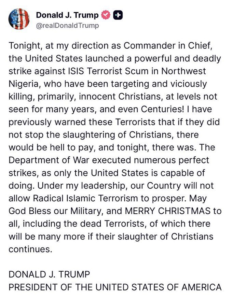
The United States carried out airstrikes targeting Islamic State (ISIS) militants in northwest Nigeria on Christmas Day, President Donald Trump announced, saying the action was aimed at halting what he described as widespread killings of Christians by extremists. The operation, conducted in Sokoto State, was confirmed by both the U.S. military’s Africa Command (AFRICOM) and Nigeria’s Ministry of Foreign Affairs as part of ongoing security cooperation between the two nations.

In a post on his social media platform, Truth Social, Trump said, “Tonight, at my direction as Commander in Chief, the United States launched a powerful and deadly strike against ISIS Terrorist Scum in Northwest Nigeria, who have been targeting and viciously killing, primarily, innocent Christians, at levels not seen for many years, and even centuries!” He added that he had previously warned the militants that “if they did not stop the slaughtering of Christians, there would be hell to pay, and tonight, there was.” Trump also posted, “May God Bless our Military…MERRY CHRISTMAS to all, including the dead Terrorists,” signaling potential follow-on action if the violence continued.

AFRICOM said the strikes were carried out “at the request of Nigerian authorities” and targeted multiple ISIS militants, though specific casualty figures have not been publicly released. The command’s statement on X noted the operation was conducted in Sokoto State, where ISIS affiliates — including factions of the Islamic State Sahel Province (ISSP) — have been active.

Nigeria’s Ministry of Foreign Affairs confirmed the strikes in its own statement, emphasising that the actions resulted from structured security cooperation with international partners, including the United States of America, to counter terrorism and violent extremism. The ministry said the collaboration involved intelligence sharing and strategic coordination carried out in accordance with international law and respect for Nigeria’s sovereignty.

A spokesperson for the ministry, Kimiebi Imomotimi Ebienfa, reiterated that Nigeria’s counter-terrorism efforts prioritise the protection of all civilians — Christians, Muslims and others — and uphold national unity. “Terrorist violence in any form — whether directed at Christians, Muslims or other communities — remains an affront to Nigeria’s values and to international peace and security,” the statement said.

The coordinated action follows weeks of increasingly sharp public criticism by Trump of Nigeria’s handling of violence attributed to militant groups. The U.S. President, who has previously labelled the situation a “genocide” against Christians and even threatened to cut aid or deploy military force, framed the strikes as part of a broader effort to defend religious communities. Senior U.S. defense officials, including Defense Secretary Pete Hegseth, praised the collaboration with Nigerian authorities and warned of further operations if extremist attacks persist.

While the Trump administration has placed Nigeria on a list of countries of particular concern under the International Religious Freedom Act, Nigerian officials have consistently rejected characterisations of the violence as singularly targeting Christians. Abuja has maintained that extremist attacks affect people of diverse faiths and that the security crisis reflects complex insurgencies involving numerous armed groups. Nonetheless, the government welcomed the precision nature of the strikes within the framework of bilateral cooperation.

The joint operation highlights the complex and evolving security landscape in Nigeria, where multiple militant groups, including ISIS affiliates and Boko Haram factions, continue to pose threats across vast swathes of the country. Nigeria has been battling insurgency and violent extremism for more than a decade, with civilians from many backgrounds bearing the brunt of the conflict.

As investigations continue, Nigeria said it will sustain and deepen collaboration with international partners to weaken terrorist networks, disrupt their funding and logistics, and strengthen the country’s security institutions and intelligence capabilities.

Presidency Denies Reports of Gbajabiamila’s Replacement as Chief of Staff

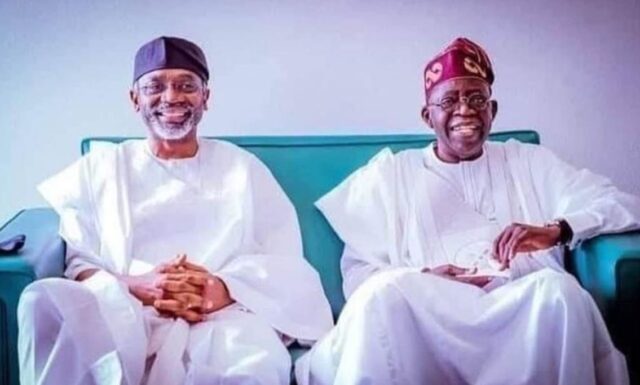
President Bola Ahmed Tinubu (right) with Femi Gbajabiamila

The Presidency has dismissed as false a viral claim circulating on social media that President Bola Ahmed Tinubu has replaced his Chief of Staff, Hon. Femi Gbajabiamila, with the Principal Private Secretary, Hakeem Muri-Okunola.

In a statement issued on Thursday, the Special Adviser to the President on Information and Strategy, Bayo Onanuga, described the report as a fabrication and urged Nigerians to ignore it completely.

“There is absolutely no truth to this story. We advise Nigerians to disregard it entirely,” Onanuga said, reacting to the widespread online speculation.

He clarified that there has been no change in the leadership structure of the Presidency, stressing that both officials remain in their respective positions. “The Chief of Staff remains in his position. The Principal Private Secretary likewise remains in his role. Hakeem Muri-Okunola has not replaced Femi Gbajabiamila as Chief of Staff,” the statement read.

The Presidency accused the originators of the report of deliberately spreading misinformation to sow discord within the government. According to Onanuga, the claim was “a fabrication by mischievous purveyors of fake news whose sole aim is to create disharmony within the government.”

He also used the opportunity to caution the media and social media users against amplifying unverified information. “We reiterate that news media should always verify their information before publishing or sharing on social media,” Onanuga said.

The clarification comes amid heightened public interest in developments within President Tinubu’s administration, with the Presidency reaffirming that its top aides remain firmly in place and that no changes have been made to the office of the Chief of Staff.

Shettima Condemns Maiduguri Mosque Bombing, Vows Intensified Security Operations in Borno

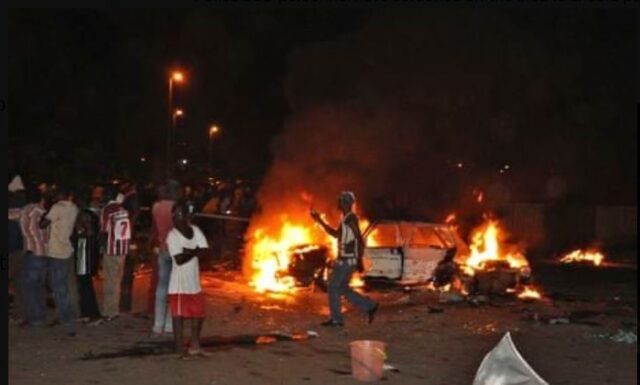
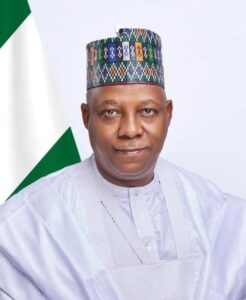
Vice President Kashim Shettima has strongly condemned the bomb explosion that rocked Gamboru Market, Maiduguri, during prayers on Wednesday evening, describing the attack as a “despicable assault on innocent citizens and the peace of the nation.” The incident, which occurred at the Al Adum Juma’at Mosque around 6:00pm on December 24, 2025, has been linked to a suspected Boko Haram suicide bomber.

In a statement issued on Thursday, the Vice President disclosed that President Bola Ahmed Tinubu has ordered the immediate intensification of security operations in Borno State following the attack. He assured Nigerians that the Federal Government is deploying additional tactical teams to track down and apprehend those responsible.

“The Federal Government will not tolerate any attempt to undermine the peace and security of our nation,” Shettima said. “Our security agencies are working round the clock to ensure that the perpetrators of this heinous crime are brought to justice immediately.”

Vice President Kashim Shettima

The Vice President expressed confidence in Nigeria’s security architecture, saying it would not only apprehend the perpetrators but also unravel the full circumstances surrounding the incident. He extended condolences to the victims and the people of Borno State.

“We sympathise with the Government of Borno State, residents, and families who have lost their loved ones in this attack,” Shettima said. “The Federal Government is confident that those responsible for this despicable act of terrorism will face the full weight of the law.”

Shettima reaffirmed the Tinubu administration’s commitment to national security, stressing that it remains unwavering. “Since President Bola Ahmed Tinubu assumed office in 2023, this administration has consistently reaffirmed its unyielding commitment to safeguarding the security, unity, and stability of our nation,” he said. “This commitment remains steadfast under God and the Constitution of the Federal Republic of Nigeria. We will continue to provide our security agencies with all necessary resources and support to decisively defeat terrorism in all its forms.”

He added that the Federal Government is working closely with state authorities and local security agencies to protect vulnerable communities and critical infrastructure across the North East and other regions, particularly during the festive season.

Meanwhile, the Joint Task Force (North East), Operation Hadin Kai, has confirmed that the explosion was carried out by a suspected Boko Haram suicide bomber who detonated an improvised explosive device (IED), killing himself and civilians at the scene. According to the task force, the initial blast claimed the lives of two civilians on the spot, while others were injured.

Troops of Operation Hadin Kai, working with the Nigeria Police Explosive Ordnance Disposal (EOD) team, other security agencies, the Borno State Government, and NEMA, swiftly responded to the incident. The affected area was secured and cordoned off to prevent further harm, while casualties were evacuated to the General Hospital and Teaching Hospital in Maiduguri for treatment.

Security authorities reported that 32 civilians sustained varying degrees of injuries. Tragically, two of the injured later died at the hospital, bringing the confirmed civilian death toll to four, while two others remain in critical condition. The remaining victims are said to be stable and receiving medical care.

In a separate update, police authorities confirmed that ongoing sweeping operations are being conducted by EOD personnel, with the mosque area still cordoned off as investigations continue. Surveillance and security measures have since been intensified within Maiduguri and surrounding communities.

Operation Hadin Kai commiserated with the families of the deceased and reassured the public of its continued commitment to safeguarding lives and property. Members of the public have been urged to remain calm, vigilant, and security-conscious, especially during the yuletide period, as security operations remain ongoing across the state.

Carabao Cup: Arsenal Hold Nerve in Penalty Shootout to Beat Crystal Palace

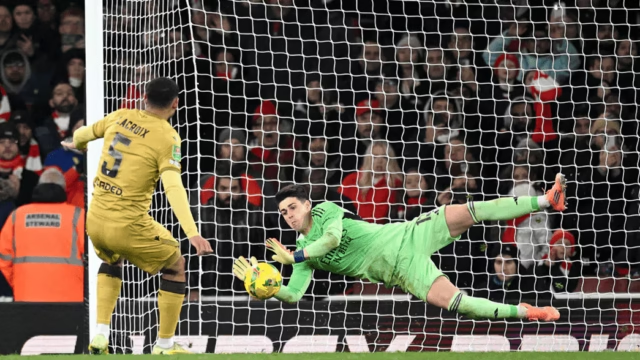
Arsenal's Kepa Arrizabalaga saves Crystal Palace's Maxence Lacroix’s penalty. Credit: arsenal.com

Arsenal survived a dramatic night at the Emirates Stadium on Tuesday as they edged **Crystal Palace in a tense penalty shootout to reach the Carabao Cup semi-finals, where they will face Chelsea in January. The Premier League leaders resisted a spirited fight from Palace before prevailing 8-7 on penalties after a 1-1 draw in regulation time.

The quarter-final tie was delayed from last week due to Palace’s involvement in the UEFA Europa Conference League and served up a gripping contest. Arsenal dominated possession and territory throughout the 90 minutes, creating several promising openings but were repeatedly denied by Crystal Palace goalkeeper Walter Benítez, whose performance kept the match alive.

Arsenal finally broke the deadlock in the 80th minute when defender Maxence Lacroix turned the ball into his own net under pressure from an Arsenal attack, giving the home side a fortunate but deserved lead. Palace, however, refused to go quietly. Deep into stoppage time, Marc Guéhi capitalised on a set piece to head in a dramatic equaliser and force the game into penalties.

The penalty shootout was an epic affair, with both teams keeping cool under pressure as each kick was converted — until Arsenal keeper Kepa Arrizabalaga became the hero. With the score poised at 7-7, Kepa saved Lacroix’s spot kick, the only miss of the shootout, securing Arsenal’s place in the last four.

“We knew it was going to be tough,” said Arsenal manager Mikel Arteta after the win. “Crystal Palace made it hard for us, and their keeper made some great saves. But the character in this team showed again, and we go forward to a big semi-final tie now.” (Club sources)

It was a night of mixed emotions for Palace, who had earlier suffered a setback when defender Chris Richards was stretchered off with a serious foot injury, leaving the visitors short at the back and adding to their mounting fitness concerns. Manager Oliver Glasner later confirmed Richards would need stitches and reported concerns about his availability for upcoming fixtures.

Despite the loss, Glasner was proud of his side’s fight. “We kept believing until the very end,” he said. “We showed resilience to get the equaliser and take it to penalties. It’s just unfortunate that one kick went against us.” (Club press conference)

Now Arsenal’s attention turns to the semi-final against London rivals Chelsea, with the two-legged tie scheduled to kick off in mid-January, the first leg at the Emirates Stadium on January 14 and the second at Stamford Bridge in early February.

Ajayi Shines as Super Eagles Dig In Early, Group C Race Intensifies at AFCON 2025

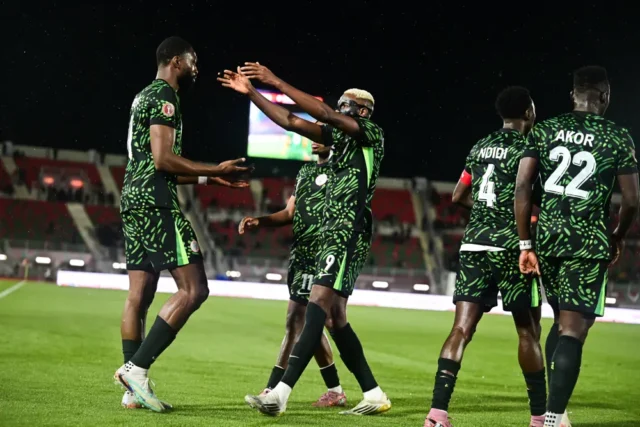
Nigeria's Super Eagles celebrate after scoring the first goal against Tanzania at the AFCON 2025 in Morocco. Credit: cafonline

Nigeria’s push for a knockout place at the 2025 Africa Cup of Nations in Morocco gathered pace as the Super Eagles claimed a hard-fought victory to remain firmly in the qualification hunt in a fiercely contested Group C.

At the heart of Nigeria’s win was Semi Ajayi, whose commanding performance at the back and crucial goal earned him Man of the Match honours. Ajayi opened the scoring and set the tone for a night that tested Nigeria’s resolve as much as its quality.

“It’s an amazing feeling to score for your country, and in such a game it gives us the possibility of getting a good start,” Ajayi said after the match. “We had an amazing tournament in Côte d’Ivoire and we are using that as a standard. We are a team — we don’t need to get goals only from the attackers — and it’s pleasing to contribute to the success of the team.”

Nigeria briefly wobbled after Tanzania found an equaliser, but the Super Eagles responded almost immediately, showing the maturity that took them deep into the last AFCON. Ajayi admitted there was still room for improvement but was encouraged by the overall display. “There are a lot of positives to take from the game and some things to fix, and we will work on that to kill games going forward,” he added.

Head coach Eric Chelle echoed that assessment, welcoming the three points while acknowledging that sharper game management will be crucial as the group tightens. “We are satisfied with the three points. That is the most important,” Chelle said. “For the moment, I want to focus on the positives. The second part of the game shows clearly that there is still some work to be done — especially when it comes to killing the game. We are aware of this, and we will work on it.”

Nigeria’s victory kept them firmly in the mix behind Tunisia, who moved top of Group C after a 3–1 win over Uganda. The North Africans struck early through Elyes Skhiri, with Elias Achouri adding goals before and after the break. Uganda, however, had the final say as Denis Omedi pulled one back deep into added time, a goal that could yet matter in a group where goal difference may prove decisive.

Despite defeat, Tanzania left the pitch with renewed belief after pushing Nigeria for long spells. Their coach, Miguel Ángel Gamondi, felt his side exceeded expectations against one of the tournament favourites. “I think Tanzania played better than many people expected,” Gamondi said. “Nigeria had a lot of possession, but we neutralised them well through our tactical system. They did create chances, but most of them came from individual quality — which is not surprising. Overall, I believe we surprised a lot of people with the quality of our performance against Nigeria today.”

As the group stands, Tunisia lead, Nigeria sit close behind, and both Uganda and Tanzania remain under pressure with little margin for error. With heavyweight clashes still to come, including Nigeria’s looming test against the group leaders, Group C is shaping into a tense battle where composure, efficiency and small moments — like Ajayi’s decisive contribution — could determine who advances and who falls short at AFCON 2025.

Makinde Draws Battle Line with Wike, Rejects Support for Tinubu in 2027

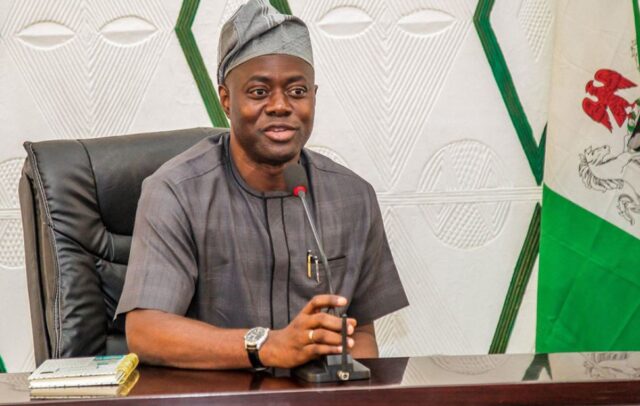
Oyo State Governor Seyi Makinde

Oyo State Governor Seyi Makinde has escalated his public break with former ally and Federal Capital Territory (FCT) Minister Nyesom Wike, reiterating his refusal to support President Bola Ahmed Tinubu’s anticipated bid for re-election in 2027 and framing the dispute as a test of democratic autonomy within the Peoples Democratic Party (PDP).

Speaking during a media chat in Ibadan on Tuesday, Makinde offered a vivid personal narrative to underscore the depth of his differences with Wike — including a revealing point about their contrasting career trajectories. Recalling his own early success in business, Makinde said:

“Within one year, I made $1 million in my pocket. I was 29 in 1997. Wike, perhaps at that time, had just left law school…”

The anecdote was used by Makinde to highlight how his independent successes shaped his rise in both business and politics and to signal fundamental personal and political differences with Wike.

The immediate trigger for the widening rift, according to Makinde, occurred in a meeting attended by President Tinubu, Wike, and other senior figures. Makinde said he was taken aback when Wike told the President he would “hold the PDP for him” ahead of the 2027 elections — a pledge the Oyo governor insists was unsolicited and beyond the minister’s mandate.

“I was in a meeting with President Tinubu, Nyesom Wike, and others when Wike volunteered to hold the PDP for Tinubu against 2027, and I was in shock,” Makinde said, adding emphatically, “Wike can support the president in 2027, but I will not.”

While acknowledging that Wike has the right to offer personal political support to Tinubu, Makinde argued that no individual — not even a senior PDP member — should determine political allegiance for others within the party. He framed his own stance as a defence of multiparty democracy and an effort to prevent Nigeria from sliding toward a de facto one-party state.

“The President did not ask him to do this; he volunteered. Wike is within his rights to support Tinubu,” Makinde said, “but those of us who want to ensure the survival of multiparty democracy and the PDP should also be allowed to make our own decisions.”

Makinde’s comments underscore the deepening factionalism within the PDP — a party rocked this year by internal tensions, defections, and leadership disputes. The governor’s faction is pushing for party autonomy and a robust opposition to the ruling All Progressives Congress (APC). Wike, on the other hand, has signalled a more conciliatory approach toward Tinubu, insisting he remains in the PDP while openly backing the President’s agenda.

Both figures were among the G5 governors — a bloc of PDP leaders that controversially supported Tinubu’s 2023 election bid before fracturing over internal disagreements and power struggles within the opposition party.

Makinde said he attempted to resolve the disagreement with Wike privately, including through mutual associates, but that efforts were unsuccessful — prompting a firm public break.

In addition to rejecting any plan to organise for Tinubu, Makinde has affirmed his own political ambition, signalling his belief that he is qualified for the presidency should he decide to contest in 2027. He cited his tenure as a two-term governor and professional experience as part of his credentials.

For now, Makinde says his priority remains protecting the PDP’s relevance and ensuring a competitive democratic landscape in Nigeria. As he put it, the choice of who to support in the coming election — whether within or outside the PDP — is a matter of personal and political principle.

CAF Overhauls AFCON: Tournament to Be Held Every Four Years After 2028

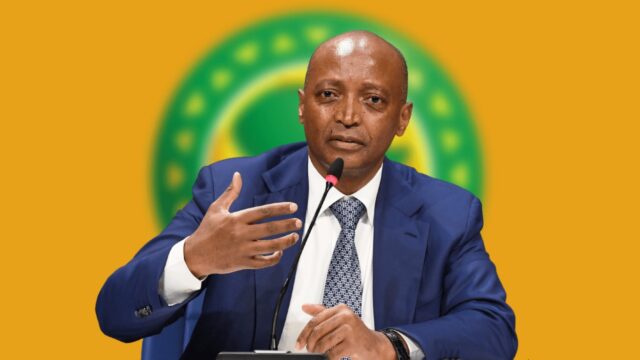
CAF president Patrice Motsepe

The Africa Cup of Nations (AFCON), Africa’s flagship international football tournament, will shift from its long-established biennial schedule to a four-year cycle beginning after the 2028 edition, the Confederation of African Football (CAF) has confirmed. The landmark decision was announced on Saturday by CAF president Patrice Motsepe on the eve of the 2025 AFCON kick-off in Morocco.

The change marks one of the most significant structural reforms in African football in decades, ending a tradition of staging the continental championship every two years since 1968, with only a brief exception between the 2012 and 2013 editions. Under the new plan, the tournament will adopt a quadrennial rhythm, mirroring other major global competitions such as the FIFA World Cup and the UEFA European Championship.

Motsepe explained that while the next AFCON finals—scheduled for 2027 in Kenya, Tanzania and Uganda—will proceed as planned, and another edition is set for 2028, the shift to a four-year cycle will take effect after 2028. “Our focus now is on this AFCON, but in 2027 we will be going to Tanzania, Kenya and Uganda, and the AFCON after that will be in 2028,” Motsepe said. “Then after the FIFA Club World Cup in 2029 we will have the first African Nations League…with more prize money, more resources and more competition. As part of this arrangement, the AFCON now will take place once every four years.”

The move comes amid longstanding pressure to harmonise Africa’s football calendar with global competitions and reduce clashes with domestic leagues, particularly in Europe, where many of the continent’s top players are based. Historically, the timing of AFCON has often forced clubs to release African stars mid-season, a point of friction increasingly cited by national associations, top clubs and FIFA officials.

CAF acknowledged that AFCON has traditionally been a major revenue driver for African football associations, accounting for an estimated 80 per cent of income. To offset the financial impact of fewer editions, the federation plans to launch an annual African Nations League beginning in 2029, modelled after UEFA’s Nations League format. The new competition is expected to enhance revenue streams and provide regular competitive fixtures for national teams outside the AFCON cycle.

In addition to the scheduling overhaul, CAF has boosted prize money for the current AFCON, with the winners set to receive $10 million—an increase from $7 million in the previous edition.


Trinidad and Tobago Backs United States as US–Venezuela Tensions Intensify in the Caribbean

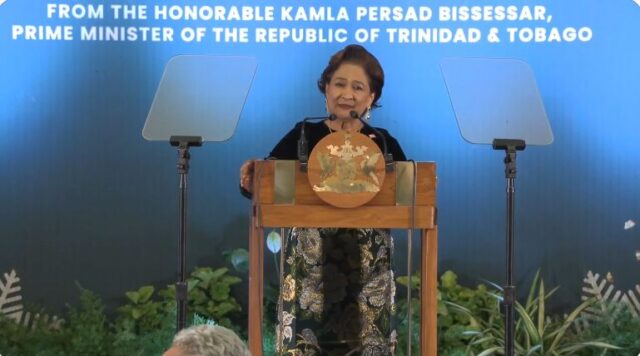
Trinidad & Tobago Prime Minister Kamla Persad-Bissessar

Prime Minister Kamla Persad-Bissessar has firmly reaffirmed Trinidad and Tobago’s support for the United States amid escalating tensions between Washington and Caracas, as concerns mount over electronic warfare and military posturing in the Caribbean.

Speaking at a supper hosted at the Diplomatic Centre on Thursday, Persad-Bissessar sought to reassure citizens that the government remains fully alert to regional developments and that there is no immediate cause for public alarm. She said the safety and stability of Trinidad and Tobago remain at the forefront of her administration’s priorities.

Addressing growing rhetoric within the country linked to the US–Venezuela standoff, the Prime Minister criticised what she described as “hypocrisy and unkindness” from individuals calling for confrontation with the United States. She stressed that Trinidad and Tobago maintains a strong and strategic bilateral relationship with Washington.

“Trinidad and Tobago stands with the United States,” Persad-Bissessar said, highlighting that the U.S. remains the country’s largest trading partner. She contrasted this with Trinidad and Tobago’s limited commercial engagement with Venezuela, noting that trade with Caracas accounts for just 0.0003 of total trade volume. “These are the facts,” she said.

The Prime Minister also warned against actions or statements that could negatively affect Trinidad and Tobago nationals living in or travelling to the United States. She revealed that more than 350,000 Trinidad and Tobago citizens hold U.S. visas, over 250,000 reside in the United States, and approximately 20,000 have dual citizenship. “I do not want anyone to lose their U.S. visa,” she said, urging citizens to act responsibly and recognise the realities of the country’s international partnerships.

Persad-Bissessar underscored the strategic importance of the United States to Trinidad and Tobago’s national security, arguing that Washington remains the only country currently capable of offering decisive military protection if the nation were threatened. “Understand where our help comes from. Understand who can protect and defend Trinidad and Tobago,” she said, adding that the U.S. possesses the military power, equipment and resources necessary to do so. “Trinidad and Tobago first.”

Her remarks come as tensions between the United States and Venezuela continue to escalate, with growing evidence of electronic warfare activity in the Caribbean. Data and security assessments indicate that both militaries have been jamming satellite navigation signals, including GPS systems, as part of defensive measures against potential attacks. Aviation and maritime experts warn that such disruptions increase the risk of accidents across the region’s busy air and sea routes.

The jamming incidents reflect rising military brinkmanship between U.S. President Donald Trump and Venezuelan President Nicolás Maduro, heightening anxiety among Caribbean nations located near the geopolitical flashpoint.

EDITOR PICKS

Recent Posts