The controversy over the financial legacy of former Anambra State Governor Peter Obi has intensified, with the state government accusing him of leaving behind external loan obligations, unpaid liabilities to workers and pensioners, and unanswered questions over a purported ₦2.13 billion ecological fund.
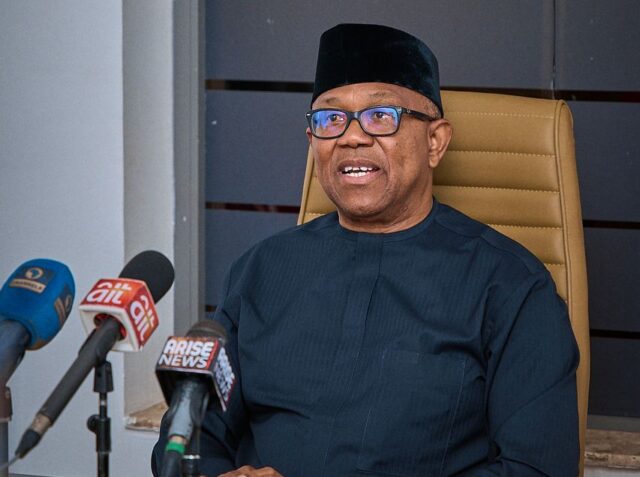
The latest salvo came from Anambra State Commissioner for Information and Value Reorientation, Law Mefor, who on Saturday issued a detailed response to Obi’s September 24 appearance on Arise Television, where the former governor rejected claims that his administration left the state with outstanding debts.
The dispute began earlier this month after the state Commissioner for Finance, Izuchukwu Okafor, said the administration of Governor Chukwuma Soludo was still servicing debts inherited from previous administrations, including those of Obi and former Governor Willie Obiano. Obi subsequently challenged the state government to provide evidence that he left unpaid debts, salaries, pensions or contractor obligations when he handed over power in March 2014.
Obi, who is now the presidential candidate of the Nigeria Democratic Congress, maintained during his Arise TV interview that he did not borrow money or issue bonds on behalf of Anambra during his eight years in office.
“Let me categorically state again: I, Mr Peter Obi, did not approach any financial institution to borrow money or issue bonds on behalf of Anambra State in the eight years I was in government,” he said.
He also insisted that when he left office, Anambra was not owing salaries, pensions, gratuities or contractors whose projects had been completed, certified and verified. Obi further argued that even if liabilities existed, the funds he said he left behind were sufficient to cover them.
“Even if there was a debt, there was enough left to pay it, and the state (Anambra) would still be financially stable,” Obi said in the interview.
The Anambra government, however, says the issue is not whether Obi left assets or savings capable of covering liabilities, but whether financial obligations were incurred during his tenure and remained outstanding.
Government cites eight external facilities
According to Mefor, records attributed to the Debt Management Office show that eight external financing facilities associated with projects undertaken during the Obi administration had a combined contracted value of $123,771,179.30.
The government says the outstanding balance on those facilities stood at $92,353,182, equivalent to about ₦127.37 billion, as of June 30, 2026.
The facilities were linked to programmes covering areas including malaria control, agriculture, healthcare, education, community development, erosion management and agricultural value-chain development.
The government argues that the existence of federal guarantees or World Bank/International Development Association financing does not turn a loan into a grant.
Mefor previously stated that monthly deductions were being made from Anambra’s Federation Account allocations to service loans which the state government attributes to the Obi administration. “First and foremost, a loan is a loan, and whether it is sovereign or not, even an interest-free loan is still a loan,” he said on Arise Television on September 18.
Obi, however, has disputed the characterization of the facilities as loans personally borrowed by him or his administration. In his latest response, he argued that the financing was part of federal arrangements and maintained that he did not personally approach financial institutions to borrow on behalf of Anambra.
The distinction between the contracted value of the facilities, actual drawdowns during Obi’s tenure, amounts repaid before his departure and the balances subsequently outstanding remains central to the disagreement.
Salary and pension arrears also disputed
The state government has also accused Obi’s administration of leaving unpaid obligations involving workers of the defunct Anambra State Water Corporation and pension arrears involving primary school teachers.
Mefor said more than 700 Water Corporation workers were affected by salary, pension and gratuity arrears which subsequently became the subject of arbitration and court proceedings.
According to the government, an out-of-court settlement reached on February 26, 2024, put the liability at ₦1,563,143,020.13, of which ₦1,199,762,000 had been paid, with the final tranche still outstanding.
The government has also referred to historical pension arrears involving primary school teachers which, according to its account, originated before Obi assumed office but were not completely cleared during his tenure.
Separately, the state government recently produced documents relating to ₦363.38 million in salary arrears involving two defunct agencies, adding another dimension to the dispute over whether liabilities inherited from earlier administrations were fully settled during Obi’s tenure.
Obi, for his part, has maintained that his administration systematically cleared historical arrears and said it liquidated more than ₦35 billion in gratuities and other arrears accumulated before he assumed office. He maintains that Anambra owed nothing in salaries, pensions or gratuities that was due from the state government when he handed over.
Dispute over Obi’s reported savings
Another major point of disagreement concerns the funds Obi says his administration left behind.
During the Arise TV interview, Obi argued that he left more than $150 million or its equivalent in funds and investments for his successor and questioned why those resources should not be considered alongside any alleged liabilities.
The former governor used an analogy to argue that even if the state had owed money, sufficient funds were available to cover such obligations.
The Anambra government rejects that approach, arguing that assets and liabilities must be separately accounted for regardless of whether the assets exceed the liabilities.
Mefor said the government’s position was that Obi’s handover documents placed significant emphasis on assets, investments and savings while failing, in the government’s assessment, to adequately disclose outstanding contractual and other obligations.
The commissioner specifically cited contracts for 101 roads covering 779 kilometres, which he said carried outstanding liabilities of about ₦127 billion at the time of handover.
The state government’s argument is that such contractual obligations should have appeared among the liabilities transferred to the incoming administration rather than being offset against funds or assets allegedly left behind.
The ₦2.13bn ecological fund controversy
The most specific unresolved issue concerns a ₦2.13 billion ecological fund which Obi says his administration left untouched for his successor.
In a statement circulated earlier this month, Obi said the money was released shortly before the end of his tenure to address the Oko/Umuchiana erosion crisis and that he deliberately preserved it because it was tied to a specific project.
He identified First Bank account number 2018779464 as the account in which he said the money was kept, claiming that the balance exceeded ₦2.13 billion when he handed over on March 17, 2014. He also said the fund was separate from the more than ₦75 billion in savings he claimed his administration left behind.
The Anambra government disputes the claim.
Mefor said the state obtained a certified statement of the account and that it was an Internally Generated Revenue Consolidated Revenue Account, rather than an ecological fund account.
“From 2011 when the account was opened until date, there has never been any such amount—whether as inflow or balance—in the account,” Mefor said in the earlier statement.
The commissioner repeated the challenge in his latest statement, asking Obi to explain where the money was kept if the account he identified did not contain the amount he claimed.
As of Saturday, the dispute over the alleged ₦2.13 billion remains unresolved in the public record, with the state government relying on the bank records it says it obtained and Obi maintaining that the funds were left in the account he identified.