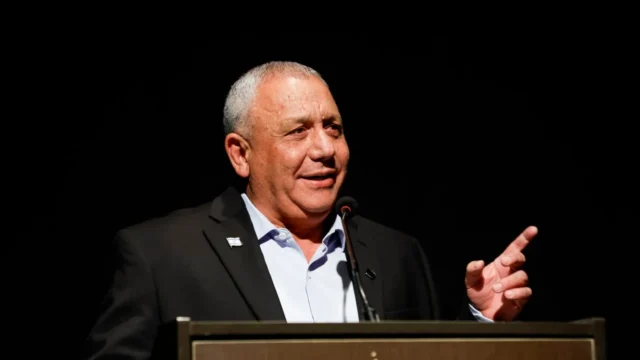
Former Israel Defense Forces chief of staff and Yashar! Party leader Gadi Eisenkot has called on opposition leaders to convene a coordination meeting aimed at forming a 61-seat majority to unseat Prime Minister Benjamin Netanyahu in the upcoming elections.
Eisenkot’s appeal comes on the heels of a major political development in Israel’s opposition landscape, following the announcement by former prime ministers Naftali Bennett and Yair Lapid of a new unified political platform, “Together.” The duo also publicly invited Eisenkot to join their alliance, signaling a push to consolidate opposition forces against Netanyahu’s long-standing leadership.
Responding to the invitation, Eisenkot emphasized that the broader objective must remain increasing electoral support for the opposition bloc rather than focusing on individual party alignments. He revealed that he had spoken with both Bennett and Lapid, stressing that his sole priority is securing what he described as a “victory for a statesmanlike, Zionist coalition.”
“I hope this is the goal of all partners,” Eisenkot said, adding, “For that victory to happen, we need to bring in more votes; that’s our only test.” He further noted that “every alliance should be judged by that, with responsibility, sound judgment, and the right timing.”
The proposed coordination meeting is expected to include key opposition figures and parties Eisenkot described as part of a “Hope Bloc,” including the Bennett-Lapid alliance, Avigdor Liberman’s Yisrael Beytenu party, and the Democrats Party led by Yair Golan. Notably absent from the invitation is Benny Gantz, whose Blue and White Party has struggled in recent polls and has not ruled out cooperation with Netanyahu.
Bennett, speaking at the launch of the joint party with Lapid, made a direct appeal to Eisenkot, declaring, “We are charging forward to victory. Gadi, our door is open to you as well.” Despite the overture, Eisenkot has previously declined offers to join Bennett’s political efforts, citing reluctance to serve in a secondary leadership role.
The evolving opposition dynamics come amid shifting polling trends. Bennett’s political bloc has been running neck and neck with Netanyahu’s ruling Likud Party, while Eisenkot’s Yashar! Party continues to trail closely. Meanwhile, Lapid’s Yesh Atid has seen its support dip to around six or seven seats, raising concerns about its electoral strength despite the new alliance.
Within the opposition, pressure is mounting on Eisenkot to join the unified front. Lawmaker Merav Ben Ari voiced strong support for his inclusion, stating, “The only thing that was missing for me, and I admit it, was Gadi. We called on him yesterday, and I very much hope he joins. He’s an excellent person and should be part of this wonderful group that will replace this government.”
Similarly, retired Major General Noam Tibon urged Eisenkot to align with the opposition bloc, saying the move would be crucial “so that we can win.”
For his part, Liberman welcomed the Bennett-Lapid merger, congratulating both leaders while asserting that his own party remains the only “truly a liberal right-wing party.” He reiterated the broader objective of the opposition, stating, “We must all remember that our shared goal is to replace the government of October 7.”
Despite growing calls for unity, uncertainty remains over whether the opposition can coalesce into a cohesive electoral force capable of unseating Netanyahu.
The Jerusalem Post