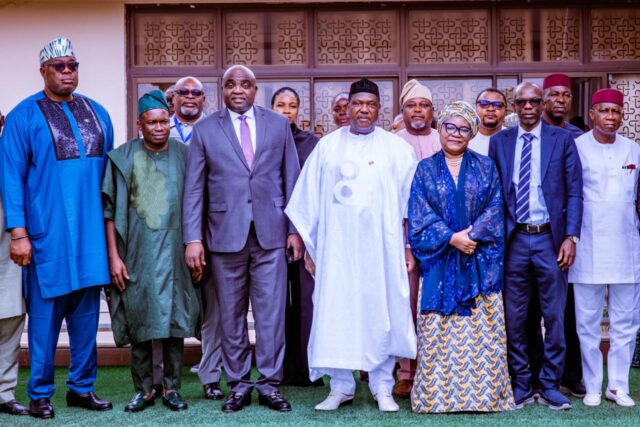
The Federal Government has inaugurated a high-level technical committee to review a proposed $200 billion integrated infrastructure project combining gas development, power generation, and a nationwide high-speed rail network, in what could become one of Nigeria’s most ambitious development initiatives.
The Secretary to the Government of the Federation, George Akume, announced the move while inaugurating the committee, stressing the strategic importance of the project to Nigeria’s long-term economic transformation. He described the proposal as a multi-phase programme designed to integrate critical sectors of the economy and unlock growth.
“The proposed project, which is estimated at Two Hundred Billion United States Dollars (US $200 Billion) is envisioned as a multi-phase programme that integrates gas development, power generation and transmission, and the construction of a 4,000-kilometre high-speed rail network connecting major economic corridors of the country, including Lagos, Abuja, Kano and Port Harcourt,” Akume said.
He added that the initiative has the potential to “significantly transform Nigeria’s transport infrastructure, strengthen energy security, stimulate industrial growth and deepen national integration,” underscoring its far-reaching implications for national development.
According to the SGF, the committee has been tasked with conducting a comprehensive review of the proposal, including verification of claims by the promoters, and an assessment of its technical, legal, and environmental viability. He urged members to approach their assignment with professionalism and objectivity, while engaging key stakeholders to ensure due diligence and alignment with international best practices.
The committee draws membership from key government institutions, including the Federal Ministry of Transportation, Federal Ministry of Petroleum Resources, Federal Ministry of Finance, and Federal Ministry of Justice, among others. Regulatory and security agencies such as the Central Bank of Nigeria, Economic and Financial Crimes Commission, and Department of State Services are also represented, reflecting the scale and sensitivity of the project.
Presenting the proposal, Managing Director of De-Sadel Nigeria Limited, Samuel Ukoh, described the initiative as a transformative undertaking capable of reshaping Nigeria’s infrastructure landscape. He said the project would feature a 4,000-kilometre dual-track high-speed rail system linking all 36 states and the Federal Capital Territory, significantly reducing inter-city travel time.
Ukoh noted that the first phase would connect major cities including Lagos, Abuja, Kano, and Port Harcourt, while also incorporating power generation capacity of about 3,500 megawatts to support the rail system.
The inauguration of the committee signals the government’s cautious but strategic approach to the mega project, as authorities weigh its feasibility, funding structure, and long-term economic impact before taking a final investment decision.