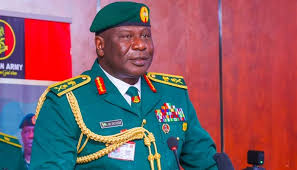
Nigeria’s Chief of Defence Staff, Olufemi Oluyede, has sounded a stark warning over the evolving dynamics of insurgency in the North-East, declaring that internal collaboration within local communities is sustaining terrorist operations and complicating military efforts.
Speaking after a closed-door, high-level security meeting in Maiduguri, the Borno State capital, Oluyede urged residents of Borno State and Yobe State to take greater responsibility in the fight against terrorism, stressing that the “enemy” is often embedded within the very communities affected by the violence.
The meeting, which lasted about four hours, brought together senior military leadership, including the Chief of Army Staff, Waidi Shuaibu, and the Theatre Commander of Operation Hadin Kai, Abdulsalam Abubakar, alongside other top officials coordinating counterinsurgency operations in the region.
At the core of Oluyede’s message was a troubling assessment drawn from intelligence reports, which indicate that many perpetrators of attacks over the past 15 years are not outsiders but individuals originating from the same communities they terrorise. According to him, this internal dimension has provided insurgents with significant operational advantages, including familiarity with terrain, access to local networks, and the ability to blend into civilian populations.
He pointed to a recent incident in Kukawa, where troops conducting post-attack clearance operations discovered wounded insurgents hiding within the community, underscoring the difficulty of distinguishing between civilians and collaborators in conflict zones.
The CDS emphasised that while the military has sustained pressure on terrorist groups such as Boko Haram and the Islamic State West Africa Province, long-term success will depend on stronger civilian cooperation. He urged residents to view the counterinsurgency campaign as a shared responsibility rather than solely a government-driven effort.
Oluyede’s remarks signal a strategic recalibration in Nigeria’s approach to the insurgency, shifting from predominantly kinetic operations to a more community-centred model that prioritises intelligence sharing and local engagement.
He also highlighted the changing tactics of insurgent groups, noting an increased deployment of drones and other technologies in recent attacks. In response, he said the Nigerian military is adapting its capabilities, including the integration of advanced drone systems to improve surveillance, targeting accuracy, and battlefield coordination.