A Michigan woman was dramatically arrested on live television over the weekend after criticising U.S. President Donald Trump’s military action in Venezuela, sparking a nationwide debate about free speech and civil liberties in the United States.
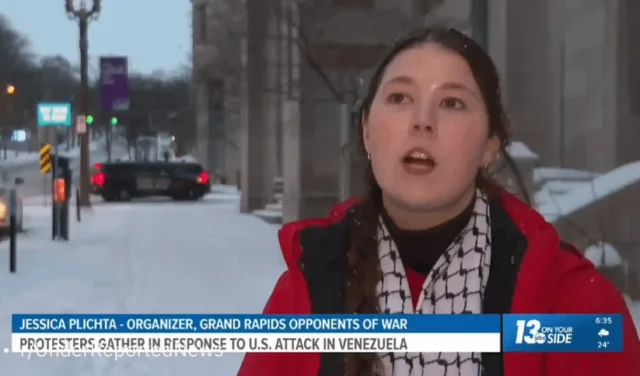
The incident unfolded in Grand Rapids, Michigan, where 22-year-old preschool teacher and peace activist Jessica Plichta was speaking to a local ABC affiliate, WZZM, about a protest condemning the U.S. military’s capture of Venezuelan President Nicolás Maduro. In the footage that quickly went viral, Plichta can be heard sharply criticising the Trump administration’s intervention before two police officers approach and place her in handcuffs, abruptly ending the interview.
“It’s not just a foreign issue, it’s our tax dollars that are being used to commit these war crimes,” Plichta said on camera. “It is also the duty of us, the people, to stand against the Trump regime, the Trump administration, that are committing crimes both here in the U.S. and against people in Venezuela.”
According to local authorities, Plichta was arrested for “obstructing a roadway and failure to obey a lawful command from a police officer,” charges that stemmed from her participation in the protest. The Grand Rapids Police Department issued repeated warnings over a public address system for demonstrators to move to the sidewalk instead of marching in the street, which they said violated city and state law.
After several hours in custody, Plichta was released and told to expect a formal notice of charges. Speaking to the independent outlet Zeteo after her release, she suggested her arrest was politically motivated and tied to her criticism of U.S. policy. “I don’t think it’s a coincidence that as soon as I finished an interview speaking on Venezuela, I was arrested — the only person arrested out of 200 people,” she said.
The timing of the protest and interview came amid one of the most controversial foreign policy developments in recent U.S. history: the dramatic U.S. military operation that captured Maduro in Caracas, a mission that resulted in his transportation to the United States on federal charges including narco-terrorism and weapons offenses. The operation has drawn both praise and condemnation on the global stage.
The arrest has ignited heated debate online and in political circles, with critics arguing the episode highlights broader concerns about civil liberties and the policing of dissent in the United States. Social media users compared the arrest to authoritarian tactics, while others pointed out that permits and lawful orders — not the content of speech — were central to the police’s justification.
Although the protest was anti-war in focus, some observers have questioned whether the police response was proportional, given that Plichta had just finished an interview and appeared to be complying at the time of her arrest. In the video captured by local news crews, the patrol car and officers approached as she concluded her comments on U.S. foreign policy, leading to questions about timing and intent behind the enforcement action.
Plichta, who told WZZM she had recently attended an international summit in Venezuela advocating for peace and sovereignty, reiterated her commitment to activism and free expression after her release. “People loved him,” she said of Maduro, recounting her experience at the summit. “Maduro was elected by the people. He is for the people, and the people want to see his return.”