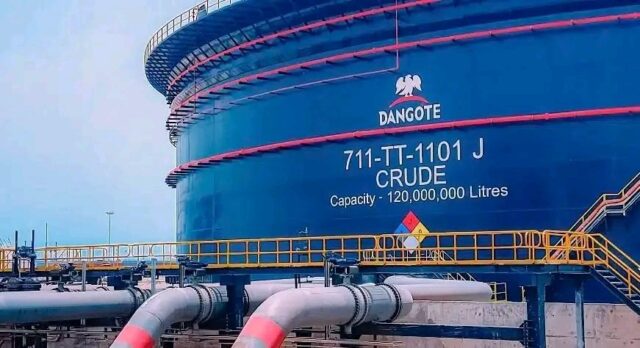
Nigeria’s ambitious push for energy self-sufficiency has received a major boost as the Dangote Petroleum Refinery announced that it has increased its crude oil processing capacity to 700,000 barrels per day (bpd), marking a significant milestone in the facility’s operational expansion and strengthening its position among the world’s largest refining complexes.
The refinery, located in Lagos and owned by billionaire industrialist Aliko Dangote, disclosed that the achievement followed a successful performance test conducted by Process Licensors. The development represents a major leap from the refinery’s nameplate capacity of 650,000 bpd and highlights its growing ability to maximize efficiency through advanced engineering and operational processes.
According to the refinery, the latest increase is part of a broader strategy to progressively expand output to 1.4 million barrels per day within the next 30 months, a move that could potentially position the facility as the largest refinery in the world.
Vice President for Oil and Gas at Dangote Industries Limited, Devakumar Edwin, said the ramp-up reflects the company’s long-term vision of transforming Nigeria into a major refining hub while supporting energy security across Africa and beyond.
The expansion is expected to significantly reduce Nigeria’s dependence on imported petroleum products, conserve foreign exchange, and enhance the country’s role in the global energy market. The refinery noted that its products are already being exported to several African countries as well as international markets, including the United Kingdom, France, Spain, Italy and the Netherlands. It also revealed that gasoline supplies have reached the American market, while jet fuel exports have extended to Saudi Arabia and other destinations.
The company said the refinery has become increasingly important to Africa’s energy landscape, particularly following disruptions in global fuel supply chains linked to geopolitical tensions in the Middle East. According to the statement, a growing number of African countries are now sourcing refined petroleum products from the facility to strengthen their energy security.
Industry observers have described the refinery as a transformative project for Nigeria’s oil and gas sector. Since commencing operations, the facility has played a key role in reducing the nation’s reliance on imported fuels while creating a more resilient domestic refining industry.
The refinery’s management said its operations align with national objectives to increase local refining capacity and extract greater value from Nigeria’s abundant crude oil resources. In addition to supporting fuel supply stability, the project is expected to drive industrial growth, stimulate job creation, and improve the country’s trade balance.
Beyond fuels, the refinery is also positioned to support Nigeria’s manufacturing sector through the production of industrial feedstocks such as polypropylene, a key raw material used in packaging materials, detergents and a wide range of consumer goods.
Looking ahead, Dangote said the refinery’s expansion plans underscore its commitment to becoming a globally competitive refining powerhouse. The projected increase to 1.4 million barrels per day is expected to further strengthen Nigeria’s energy independence while enhancing the country’s influence in international energy markets.