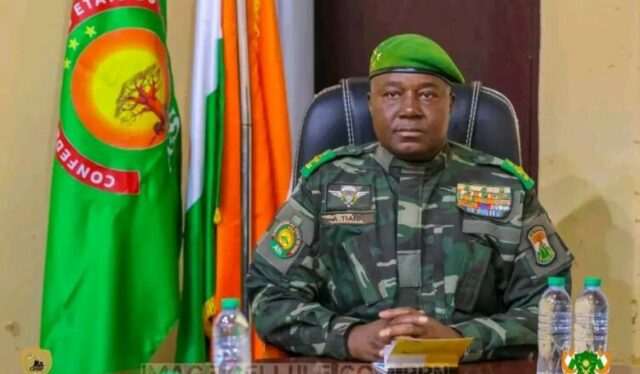
Niger’s military leader, General Abdourahamane Tiani, has alleged that fighters from multiple jihadist groups, including operatives based in northwestern Nigeria, took part in a recent attack on a key military facility in the capital, Niamey, while also accusing foreign governments of sponsoring the assault.
Speaking in a televised interview on Saturday evening, Tiani addressed the attack on the Nigerien Air Force’s Base 101, claiming it was carried out by a joint force drawn from several extremist organisations. According to him, the operation involved “10 motorcycles of JNIM, 10 of IS-Sahel and 20 of ISWAP fighters from Katsina, Sokoto, Zamfara and Kebbi States in Nigeria.”
The Nigerien leader said the attackers represented a coordinated effort between Jama’at Nusrat al-Islam wal-Muslimin (JNIM), Islamic State in the Sahel (IS-Sahel) and Islamic State West Africa Province (ISWAP), underscoring what he described as the growing cross-border nature of insurgent threats in the Sahel and the Lake Chad region.
Tiani also levelled serious accusations against France, Benin and Ivory Coast, alleging external sponsorship of the operation. He claimed the alleged backers paid “about $540,000 to IS-Sahel to carry out and claim the attack,” though he did not present evidence during the interview to support the claim.
Escalating his allegations further, the junta leader said French President Emmanuel Macron had planned a broader campaign of simultaneous strikes against Nigerien military positions across the country. According to Tiani, the proposed targets included Tamou, Say, Torodi, Tera, Bankilare, Ouallam, Bani Bangou and Ayorou.
“Macron had planned seven other simultaneous attacks against positions of the Nigerien military,” he said, adding that Nigerien forces had repelled the attempted assaults.
The claims mark the latest escalation in tensions between Niger’s military government and Western powers, particularly France, following the 2023 coup that brought Tiani to power and led to the withdrawal of French troops from the country.
There has been no immediate official response from France, Benin or Ivory Coast to the allegations. Security analysts caution that the Sahel region has witnessed increasingly complex insurgent operations involving multiple armed groups, but say claims of foreign state sponsorship require independent verification.
The interview comes amid a deteriorating security situation across the central Sahel, where Niger, Mali and Burkina Faso have all faced persistent attacks from jihadist groups despite the formation of a new security alliance among the three military-led governments.
Tiani maintained that Niger’s armed forces had successfully defended key positions and vowed continued resistance against what he described as external interference and coordinated militant threats, as the country grapples with one of the region’s most volatile security environments.