The European Union has announced a major upgrade in its relationship with Nigeria, unveiling a €290 million Global Gateway investment package aimed at accelerating development across key sectors including digital infrastructure, healthcare, agriculture, and migration management.
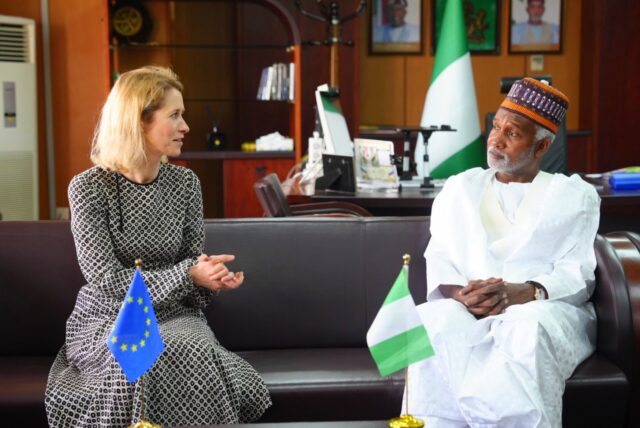
The announcement was made on Monday during the eighth EU-Nigeria Ministerial Dialogue held in Abuja, co-chaired by Nigeria’s Foreign Affairs Minister Yusuf Maitama Tuggar and EU foreign policy chief Kaja Kallas. The new funding signals a renewed commitment by both parties to deepen bilateral cooperation amid shifting global economic and geopolitical realities.
Kallas underscored the strategic importance of the partnership, stating, “In the current geopolitical context, the European Union is keen to enhance its partnership with Nigeria,” adding that increasing EU investment in alignment with Nigeria’s development agenda is “a key priority for both sides.”
The €290 million package will fund seven new projects under the EU’s Global Gateway strategy, a flagship initiative designed to boost sustainable infrastructure and economic connectivity worldwide. The investments include €131 million dedicated to digitalisation, with plans to expand broadband access through the rollout of approximately 90,000 kilometres of fibre optic cables, aimed at improving internet access for millions of Nigerians.
Additional funding will support the healthcare sector, with €55 million allocated to enhance local pharmaceutical production and improve access to medical supplies, including vaccines. In agriculture, €86 million will be channelled into strengthening cocoa and dairy value chains, alongside promoting climate-smart farming practices to improve productivity and resilience.
EU Commissioner for International Partnerships Jozef Sikela emphasised the broader economic impact of the initiative, stating, “Together with Nigeria, we are investing in the modernisation of the digital sector, a stronger health system and in the development of agriculture.” He added that the investments “create new quality infrastructures, sustainable jobs and long-term economic opportunities that benefit the Nigerian people.”
The latest development builds on an already robust EU-Nigeria relationship, with the bloc remaining Nigeria’s largest trading and investment partner. Both sides also reaffirmed cooperation in areas such as security, migration, and regional stability, particularly in addressing threats posed by insurgency and economic volatility in West Africa.