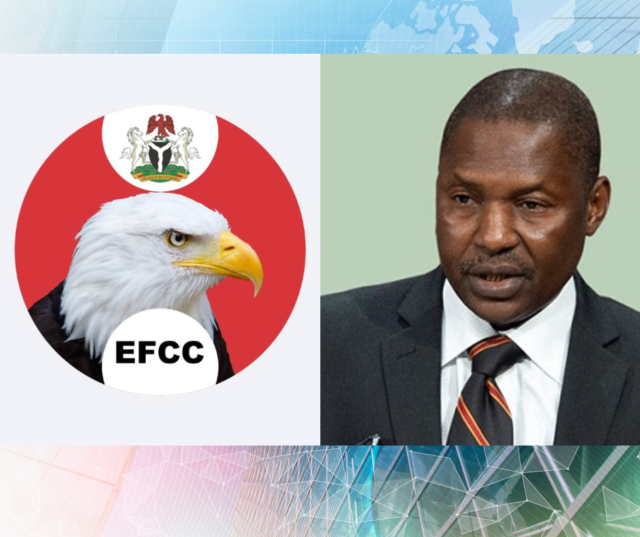
The Federal High Court in Abuja has ordered the final forfeiture of 48 properties linked to former Attorney-General of the Federation and Minister of Justice, Abubakar Malami (SAN), to the Federal Government after ruling that the assets were reasonably suspected to have been acquired with proceeds of unlawful activities.
Justice Joyce Abdulmalik delivered the judgment on Wednesday, granting the Economic and Financial Crimes Commission (EFCC)’s application for final forfeiture after holding that the anti-graft agency had established a prima facie case that the properties were not acquired from legitimate sources of income.
Among the assets forfeited are Rayhaan University in Kebbi State, including its permanent site, temporary site, third campus and the Vice Chancellor’s residence, as well as Rayhaan Radio located along the Sani Abacha Bypass in Birnin Kebbi.
The court also ordered the forfeiture of several hotels and commercial properties, including Meethaq Hotels in Jabi and Maitama, Abuja; the former Harmonia Hotels in Garki, Abuja; Zeennoor Hotel in Kano; luxury residential buildings in Maitama, Asokoro, Gwarimpa and Wuse II in the Federal Capital Territory; commercial plazas in Abuja and Kano; filling stations; warehouses; factories; agricultural facilities; and large parcels of land in Kebbi State.
Also forfeited are Rayhaan Agro Allied Factory, including its factory buildings, machinery, plant units, mosque and staff quarters; Azbir Arena and its associated hotel, printing press, gallery, gardens, mosque, clothing outlet, pharmacy and supermarket; the Al-Afiya Energy tanker garage; Rayhaan Security House; an uncompleted commercial plaza opposite the Central Motor Park in Birnin Kebbi; Amasdul Oil and Gas Limited filling station; and several residential developments acquired through the Khadimiyya for Justice and Development Initiative.
In her judgment, Justice Abdulmalik held that the EFCC successfully demonstrated that the assets were reasonably suspected to be proceeds of unlawful activities and that the respondents failed to establish that the properties were acquired with lawfully earned income.
According to the court, the respondents merely asserted ownership of the assets without producing credible evidence showing the legitimate sources of the funds used to acquire them.
The judge further held that in non-conviction-based forfeiture proceedings, it is insufficient for claimants to merely state that they own the properties. Rather, they must present evidence tracing the acquisition of such assets to lawful sources of income.
The judgment followed an earlier interim forfeiture order granted by Justice Emeka Nwite on January 6, 2026, after the EFCC filed an ex parte application through its counsel, Ekele Iheanacho (SAN).
Following the interim order, the commission published notices in national newspapers inviting any interested persons to appear before the court and show cause why the assets should not be permanently forfeited to the Federal Government.
In response, Malami and 14 other respondents, including members of his family and associates, filed applications challenging the interim forfeiture order. They also questioned the jurisdiction of the court to entertain the matter and urged Justice Abdulmalik to dismiss the EFCC’s request for a final forfeiture.
The parties adopted their arguments during proceedings on May 27, 2026, after which the court reserved judgment.
Delivering the ruling on Wednesday, Justice Abdulmalik dismissed the objections raised by the respondents and ruled that they had failed to discharge the evidential burden required under the law by proving that the properties were acquired with legitimate funds.
Malami has consistently denied wrongdoing in matters relating to investigations involving his tenure as Attorney-General. However, Wednesday’s judgment relates specifically to the ownership and source of funds used to acquire the listed properties. There has been no criminal conviction against the former Attorney-General in connection with the forfeiture proceedings, which were determined under Nigeria’s civil asset forfeiture framework.