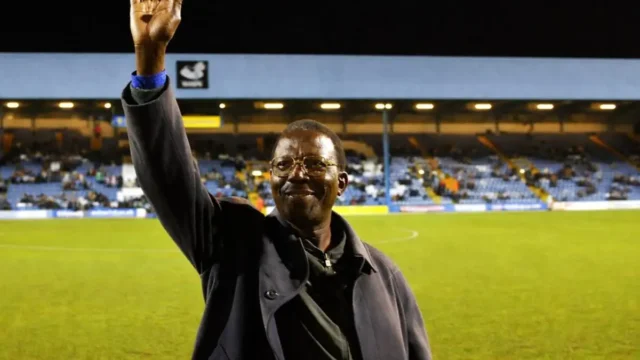
Nigeria’s football community awoke on Tuesday to the news that one of its founding pillars had fallen. High Chief Festus Adegboye Onigbinde, the first indigenous coach of the Super Eagles and a tireless architect of the nation’s football identity, passed away on the evening of 9 March 2026 at the age of 88 in his hometown of Modakeke, Osun State.
His family’s statement, signed by Mrs Bolade Adesuyi, captured the essence of a life devoted to the round leather game: “With great gratitude to God for a life well spent, we announce the passing of this great man: a Modakeke High Chief, the first indigenous Nigerian Super Eagles football coach, father, husband, grandfather, great-grandfather, brother and friend.”
Onigbinde’s story is not merely one of matches won or lost; it is the chronicle of how a son of Modakeke helped Nigeria believe that its own sons could lead its greatest sporting export on the world stage.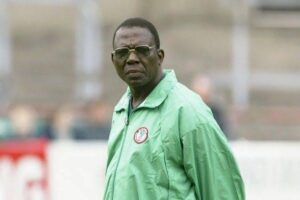
Roots in Modakeke: From Classroom and Pitch to the Bench
Born on 5 March 1938 in Modakeke, Osun State (then part of the old Western Region), Festus Adegboye Onigbinde grew up in an era when football in Nigeria was still finding its post-independence voice. He attended St Stevens Primary School, Modakeke, before proceeding to St Peter’s College, Ilesa (1956–57), St Luke’s College (1960–61) and Akure Rural Education College. His formal entry into the game came through a coaching course organised in Ibadan in 1961 by Bet Halemi, followed by further certificates and attachments in Germany (MSV Duisburg) and Brazil, where he observed preparations for the 1982 World Cup.
Before he ever blew a whistle as a coach, Onigbinde was a Grade One referee from 1967 and an active member of the Referees’ Association. He also found artistic expression in the University of Ife Theatre and Music Group, performing in plays such as Obaluaye, Kurunmi and Rere, and representing Nigeria at cultural events in Germany (1972) and Senegal (1972). These diverse experiences — discipline on the field, creativity off it — would later shape a coaching style that blended tactical rigour with an almost professorial patience.
Rise Through the Domestic Ranks
Onigbinde’s club coaching journey began in earnest with Water Corporation FC of Ibadan in 1970. His breakthrough at the highest domestic level came in 1984 when he took charge of Shooting Stars Sports Club of Ibadan and guided them all the way to the final of the African Club Champions Cup, only to lose to Egypt’s Zamalek. That run remains one of the high-water marks of Nigerian club football on the continent and underscored his ability to extract maximum performance from home-grown talent.
The National Team: Two Eras, One Enduring Pioneer
Onigbinde first answered the national call between 1981 and 1984, becoming the first Nigerian to lead the senior men’s team (then still known in some quarters as the Green Eagles). His crowning achievement in that spell was steering Nigeria to the final of the 1984 Africa Cup of Nations in Côte d’Ivoire. The Super Eagles fell 3-1 to Cameroon in the decider, yet the silver medal marked the first time an indigenous coach had taken the nation to an AFCON final.
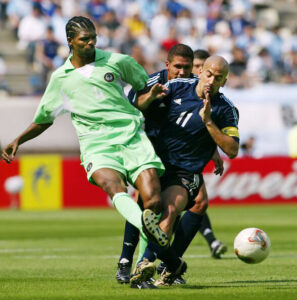
Eighteen years later, in March 2002, he was recalled after the sacking of Shuaibu Amodu’s technical crew following a disappointing third-place finish at the Africa Cup of Nations. With just months to prepare, Onigbinde assembled a young, largely inexperienced squad and guided Nigeria to the 2002 FIFA World Cup in South Korea and Japan — becoming the first indigenous Nigerian (and, by some accounts, the first Black African coach) to lead the Super Eagles at football’s global showpiece.
The tournament itself proved difficult: Nigeria lost 0-1 to Argentina, 1-2 to Sweden after leading 1-0, and drew 0-0 with England, exiting at the group stage. Critics, including some players, questioned squad selection. Yet Onigbinde’s appointment itself was historic — a powerful statement that Nigerian football no longer needed to look exclusively overseas for leadership.
The Teacher: Philosophy Rooted in Discipline and Development
Colleagues and players alike knew him as “The Teacher,” a nickname that perfectly captured his approach. Onigbinde’s philosophy centred on tactical awareness, iron discipline, meticulous preparation and — above all — the nurturing of young talent. He insisted that football education was as important as physical conditioning; players were expected not merely to execute instructions but to understand why they were executing them.
As a long-serving CAF and FIFA technical instructor — delivering courses in Malaysia (1997), France (1998) and the USA (1999) among others — he helped professionalise coaching across Africa. He also served as the Nigeria Football Federation’s Technical Director, shaping curricula and youth policies that influenced generations of coaches and administrators.
Contributions Beyond the Touchline
Onigbinde’s impact extended far beyond match days. He was a passionate advocate for grassroots football and indigenous talent at a time when foreign coaches still dominated high-profile appointments. His insistence on building from home — scouting widely, developing local technical staff and demanding administrative accountability — helped lay the intellectual foundation for later successes under coaches such as Stephen Keshi.
At club and federation level he mentored countless young coaches, many of whom now occupy influential positions in the Nigerian Premier Football League and the national team setup. His quiet, methodical work in youth development and coaching education remains one of the least-celebrated but most enduring strands of his legacy.
Tributes Pour In
The outpouring of grief has been national. President Bola Tinubu described Onigbinde’s death as “a great loss to Nigerian football and the nation’s sporting community,” praising his “discipline, integrity, foresight and passion” and commending his historic leadership at the 1984 AFCON final and his contributions to grassroots football and administration.
The Nigeria Football Federation, through General Secretary Dr Mohammed Sanusi, spoke for many when it declared: “A big tree has fallen… Chief Onigbinde ate, drank, breathed, slept and lived football development. We will miss him greatly, as he was never tired of giving advice on the game’s development even at his ripe old age.” Sanusi added that Onigbinde was “an extraordinary achiever who impacted positively not only on Nigeria football, but on the African and the global game at large.”
The Super Eagles themselves issued a heartfelt statement: “We commiserate with the family of our former coach, Festus Adegboye Onigbinde, following his passing. A respected leader and a true servant of Nigerian football. Rest in peace, Coach.”
Legacy: The Road He Paved
Chief Festus Adegboye Onigbinde lived long enough to see the fruits of his labour. Indigenous coaches are now the norm rather than the exception; Nigerian technical staffs routinely lead the Super Eagles at World Cups and AFCONs; and the conversation about building football from the grassroots — the very conversation he started decades ago — continues at the highest levels of the NFF.
He never won an AFCON or advanced beyond the World Cup group stage, yet his true victory was structural. He proved that Nigerian football could trust its own. In an era when many still believed excellence required a foreign accent, Onigbinde’s quiet authority and unshakeable belief in local capacity changed mindsets permanently.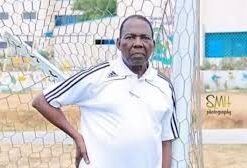
The Final Whistle
On March 9th, 2026, just four days after celebrating his 88th birthday, the Teacher blew his final whistle. But the lessons he taught — discipline over drama, development over shortcuts, pride in indigenous excellence — will echo every time a Nigerian coach stands in the technical area at a major tournament.
High Chief Festus Adegboye Onigbinde did not simply coach the Super Eagles. He helped birth a football nation that could coach itself. For that, Nigerian football — and indeed African football — will remain forever in his debt.
May his soul rest in perfect peace.